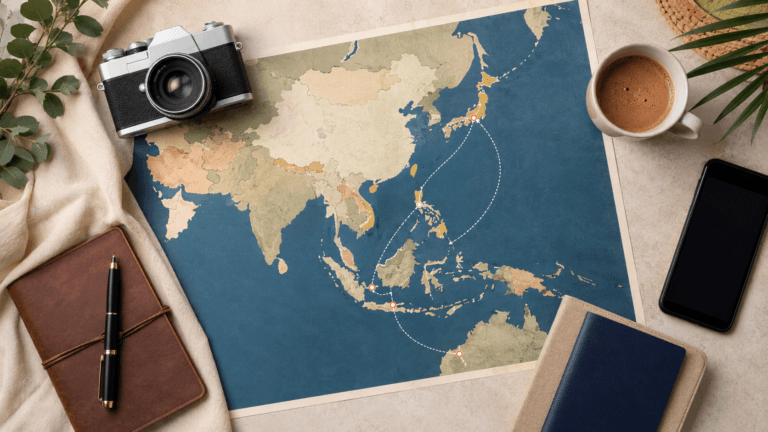
Tag: 1 month Asia itinerary

  • Asia Travel Itinerary 2026: Best Routes for First-Time Visitors

    Asia Travel Itinerary 2026: Best Routes for First-Time Visitors

    Planning your first trip to Asia is exciting until you open a map and realize that Asia is not one destination. It is a whole continent of neon cities, quiet temples, tropical islands, bullet trains, night markets, mountain towns, airport transfers and noodles that may change your standards forever.

    The good news is that your first Asia itinerary does not need to include everything.

    Actually, it probably should not.

    For most first-time visitors, the best Asia travel itinerary in 2026 is not the one with the most countries. It is the one that gives you enough time to enjoy where you are, understand the local rhythm and avoid spending half your trip inside airports.

    This guide will help you choose the best Asia route for your first trip, whether you have 2 weeks, 3 weeks or 1 month. It covers easy East Asia routes, classic Southeast Asia routes, beginner-friendly combinations, pop culture itineraries and practical tips before you book.

    Quick Answer: Best Asia Itineraries for First-Time Visitors

    If this is your first trip to Asia, start with one of these routes:

    • Best 2-week Asia itinerary: Japan + South Korea, or Thailand + Vietnam
    • Best 3-week Asia itinerary: Japan + South Korea + Taiwan, or Thailand + Vietnam + Cambodia
    • Best 1-month Asia itinerary: Japan + South Korea + Taiwan, or Thailand + Cambodia + Vietnam
    • Easiest beginner route: Japan + South Korea + Taiwan
    • Best value route: Thailand + Vietnam + Cambodia
    • Most comfortable route: Singapore + Malaysia + Thailand
    • Best pop culture route: South Korea + Japan
    • Best slow travel route: Vietnam + Thailand, or Taiwan + Japan

    The most important rule is simple: choose one region first.

    East Asia and Southeast Asia are both amazing, but mixing too much of both in a short trip can make your itinerary feel rushed. A good first Asia trip should feel like travel, not a geography exam with luggage.

    How Many Countries Should You Visit on Your First Asia Trip?

    For a first Asia trip, this is a realistic guide:

    • 10 days: 1 country
    • 2 weeks: 1 to 2 countries
    • 3 weeks: 2 to 3 countries
    • 1 month: 3 to 4 countries

    You can technically visit more, especially with budget flights between major Asian cities. But every country change usually means packing, checking out, getting to the airport, waiting, flying, going through immigration, finding your hotel and starting again.

    A one-hour flight can easily become a six-hour travel day.

    That does not mean multi-country trips are bad. They can be fantastic. But for a first Asia itinerary, fewer stops usually means better days.

    You want enough time to:

    • Recover from jet lag
    • Learn local transport
    • Eat without rushing
    • Handle weather changes
    • Enjoy neighborhoods beyond the famous sights
    • Leave room for small surprises

    Asia rewards curiosity, but it also rewards breathing room.

    Route 1: Easy East Asia Itinerary

    East Asia itinerary city scene representing Japan, South Korea and Taiwan with train station, skyline, cafes and evening street lights
    Japan, South Korea and Taiwan make one of the easiest East Asia routes for first-time visitors.

    Japan + South Korea + Taiwan

    This is one of the easiest Asia itineraries for first-time visitors. Japan, South Korea and Taiwan all offer excellent food, efficient public transport, strong city infrastructure and plenty of cultural variety without making the trip too difficult to manage.

    This route is especially good if you like big cities, trains, cafes, shopping, temples, historic neighborhoods, night views and well-organized travel days.

    2 Weeks: Japan + South Korea

    For 2 weeks, keep the route simple:

    Tokyo → Kyoto or Osaka → Seoul

    A comfortable version could look like this:

    • Days 1 to 4: Tokyo
    • Days 5 to 8: Kyoto or Osaka
    • Days 9 to 14: Seoul

    This route gives you a strong first taste of East Asia without trying to squeeze in too much. Tokyo gives you the scale and energy. Kyoto or Osaka adds history, food and a different Japanese rhythm. Seoul brings palaces, street food, shopping, cafes, K-culture and easy day trips.

    If you only have two weeks, this is one of the best Asia routes for travelers who want variety without chaos.

    3 Weeks: Japan + South Korea + Taiwan

    With 3 weeks, Taiwan fits beautifully at the end:

    Tokyo → Kyoto/Osaka → Seoul → Taipei

    A good route could be:

    • Days 1 to 5: Tokyo
    • Days 6 to 9: Kyoto and Osaka
    • Days 10 to 15: Seoul
    • Days 16 to 21: Taipei and nearby day trips

    Taipei is a great final stop because it is food-focused, friendly, easy to explore and less overwhelming than adding another large multi-city country.

    1 Month: Slow East Asia Route

    With one month, do not just add more countries. Add better stops.

    A strong one-month East Asia route could include:

    • Tokyo
    • Kyoto
    • Osaka
    • Seoul
    • Busan
    • Taipei
    • Jiufen
    • Tainan or Kaohsiung

    This route works well because you can slow down in each country. Instead of seeing only capital cities, you get different moods: Japan’s urban and traditional sides, South Korea’s city and coastal energy, and Taiwan’s food streets and relaxed neighborhoods.

    Why This Route Works

    East Asia is a strong choice for first-time visitors because the travel systems are relatively easy to understand. Major cities are well connected, public transport is reliable and many attractions are simple to visit independently.

    The main downside is cost. Japan and South Korea are usually more expensive than Vietnam, Thailand or Cambodia. But if this is your first major Asia trip, the comfort and ease may be worth the extra budget.

    Route 2: Classic Southeast Asia Itinerary

    Southeast Asia itinerary scene with night market, street food, scooters, lanterns and temple silhouettes at sunset
    Thailand, Vietnam and Cambodia are classic choices for travelers who want food, temples, value and lively street life.

    Thailand + Vietnam + Cambodia

    Thailand, Vietnam and Cambodia make one of the most popular Southeast Asia routes for first-time travelers. This itinerary is warmer, cheaper and a little more adventurous than the East Asia route.

    It is great for street food, temples, night markets, old towns, beaches, backpacker areas, history and lively cities.

    2 Weeks: Thailand + Vietnam

    For 2 weeks, choose Thailand and Vietnam only.

    A good route is:

    Bangkok → Chiang Mai → Hanoi or Hoi An

    A simple plan:

    • Days 1 to 4: Bangkok
    • Days 5 to 8: Chiang Mai
    • Days 9 to 14: Hanoi, Hoi An or Ho Chi Minh City

    This gives you Thailand’s city and cultural side, then Vietnam’s food and local atmosphere. Bangkok is energetic, Chiang Mai is slower and more relaxed, and Vietnam adds a completely different texture to the trip.

    Trying to add Cambodia too can work, but only if you are comfortable moving quickly. For most first-time visitors, Thailand and Vietnam are enough for two weeks.

    3 Weeks: Thailand + Cambodia + Vietnam

    With 3 weeks, Cambodia becomes much easier to include.

    A good route is:

    Bangkok → Chiang Mai → Siem Reap → Hanoi/Hoi An

    A sample plan:

    • Days 1 to 4: Bangkok
    • Days 5 to 8: Chiang Mai
    • Days 9 to 11: Siem Reap and Angkor Wat
    • Days 12 to 16: Hanoi and Ninh Binh or Ha Long Bay
    • Days 17 to 21: Hoi An or Ho Chi Minh City

    This gives your trip a strong mix of cities, temples, food, history and scenery.

    Angkor Wat is the big reason to include Cambodia. It is one of the most memorable cultural stops in Southeast Asia, but it deserves time. Do not treat it like a quick checkbox between flights.

    1 Month: Classic Southeast Asia Route

    With one month, this route becomes much better.

    A strong route could include:

    • Bangkok
    • Chiang Mai
    • Southern Thailand or islands
    • Siem Reap
    • Phnom Penh
    • Hanoi
    • Ninh Binh
    • Hoi An
    • Ho Chi Minh City

    This is one of the best one-month Asia itineraries for travelers who want variety and value. It gives you temples, beaches, food, history, cities and slower travel days.

    Why This Route Works

    Thailand is a great entry point because Bangkok has excellent international flight connections and a huge travel network. Vietnam offers strong value, incredible food and a natural north-to-south route. Cambodia adds a major historical highlight with Angkor Wat.

    The trade-off is that this route can feel less polished than Japan, Korea or Singapore. Transport may take more patience, weather can affect plans and travel days can feel longer. But for many travelers, that is also part of the appeal.

    Route 3: Comfortable First-Time Asia Route

    Beginner-friendly Asia travel route scene with tropical city walkway, luggage, skyline, greenery and Southeast Asian architecture
    Singapore, Malaysia and Thailand work well for travelers who want a comfortable start before adding more adventure.

    Singapore + Malaysia + Thailand

    If you want your first Asia trip to feel easier, start with Singapore and Malaysia before moving on to Thailand.

    This route is ideal for travelers who want good infrastructure, familiar comforts, English-friendly environments and a gentle start after a long flight. Singapore is one of the easiest cities in Asia to arrive in. Public transport is simple, the airport is excellent and the city is compact.

    Malaysia adds food, culture, history and better value. Thailand adds the classic Southeast Asia travel feeling.

    2 Weeks: Singapore + Malaysia

    For 2 weeks, a comfortable route is:

    Singapore → Kuala Lumpur → Penang or Langkawi

    A simple plan:

    • Days 1 to 4: Singapore
    • Days 5 to 8: Kuala Lumpur
    • Days 9 to 14: Penang or Langkawi

    Choose Penang if you care more about food, culture and old streets. Choose Langkawi if you want beaches and a slower final stretch.

    This route is great for first-time visitors who do not want every travel day to feel like a puzzle.

    3 Weeks: Singapore + Malaysia + Thailand

    With 3 weeks, add Thailand:

    Singapore → Kuala Lumpur → Penang → Bangkok → Chiang Mai or Phuket

    A good plan:

    • Days 1 to 4: Singapore
    • Days 5 to 8: Kuala Lumpur
    • Days 9 to 12: Penang
    • Days 13 to 17: Bangkok
    • Days 18 to 21: Chiang Mai or Phuket

    This route starts easy and becomes more colorful as you go. It is a good balance between comfort and adventure.

    1 Month: Singapore to Thailand Slow Route

    With one month, you can move slowly through the region:

    • Singapore
    • Malacca
    • Kuala Lumpur
    • Penang
    • Langkawi
    • Bangkok
    • Chiang Mai
    • Phuket, Krabi or Koh Samui

    This route is especially good for food lovers. Singapore, Malaysia and Thailand together create one of the strongest food routes in Asia.

    Why This Route Works

    This is probably the softest landing into Southeast Asia. Singapore gives you structure. Malaysia gives you variety. Thailand gives you energy.

    It is also a good family route because transport, hotels and food options are easier than in more remote or complex destinations.

    Route 4: Pop Culture and City Itinerary

    South Korea and Japan pop culture itinerary scene with neon streets, shopping areas, city lights and busy nightlife
    South Korea and Japan are one of the easiest two-country routes for travelers interested in food, shopping, K-pop, anime and city culture.

    South Korea + Japan

    If your Asia trip is built around K-pop, anime, shopping, skincare, themed cafes, convenience store snacks and big city neighborhoods, South Korea and Japan are probably the easiest two-country route to love.

    This route is simple, popular and easy to plan. Seoul and Tokyo both have huge appeal for first-time visitors, and the flight between Korea and Japan is short.

    10 to 14 Days: Seoul + Japan

    A good route is:

    Seoul → Osaka/Kyoto → Tokyo

    Or, if you want more Korea:

    Seoul → Busan → Tokyo

    A simple 2-week version:

    • Days 1 to 5: Seoul
    • Days 6 to 8: Busan, Osaka or Kyoto
    • Days 9 to 14: Tokyo

    This route gives you two of Asia’s most exciting travel cultures in one trip. Seoul feels fast, stylish and food-heavy. Tokyo feels endless, layered and wonderfully specific. Osaka and Kyoto add food, history and classic Japan atmosphere.

    3 Weeks: Korea + Japan City Route

    With 3 weeks, the route becomes much more comfortable:

    Seoul → Busan → Osaka/Kyoto → Tokyo

    A sample plan:

    • Days 1 to 6: Seoul
    • Days 7 to 9: Busan
    • Days 10 to 15: Osaka and Kyoto
    • Days 16 to 21: Tokyo

    This is one of the best Asia itineraries for travelers who want cities, food, culture, shopping and pop culture without complicated logistics.

    Why This Route Works

    South Korea and Japan are close, well connected and easy to combine. Both countries also reward travelers who like walking, eating, shopping and exploring neighborhoods.

    The only warning is to avoid overloading the schedule with too many famous spots. Seoul and Tokyo are both huge. You do not need to conquer them. You need to enjoy them.

    Popular attractions, concerts, special exhibitions and theme parks should be booked early when possible. In Korea and Japan, tickets do not always wait politely for last-minute optimism.

    Route 5: Slow Travel Asia Itinerary

    Slow travel Asia itinerary planning scene with notebook, laptop, map, tea and an Asian city street view from a window
    Slow travel gives you fewer airport days and more time to actually enjoy where you are.

    Vietnam + Thailand or Taiwan + Japan

    A slow travel route is one of the smartest choices for a first Asia trip.

    Slow travel does not mean doing less. It means spending less time in transit and more time actually enjoying your destination. For many travelers, this is what turns a good Asia trip into a great one.

    Option 1: Vietnam + Thailand

    This is a strong slow route for travelers who want food, warm weather, lower costs and varied scenery.

    For 2 weeks:

    • 1 week in Vietnam
    • 1 week in Thailand

    For 3 weeks:

    • 10 days in Vietnam
    • 11 days in Thailand

    For 1 month:

    • 2 weeks in Vietnam
    • 2 weeks in Thailand

    A good route could include Hanoi, Ninh Binh, Hoi An, Bangkok, Chiang Mai and one beach destination.

    This route is better when you do not rush. Vietnam alone can fill two weeks easily, and Thailand can fill a month without trying very hard.

    Option 2: Taiwan + Japan

    This is a great slow route for travelers who prefer trains, food streets, cafes, city walks and easier logistics.

    For 2 weeks:

    Taipei → Kyoto/Osaka or Tokyo

    For 3 weeks:

    Taiwan → Osaka/Kyoto → Tokyo

    For 1 month:

    Taiwan → Tokyo → Kyoto → Osaka → one smaller Japanese region

    This route feels calmer than trying to visit three or four countries. It is good for travelers who want culture and food without too much travel stress.

    Why Slow Travel Works

    If your first Asia trip is only two weeks, one country can sometimes be better than three. You get fewer passport stamps, but you also get fewer headaches.

    Slow travel gives you space for rainy days, rest days, laundry, better meals, spontaneous cafes and day trips that do not feel squeezed between airport transfers.

    A first trip to Asia should not feel like a spreadsheet wearing shoes.

    Best Time to Travel Around Asia

    There is no single best time to visit all of Asia. The region is too large, and the weather changes a lot between East Asia and Southeast Asia.

    Still, these general patterns can help.

    Best Time for East Asia

    For Japan, South Korea and Taiwan, the easiest travel seasons are usually:

    • March to May
    • October to November

    Spring brings cherry blossoms, mild weather and good walking conditions. Autumn brings cooler air, fall colors and comfortable city travel.

    Summer can be hot, humid and rainy in many areas. Winter can be beautiful, especially in Japan and South Korea, but you need warmer clothes.

    Best Time for Southeast Asia

    For much of mainland Southeast Asia, the most comfortable period is often:

    • November to April

    This usually means drier weather in many popular destinations. The rainy season does not mean you cannot travel, but it can affect island trips, outdoor tours and rural routes.

    Rainy season can also bring greener scenery, fewer crowds and lower prices. It depends on your route and travel style.

    Best Month for a First Asia Trip

    If you want a simple answer:

    • Choose April for spring in East Asia
    • Choose October or November for East Asia comfort and Southeast Asia transition
    • Choose January or February for Southeast Asia weather

    If you want to combine East Asia and Southeast Asia, October or November can be a good compromise.

    How to Choose the Right Asia Route

    If you are still unsure, start with your travel personality instead of the map.

    Choose East Asia if you like:

    • Trains
    • Big cities
    • Shopping
    • Cafes
    • Seasonal scenery
    • Pop culture
    • Smoother logistics
    • A more organized travel experience

    Choose Southeast Asia if you like:

    • Warm weather
    • Lower costs
    • Street food
    • Beaches
    • Temples
    • Night markets
    • Flexible travel days
    • A more adventurous rhythm

    Choose Singapore and Malaysia if you want your first few days in Asia to feel easier, especially after a long flight.

    Choose South Korea and Japan if your trip is mostly about food, culture, shopping, K-pop, anime, city neighborhoods and modern Asian travel.

    The best route is not the one that looks most impressive on a map. It is the one you can actually enjoy.

    Before You Book: Entry Rules and Travel Logistics

    Before booking a multi-country Asia itinerary, check entry rules for every country on your route.

    Depending on your passport, you may need a visa, eVisa, electronic travel authorization or digital arrival card.

    As of 2026:

    • South Korea has extended temporary K-ETA exemption for eligible visa-free travelers until December 31, 2026.
    • Japan offers an eVISA system for eligible travelers who need a short-term tourism visa.
    • Thailand requires foreign travelers to complete the Thailand Digital Arrival Card before arrival.
    • Vietnam offers eVisas valid for up to 90 days, with single or multiple-entry options.
    • Singapore requires most travelers to submit the SG Arrival Card within three days before arrival.
    • Malaysia requires foreign visitors to complete the Malaysia Digital Arrival Card before arrival.
    • Cambodia uses an e-Arrival system that includes arrival, health and customs declaration elements.

    Rules can change, so always confirm the latest requirements through official government websites before booking flights.

    Also check:

    • Passport validity
    • Proof of onward travel
    • Visa length
    • Multiple-entry rules
    • Arrival card deadlines
    • Airport transfer options
    • Travel insurance
    • Mobile data or eSIM coverage

    This is not the most glamorous part of planning, but it can save your trip from a paperwork ambush.

    Common Mistakes to Avoid on a First Asia Trip

    Visiting Too Many Countries

    The biggest mistake is trying to visit five countries in two weeks.

    It sounds exciting during planning. It feels less exciting when you are repacking at midnight for the third time in six days.

    For most first-time visitors, two countries in two weeks is enough.

    Ignoring Travel Time

    A short flight is not a short travel day.

    Hotel checkout, airport transfer, check-in, security, immigration, baggage claim and hotel check-in can turn a quick flight into half a day.

    Leave space between major travel days.

    Planning Every Day Too Tightly

    Asia is full of small surprises: weather changes, long queues, amazing food stalls, confusing exits, beautiful side streets and sudden rest needs.

    Leave at least one slower day each week.

    Forgetting Entry Forms

    Digital arrival cards and eVisas are easy to miss because they do not feel as serious as traditional visas. But they still matter.

    Check every country before departure, not at the airport.

    Booking the Cheapest Flight Without Checking the Arrival Time

    A cheap flight that arrives at 1:30 a.m. may not feel cheap after late-night transport, tired confusion and a hotel check-in that tests your soul.

    Sometimes the better flight is the one that protects your first day.

    Best Asia Itineraries by Trip Length

    2 Weeks in Asia

    For 2 weeks, choose one of these:

    Japan + South Korea
    Best for cities, food, culture, shopping and easy transport.

    Thailand + Vietnam
    Best for value, street food, warm weather and classic Southeast Asia energy.

    Singapore + Malaysia
    Best for comfort, food and a beginner-friendly first Asia trip.

    3 Weeks in Asia

    For 3 weeks, choose one of these:

    Japan + South Korea + Taiwan
    Best for East Asia cities, food, culture and public transport.

    Thailand + Cambodia + Vietnam
    Best for temples, history, value and Southeast Asia variety.

    Singapore + Malaysia + Thailand
    Best for travelers who want comfort at the start and more adventure later.

    1 Month in Asia

    For 1 month, choose one of these:

    Japan + South Korea + Taiwan
    Best for a slower East Asia route with excellent food and transport.

    Thailand + Cambodia + Vietnam
    Best for a classic Southeast Asia route with value, history and variety.

    Singapore + Malaysia + Thailand
    Best for food, cities, islands and a smoother travel rhythm.

    FAQ: First-Time Asia Itinerary

    Is 2 weeks enough for Asia?

    Yes, 2 weeks is enough for a first Asia trip if you keep the route focused. Choose one country deeply or two countries with simple connections. Japan + South Korea, Thailand + Vietnam, and Singapore + Malaysia are all good 2-week options.

    How many countries should I visit in Asia in 2 weeks?

    One or two countries is best. Three countries can work if they are close and well connected, but it may feel rushed for a first visit.

    What is the easiest Asia itinerary for first-time visitors?

    Japan + South Korea + Taiwan is one of the easiest East Asia routes. Singapore + Malaysia is one of the easiest Southeast Asia routes. Both are good for first-time visitors who want strong transport, good food and simpler logistics.

    Should I visit East Asia or Southeast Asia first?

    Choose East Asia if you want smoother transport, big cities, shopping, seasonal scenery and pop culture. Choose Southeast Asia if you want lower costs, warmer weather, street food, beaches and a more flexible travel style.

    Is Japan and Korea a good first Asia route?

    Yes. Japan and South Korea are one of the best two-country combinations for a first Asia trip. They are close, well connected and ideal for food, culture, shopping, pop culture and city travel.

    Is Thailand and Vietnam too rushed for 2 weeks?

    Thailand and Vietnam can work well in 2 weeks if you limit the number of cities. Bangkok, Chiang Mai and one Vietnam region can be enjoyable. Trying to cover too many stops will feel rushed.

    What is the best month to travel around Asia?

    It depends on the region. March to May and October to November are usually good for East Asia. November to April is often better for many Southeast Asia routes. October or November can be a good compromise if you want to combine regions.

    Do I need visas for multiple Asian countries?

    It depends on your passport and route. Some countries allow visa-free entry for certain nationalities, while others require eVisas, digital arrival cards or electronic travel authorizations. Always check official government websites before booking.

    Should I fly or travel overland between Asian countries?

    For East Asia, flying is usually the easiest way to move between countries. In Southeast Asia, flights are often fastest, but buses and trains can work on some routes, such as Malaysia to Thailand or Thailand to Cambodia. Choose based on time, comfort and border requirements.

    Final Thoughts: Your First Asia Trip Does Not Need to Include Everything

    Asia is not a place you finish in one trip.

    Your first Asia itinerary should open the door, not exhaust you before you understand where you are. If you have 2 weeks, choose one or two countries. If you have 3 weeks, choose two or three. If you have one month, slow down instead of simply adding more borders.

    For most first-time visitors, Japan + South Korea, Thailand + Vietnam, Singapore + Malaysia, or South Korea + Japan are excellent starting routes. They are popular because they work.

    The best Asia travel itinerary is not the one with the most pins on the map. It is the one that gives you enough time to walk, eat, rest, look around and think, “Yes, I want to come back.”

    And that is the real trick with Asia.

    Your first trip is rarely your last.