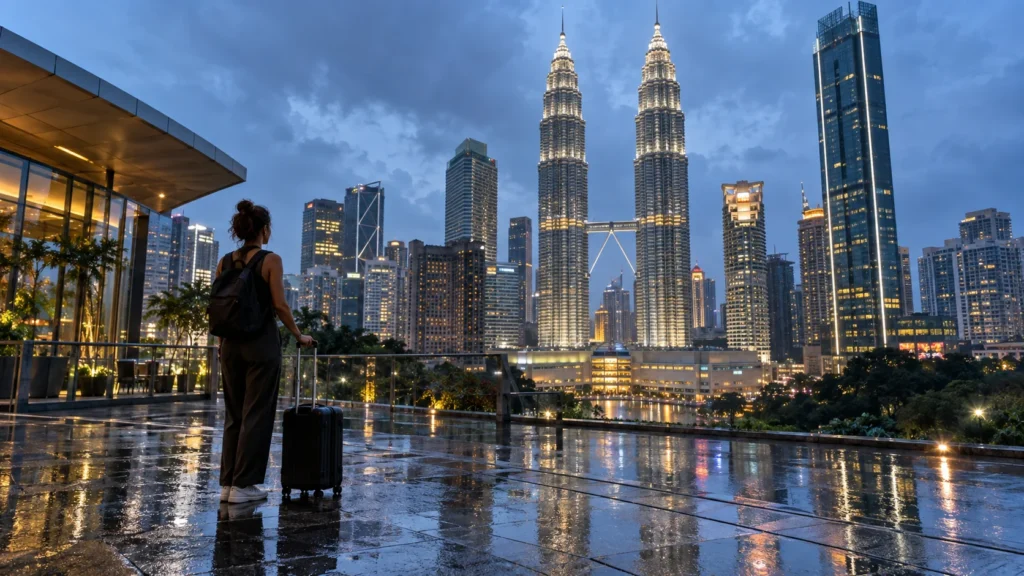
Choosing where to stay in Kuala Lumpur looks easy until the map starts lying by omission. Two hotels may both claim to be “city centre,” yet one connects to an MRT entrance and covered walkway while the other requires a sweaty ten-minute walk beside six lanes of traffic. Add a tropical downpour, a suitcase and a Grab pickup point hidden behind a mall, and 700 metres becomes a small expedition.
For most first-time visitors, Bukit Bintang is the best all-round base. Food, shopping and several rail lines stay close, and evenings do not require much planning. Choose KLCC for skyline views, a calmer atmosphere and family-friendly days. Choose Chinatown or Pasar Seni for heritage, excellent food, useful transit and better value. KL Sentral wins when airport access or a one-night stop matters more than neighborhood charm.
This guide compares the trade-offs that hotel descriptions tend to skip: station exits, rain-proof walking, traffic, street noise, late check-in food and the difference between “near KLCC” and actually being near KLCC.
The 30-second Kuala Lumpur neighborhood decision
| Area | Best for | What works | Main catch |
|---|---|---|---|
| Bukit Bintang | First visits, food, nightlife, shopping | Walkable evenings and strong MRT/monorail access | Noise, crowds and slow road traffic |
| KLCC | Families, skyline views, luxury stays | Park, major sights and a polished setting | Higher prices; “KLCC” labels can stretch far |
| Chinatown / Pasar Seni | Value, heritage, markets, food | Central transit and plenty to explore on foot | Uneven pavements, street noise and variable room quality |
| KL Sentral | Airport transfers, short stays, day trips | Best transport interchange in the city | Functional rather than atmospheric |
| Chow Kit / Kampung Baru | Repeat visitors, local food, lower rates | More local rhythm and quick access to the centre | Less convenient for a classic first-trip itinerary |
If you want one answer, shortlist hotels within a true five- to eight-minute walk of Bukit Bintang MRT, Pavilion KL, Pasar Seni MRT/LRT or KLCC LRT. Check recent guest reviews and the exact entrance—not just the distance to the station pin. Kuala Lumpur stations, malls and elevated walkways can have multiple levels and exits. The hotel may be close to the building but far from the door that helps you.
Four checks to make before paying
1. Test the last 500 metres
Kuala Lumpur has excellent rail coverage, but pedestrian continuity changes block by block. A short route can include a footbridge, stairs, a road without a comfortable crossing or a walkway that closes late. Open street view, look for the hotel entrance and trace the route from the station. If reviews repeatedly mention crossing a highway, taking a back lane or walking through a mall, believe them.
This matters most with luggage. A cheap Grab from the station can solve the problem, but mall and hotel pickup zones are not always where the blue map dot suggests. Screenshot the property’s pickup instructions before landing.
2. Decide how much rain protection you want
KL rain is often brief and dramatic. It also tends to arrive when you are dressed for dinner. The official Kuala Lumpur Convention Centre guidance describes the 1.7-kilometre KLCC–Bukit Bintang pedestrian route and connecting tunnel as covered, air-conditioned and monitored by CCTV. Its underground section linking the convention centre, Suria KLCC, the towers and KLCC LRT is listed as open from 6 a.m. to 11 p.m. daily. That connection makes southern KLCC and the Pavilion side of Bukit Bintang much more practical than the road map alone suggests.
Do not assume every hotel between the two areas has direct indoor access. Some are one awkward crossing away. In a tropical downpour, that crossing will develop a personality.
3. Read reviews for sound, lifts and deposits
Bukit Bintang and Chinatown stay lively late. A room facing Jalan Alor, Changkat or Petaling Street can receive the full soundtrack. Ask for a high floor or an inward-facing room if sleep matters. At small hotels and serviced apartments, check lift access, reception hours, security deposits and whether late check-in requires messaging a host. “Residence” may mean a private unit in a large mixed-use tower, not a hotel with a staffed desk.
4. Compare the final price, not the search tile
Taxes, service charges, breakfast and cancellation rules can change the ranking after checkout. Search the same room type and dates on two platforms, then confirm the final total. You can compare Kuala Lumpur hotels on Agoda and check Kuala Lumpur hotel rates on Trip.com. Filter by your actual dates; a hotel that is good value on Tuesday may become ambitious on Saturday.
Affiliate note: these booking links may earn us a commission at no extra cost to you. We include them as comparison tools, not as a reason to choose a worse location.
Bukit Bintang: the easiest first-time base
Bukit Bintang is Kuala Lumpur’s shopping and entertainment district, but that description undersells its practical advantage: you can finish sightseeing, return to the hotel, and still have dozens of dinner choices without arranging another ride. Pavilion KL, Lot 10, Jalan Alor, Changkat and the newer TRX area create a dense band of malls, restaurants, hawker food and nightlife.
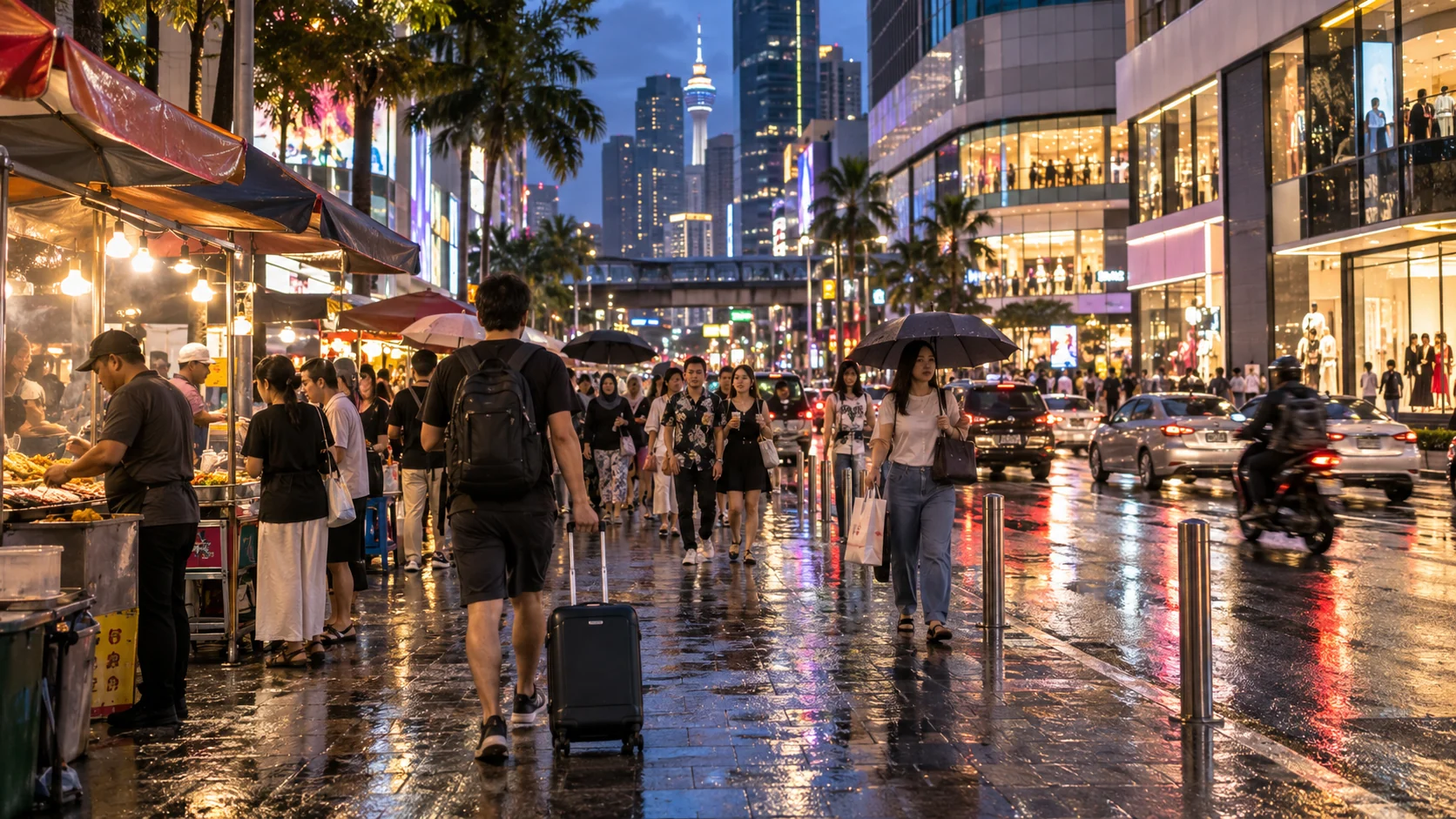
Transport is strong. Bukit Bintang MRT sits on the Kajang Line, the monorail runs through the district, and the covered walkway begins around Pavilion for the walk toward the convention centre and KLCC. That means you can plan many first-trip days without depending on road traffic.
Where inside Bukit Bintang?
- Near Pavilion and Bukit Bintang MRT: the most convenient first-time position. Shopping, restaurants, the covered KLCC walkway and rail are close. Prices and crowds are higher.
- Near Jalan Alor: ideal for late-night food and maximum energy. Check noise reviews carefully and expect slow Grab pickups at busy hours.
- Near Changkat: best for bars and nightlife. Poor choice for light sleepers unless the room is well insulated.
- South toward Imbi and Berjaya Times Square: often better value with monorail access, though the walk to Pavilion feels longer in heat.
- East toward TRX: modern malls and the MRT interchange are useful, but confirm the walking route; construction and wide roads can separate nearby-looking towers.
Choose Bukit Bintang if: this is your first visit, you like walking to dinner, or different people in your group want different things after 6 p.m. It is also the forgiving choice when rain cancels your outdoor plan: a mall, meal and coffee are rarely far away.
Skip it if: nightlife noise drains you, your ideal morning begins with a quiet park, or you dislike negotiating busy crossings. The district can feel like the entire city decided to meet outside Pavilion at the same time.
KLCC: skyline, park and a calmer city-centre stay
KLCC is built around the Petronas Twin Towers, Suria KLCC, KLCC Park, Aquaria and the convention centre. The area is landscaped, polished and easy to understand. Families appreciate the park and indoor attractions; short luxury trips benefit from hotels with skyline views and full service.
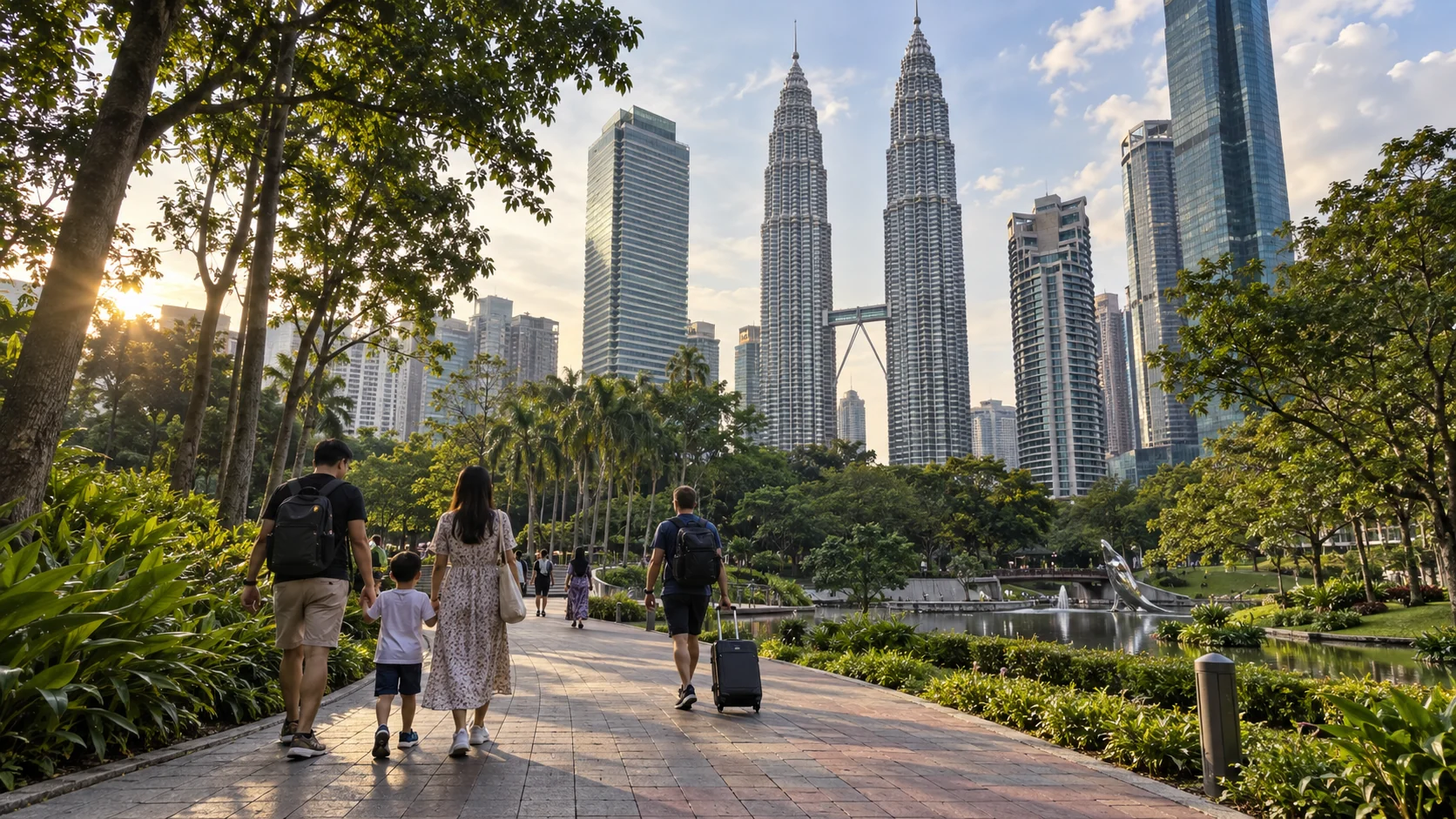
The neighborhood also suits travelers who want predictable evenings. You can eat inside Suria KLCC, walk in the park, see the towers after dark and return without calling a car. The Kelana Jaya LRT line connects KLCC to Pasar Seni and KL Sentral, while the covered walkway makes Pavilion reachable without fighting the weather.
The “near KLCC” trap
Booking sites use KLCC as a broad marketing label. A property can have “KLCC” in its name while sitting a long walk from the LRT station, the park or the covered corridor. Check three distances separately: the nearest usable station entrance, the park, and a 24-hour shop or late dinner. Some apartment towers look central from the skyline but sit behind wide roads and quiet office blocks.
Serviced apartments deserve extra scrutiny. They can offer more space, kitchens and excellent views, but the experience depends on the host. Confirm reception location, luggage storage, deposit method, housekeeping and late-arrival procedure. If your flight lands at 11 p.m., “message us 30 minutes before arrival” is not a tiny detail.
Choose KLCC if: you travel with children, want a landmark view, prefer a calmer and more polished base, or plan a short celebratory stay. It also works well for convention visitors who can walk indoors to the venue.
Skip it if: your priority is cheap local food immediately outside the hotel or your budget depends on nightlife-free streets. KLCC has plenty to eat, but a spontaneous late supper often feels more mall-shaped than in Bukit Bintang or Chinatown.
Chinatown and Pasar Seni: best balance of value and character
Chinatown places Petaling Street, Central Market, temples, cafes and old shophouses within an easy wandering radius. The useful transport anchor is Pasar Seni, where the MRT Kajang Line and Kelana Jaya LRT meet. That gives you direct connections toward Bukit Bintang and KLCC without making the area feel like a transport terminal.
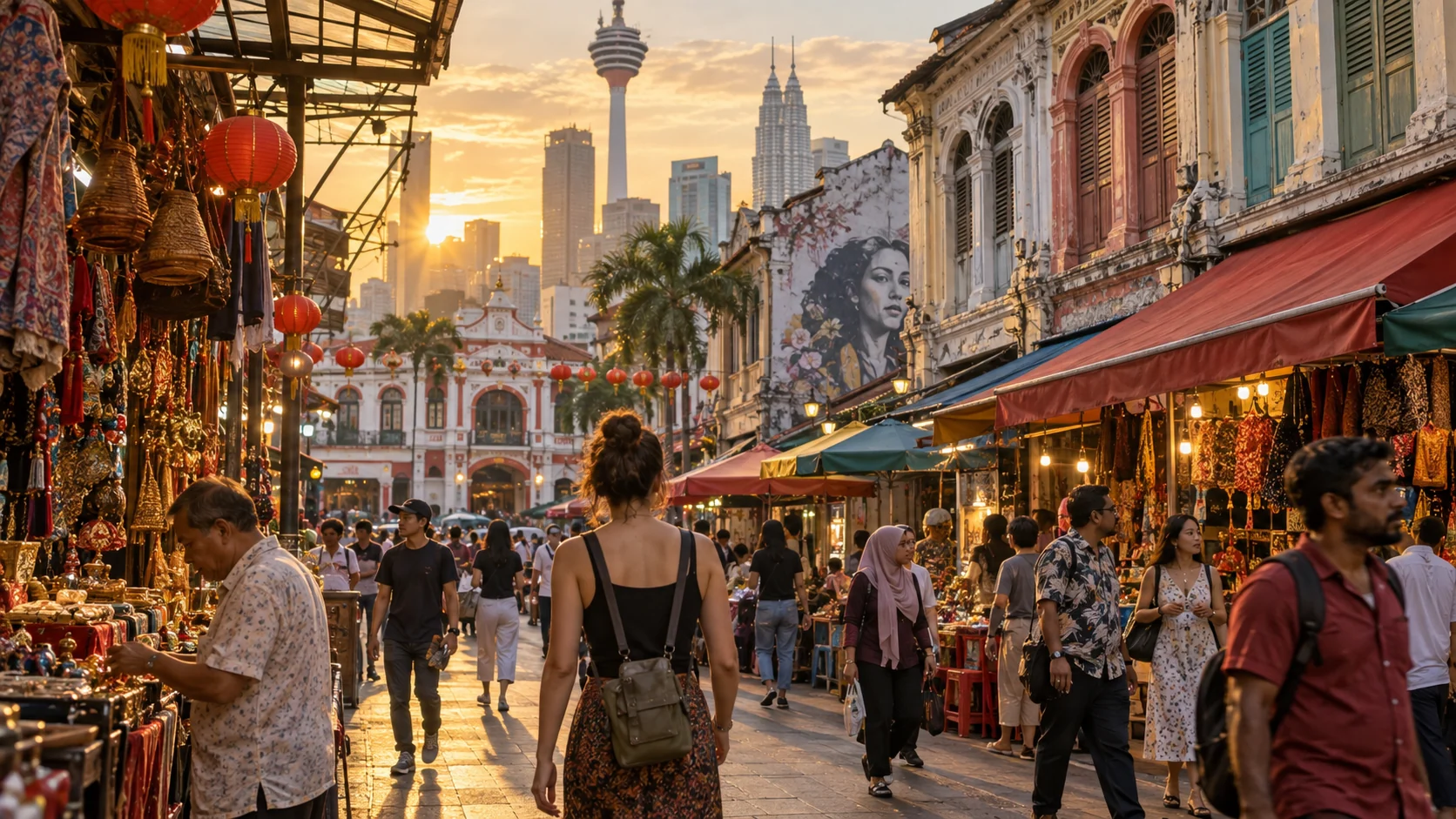
This is the best base for travelers who want to step outside into an older layer of Kuala Lumpur. Breakfast can be noodles or kaya toast, afternoons move between temples and restored lanes, and evenings bring food stalls and bars in adapted heritage buildings. Merdeka Square, Masjid Jamek and the River of Life area are walkable for many visitors, although heat and road crossings make distances feel longer at midday.
Pick the right side of the neighborhood
- Near Pasar Seni station: best for transport, Central Market and easy arrival. The immediate streets can be busy with buses and daytime foot traffic.
- Near Petaling Street: best for market atmosphere and food. Expect early deliveries, late activity and uneven noise.
- Near Merdeka MRT: useful for the Kajang Line and Stadium Merdeka area. Check the exact walking route at night.
- North toward Masjid Jamek: convenient for two LRT lines and historic sights, but the block-by-block atmosphere varies.
Budget hotels vary widely here. A handsome lobby photo tells you little about window size, plumbing, street sound or the lift. Read the newest reviews, especially comments from guests who stayed in the same room category. Hostels and design hotels can be excellent; the cheapest private room may also teach you how little floor space a suitcase technically needs.
Choose Chinatown if: food, heritage and value matter more than a tower view; you enjoy exploring on foot; or you want useful rail connections without sleeping in a mall district.
Skip it if: you expect immaculate pavements, guaranteed quiet or a resort-style hotel bubble. KL’s old centre is interesting because it has texture. Texture occasionally includes a delivery scooter and a drain you would prefer not to meet in sandals.
KL Sentral: the airport-transfer specialist
KL Sentral is Kuala Lumpur’s main transport interchange and the terminus for KLIA Ekspres. Choose it for a late arrival, early flight, one-night stop or itinerary with several day trips. Nu Sentral mall provides food and basics, and rail lines spread across the city.
The official KLIA Ekspres fare from KLIA Terminal 1 or 2 to KL Sentral is RM55 one way for adults and RM25 for children aged 6–15; the adult return is RM100. Children under six travel free within the operator’s stated limit. The express train is the cleanest way to avoid highway traffic, but it deposits you at KL Sentral—not at Bukit Bintang or KLCC. Budget another rail transfer or Grab after arrival.
If the train fits your arrival, you can check KLIA Ekspres tickets on Klook. Compare the ticket conditions with the operator’s current fare before buying, and confirm which airport terminal you use.
KL Sentral’s weakness is atmosphere. It works brilliantly as infrastructure, then becomes less compelling once you ask where to stroll after dinner. Brickfields, immediately south, has excellent Indian food and more neighborhood life, but crossing roads and navigating station levels with luggage can be confusing on the first attempt.
Choose KL Sentral if: transport efficiency is the trip’s main constraint. Do not choose it merely because every line appears to meet there. If you stay four nights and spend every evening in Bukit Bintang, repeated transfers erase the arrival-time saving.
Two quieter alternatives for a second visit
Chow Kit
Chow Kit has a large local market, traditional food, newer design hotels and monorail access. Rates can be kinder than in KLCC, and the area feels more lived-in than the polished centre. It suits repeat visitors and food-focused travelers. Street atmosphere changes quickly, so check the hotel’s immediate block and recent night-time reviews rather than judging the whole district by one pin.
Kampung Baru
Kampung Baru offers Malay food, low-rise streets and striking tower views close to KLCC. It is one of the most interesting contrasts in central Kuala Lumpur. The catch is pedestrian access: rail helps, but some routes involve wide roads or indirect crossings. Stay here because you want the neighborhood, not because a listing calls it “steps from the towers.”
How to arrive without wasting the first evening
For KL Sentral: KLIA Ekspres is the simple option. Follow signs at the airport, keep the QR ticket accessible and use the wide gate with large luggage.
For Chinatown: take KLIA Ekspres to KL Sentral, then the Kelana Jaya LRT to Pasar Seni, or use Grab from KL Sentral if luggage is heavy. The transfer is short, but finding the correct level inside KL Sentral takes more time than the rail map admits.
For KLCC: transfer at KL Sentral to the Kelana Jaya LRT for KLCC station. With two large suitcases or a late arrival, a car from the airport may be easier, but highway traffic makes the travel time unpredictable.
For Bukit Bintang: the rail-only route usually means KLIA Ekspres to KL Sentral, then another connection. A practical alternative is the airport train to KL Sentral followed by Grab. Tell the driver the hotel entrance, not only “Bukit Bintang,” and check for a designated pickup lobby.
Rapid KL rail services generally operate from around 6 a.m. to midnight, according to MyRapid, but last trains vary by line and station. Single-journey tokens work on LRT, MRT and monorail: tap the token to enter and insert it to exit. Debit and credit cards can be used for purchases at Rapid Rail customer-service counters, but that does not mean every fare gate accepts an ordinary bank card for tap-in travel. Carry some ringgit or use a Touch ’n Go card if you expect frequent rides.
Best area by trip type
- First trip, three or four nights: Bukit Bintang near the MRT and Pavilion.
- Family with young children: KLCC near the park, Suria KLCC and a usable LRT entrance.
- Food-first budget trip: Chinatown near Pasar Seni.
- Late arrival or early departure: KL Sentral, particularly for one night.
- Nightlife weekend: Bukit Bintang near Changkat, but book soundproofing rather than optimism.
- Luxury skyline break: KLCC; confirm the view category before paying.
- Repeat visit with local food focus: Chow Kit or Kampung Baru.
- Southeast Asia multi-country route: prioritize airport and rail access. Our Singapore–Malaysia–Thailand itinerary helps place Kuala Lumpur in a practical regional sequence.
A simple booking method that works
- Pin the three places you expect to visit most after dark.
- Choose the neighborhood that reduces repeated evening transfers.
- Shortlist only hotels within a verified walk of a station, covered route or easy pickup point.
- Check newest reviews for noise, deposit, lift, reception and rain-time access.
- Compare the final price for the same room and cancellation terms.
- Save the hotel entrance and arrival instructions offline.
Planning a wider first trip around the continent? Start with our Asia itinerary guide for first-time visitors, then lock the Kuala Lumpur neighborhood before choosing individual attractions.
Quick answers before you book
Is Bukit Bintang or KLCC better for a first visit?
Bukit Bintang is better for most first-time visitors because dining, shopping, MRT access and late-night activity are concentrated together. KLCC is better for families, luxury stays and travelers who prioritize the towers, park and a calmer evening.
Can I walk from Bukit Bintang to KLCC?
Yes. The covered, air-conditioned pedestrian route connects the Pavilion side of Bukit Bintang with the Kuala Lumpur Convention Centre, then continues through the tunnel toward Suria KLCC and KLCC LRT. Allow roughly 20–30 minutes depending on your starting point, walking speed and mall navigation. Check closing times if returning late.
Is Chinatown safe for tourists?
Chinatown is a busy tourist and local district, and many visitors stay there comfortably. Use normal big-city precautions: watch your phone and wallet in crowds, choose well-lit routes at night and read recent hotel-block reviews. The bigger everyday annoyances are usually traffic, uneven walking surfaces and noise rather than sightseeing access.
Should I stay near KL Sentral for the whole trip?
Only if airport transfers and day trips dominate. It is extremely convenient for transport but less satisfying as an evening base than Bukit Bintang, KLCC or Chinatown. For a longer stay, saving twenty minutes on arrival can create several days of extra commuting.
Do I need a car in Kuala Lumpur?
No for a central sightseeing trip. MRT, LRT, monorail, covered walkways and occasional Grab rides are usually easier than driving and parking. The key is choosing a hotel near the network you will actually use.
The bottom line
Book Bukit Bintang for the most forgiving first-trip experience. Book KLCC for skyline, family convenience and a polished stay. Book Chinatown or Pasar Seni for value, food and heritage. Use KL Sentral when the airport or onward train is the real priority.
The best Kuala Lumpur hotel is not necessarily the one closest to the towers. It is the one that still feels easy when the rain starts, your phone battery is low and everyone suddenly wants dinner in a different direction.