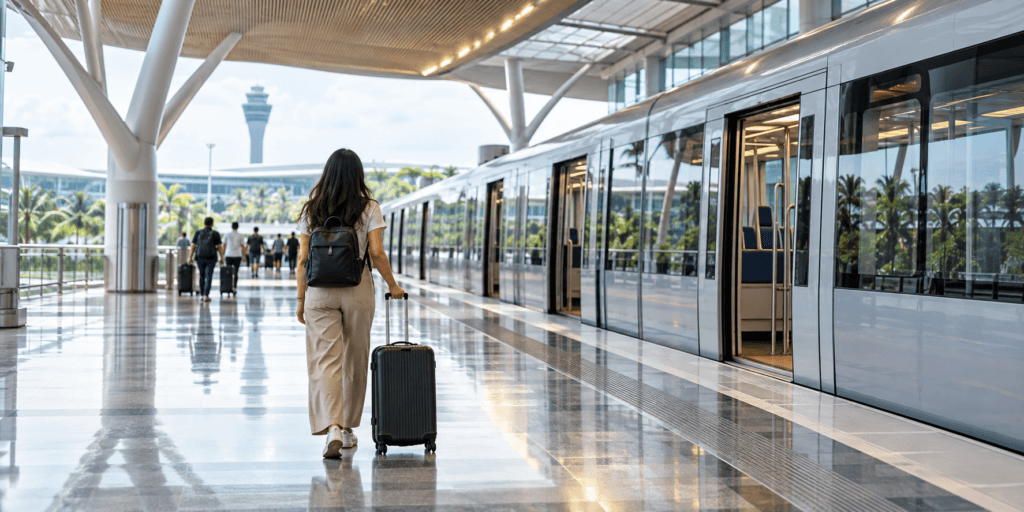
Kuala Lumpur airport transfers become easier once you stop treating “the city” as a single destination. A train to KL Sentral is excellent if your hotel is beside KL Sentral. For an apartment with a complicated entrance in Bukit Bintang, the same train still leaves an onward journey to arrange.
This guide compares KLIA airport to Kuala Lumpur routes by hotel area, party size and arrival time. It covers Terminal 1 and Terminal 2, the KLIA Ekspres, airport coaches, Grab and official taxis—with particular attention to the bit between the transport stop and your actual bed.
Information checked on October 2, 2026. All amounts are Malaysian ringgit (RM). Road journey times are planning estimates, not operator guarantees. This article includes affiliate links: Asia Travel Lab may earn a commission if you book through them, at no additional cost to you.
The short answer: pick the hotel door first
- One person, manageable luggage, daytime arrival: the airport train is a strong default, especially for KL Sentral or a hotel with a simple rail connection.
- Budget matters more than speed: compare an airport coach to KL Sentral, then include the onward journey in the calculation.
- Three or four people, several suitcases: compare the live quote for a suitably sized car against the total train cost—not one train ticket.
- Late arrival, young children or a difficult apartment check-in: an official taxi, Grab or a prearranged transfer may be worth the extra expense.
A useful rule: save money on the long ride if you can, but do not create a difficult final connection just to win the airport-transfer spreadsheet.
| Option | Cost basis | Where it leaves you | Main compromise |
|---|---|---|---|
| KLIA Ekspres | Standard adult single RM55 in 2026; online offers vary | KL Sentral | Another journey for most city hotels |
| Airport coach | Check the operator’s live fare for your terminal and departure | Booked city terminus, often KL Sentral | Waiting and road traffic |
| Grab | Live vehicle quote; review additional charges | Selected hotel entrance | Pickup coordination and traffic |
| Official airport taxi | Coupon quote or metered fare | Hotel address | Vehicle category and fare conditions matter |
| Prebooked transfer | Vehicle/package quote | Agreed meeting point to hotel | Waiting limits and cancellation terms |
The 2026 train fare comes from the official KLIA Ekspres fare page. Its normal daytime journey is 28 minutes between Terminal 1 and KL Sentral; allow around 33 minutes from Terminal 2, plus waiting and the hotel connection. Neither figure starts at the aircraft door.
Before leaving arrivals: confirm T1 or T2
Both terminals serve Kuala Lumpur International Airport. They are not interchangeable pickup locations. Check the flight’s actual terminal in your arrival details and use that terminal in a bus booking or car request.
You generally do not need to move to the other terminal to reach Kuala Lumpur. Start by checking the transport available in the terminal where you have just collected your luggage. A cheap ticket from the wrong terminal can become a surprisingly energetic purchase.
If you genuinely need an inter-terminal transfer, Malaysia Airports lists a free round-the-clock shuttle, with a stated frequency of approximately 15 minutes. Its published stops include T1 Door 4, Level 1, and T2 Bay A10, Level 1 Transportation Hub. Follow current airport signs if arrangements change. See the official inter-terminal guide.
Before committing to a ride, save your hotel name, full address and entrance instructions. Apartments sometimes have a tower name, a booking name and a host’s preferred drop-off point. Make those agree while you still have airport Wi-Fi.
The train decision: fast airport leg, separate city leg
KLIA Ekspres is appealing when avoiding road congestion is the priority. Standard 2026 fares are RM55 one-way and RM100 return for adults; children aged 6–15 pay RM25 single or RM45 return. Under-six travel is free subject to the operator’s conditions. The official website advertises a 10% discount on standard online tickets.
There is already an announced change for next year: ERL says the adult Ekspres fare will become RM65 single and RM118 return from January 1, 2027. Do not apply those prices to a 2026 journey, and check purchase validity carefully if buying ahead. Read the official fare-change notice.
At the airport, follow rail signs and confirm that the ticket and service match. KLIA Transit is the stopping service, serving intermediate stations including Putrajaya & Cyberjaya and Bandar Tasik Selatan. It is not automatically a cheaper airport-to-KL-Sentral ticket. Consult the Transit route and fare information if your destination is one of those intermediate stops.
Before buying a return, ask a boring but profitable question: will you actually use it? A city arrival by train and a predawn departure by car may make two different transfer choices more sensible.
If you prefer booking through a platform you already use, compare KLIA Ekspres ticket options on Klook. Check the package’s validity, direction and cancellation policy, then compare the final price with the operator’s own offer. Platform currency conversions are not permanent ringgit fares.
Do not rely on a copied last-train time
During this check, ERL pages showed differing late-night information: the Ekspres product page described extended stopping services after 11pm, while summary tables and timetable material did not present one consistent last departure. Some pages also showed a combined-service alert. That means a precise cutoff copied into a blog would give false confidence.
For a late flight, use the operator’s live schedule and ask station staff which airport-to-city train you can actually board. Scheduled landing time is not station arrival time. Immigration, a delayed suitcase and the terminal walk can consume your margin before you even see a train.
Also check the onward city service. Reaching KL Sentral does not prove the LRT, MRT or monorail connection you need is still running. If the connection is doubtful, price a car for the last leg before purchasing.
After KL Sentral: four hotel situations
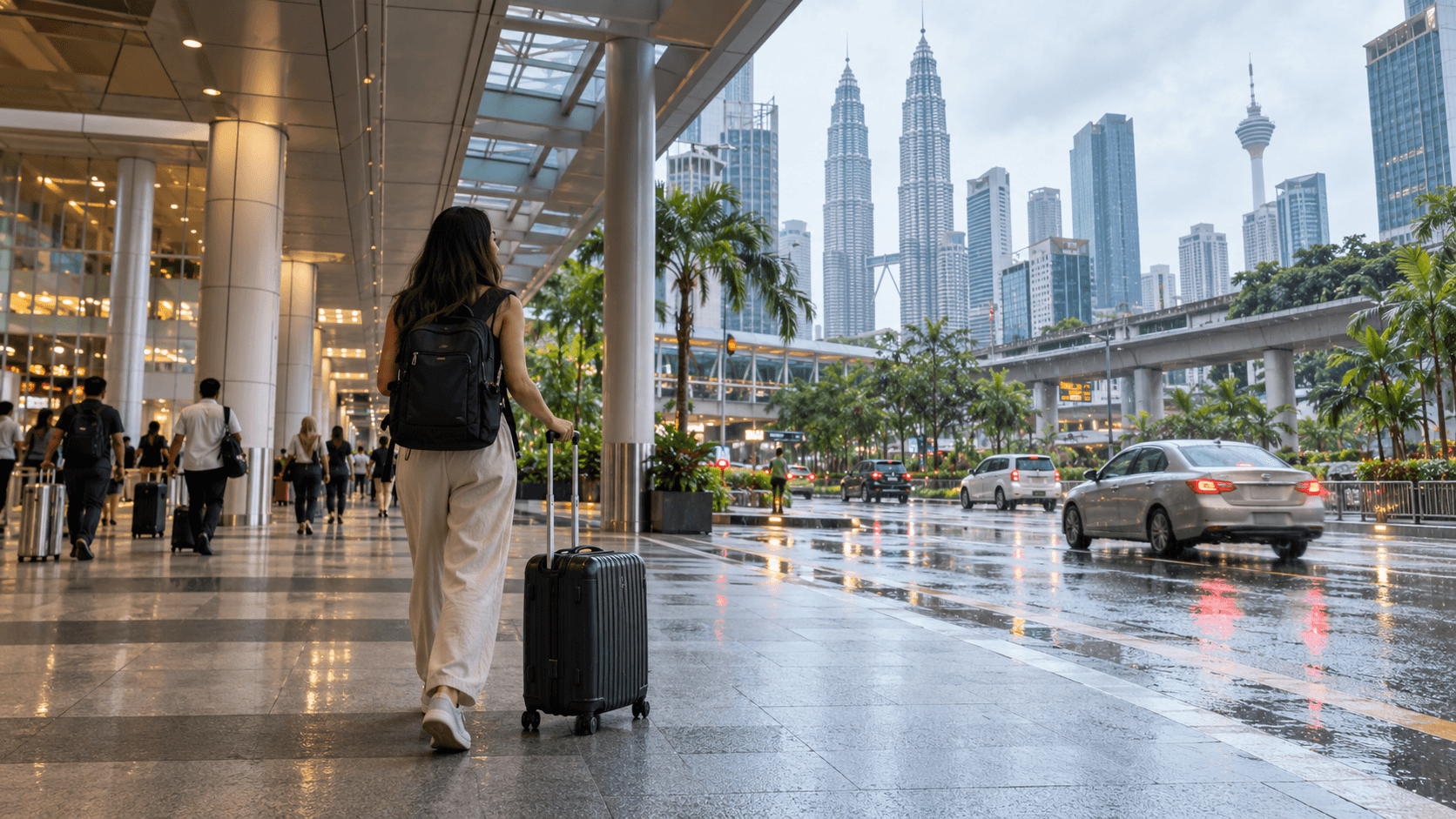
Your hotel is beside KL Sentral
This is the simplest case for the train. Check the property’s pedestrian directions rather than following a straight line across the map. A station-adjacent hotel and a hotel “in the KL Sentral area” can require different amounts of walking, road crossing and lift hunting.
If airport access is influencing your hotel choice, start with our Kuala Lumpur hotel-area comparison. You can then check Kuala Lumpur hotel locations on Agoda. Open the map, inspect the actual address and read recent comments about access; the neighborhood label alone is not a walking route.
You are staying around KLCC
KLCC is served by the Kelana Jaya LRT line, making rail onward travel a practical option for a hotel near the relevant station. Use the hotel entrance—not the Petronas Towers—as the destination when evaluating the walk.
A “KLCC” property may still leave you with luggage on an exposed pavement. If heavy rain starts, switching to a car at KL Sentral can be a reasonable hybrid choice. The train has already removed the long highway leg from the traffic equation.
You are staying in Bukit Bintang
Compare the monorail with the MRT connection via Muzium Negara, choosing the option that suits the property’s entrance. Do not assume all lines share one platform because a map puts them under the same interchange name. Look up the walking connection and the destination exit before starting.
For a group with large cases, a direct car may be simpler than splitting into several transfers. The right answer depends on your hotel, not on a universal declaration that trains or cars are always better.
You are staying around Chinatown or Pasar Seni
A rail connection to Pasar Seni can work well for a nearby property. Check the final pavement route, particularly with luggage after dark. A compact neighborhood does not make every entrance easy to locate.
For current route planning and service alerts, use Rapid KL’s official network information. City fares are separate from the airport ticket; do not assume one voucher covers both.
The bus: inexpensive only if the whole route works
A coach is worth considering when your schedule is flexible. Confirm the terminal, destination, boarding time and luggage arrangements before paying. “Airport bus” describes a category, not a guarantee that every departure serves your preferred city stop.
SkyBus currently advertises KL Sentral services for both T1 and T2. Its directions place T1 boarding at the ground-floor Block C annex and T2 boarding at the Level 1 Transportation Hub. At KL Sentral, its bus terminal is on the lower-ground level. Check the operator’s booking page and boarding directions for your trip.
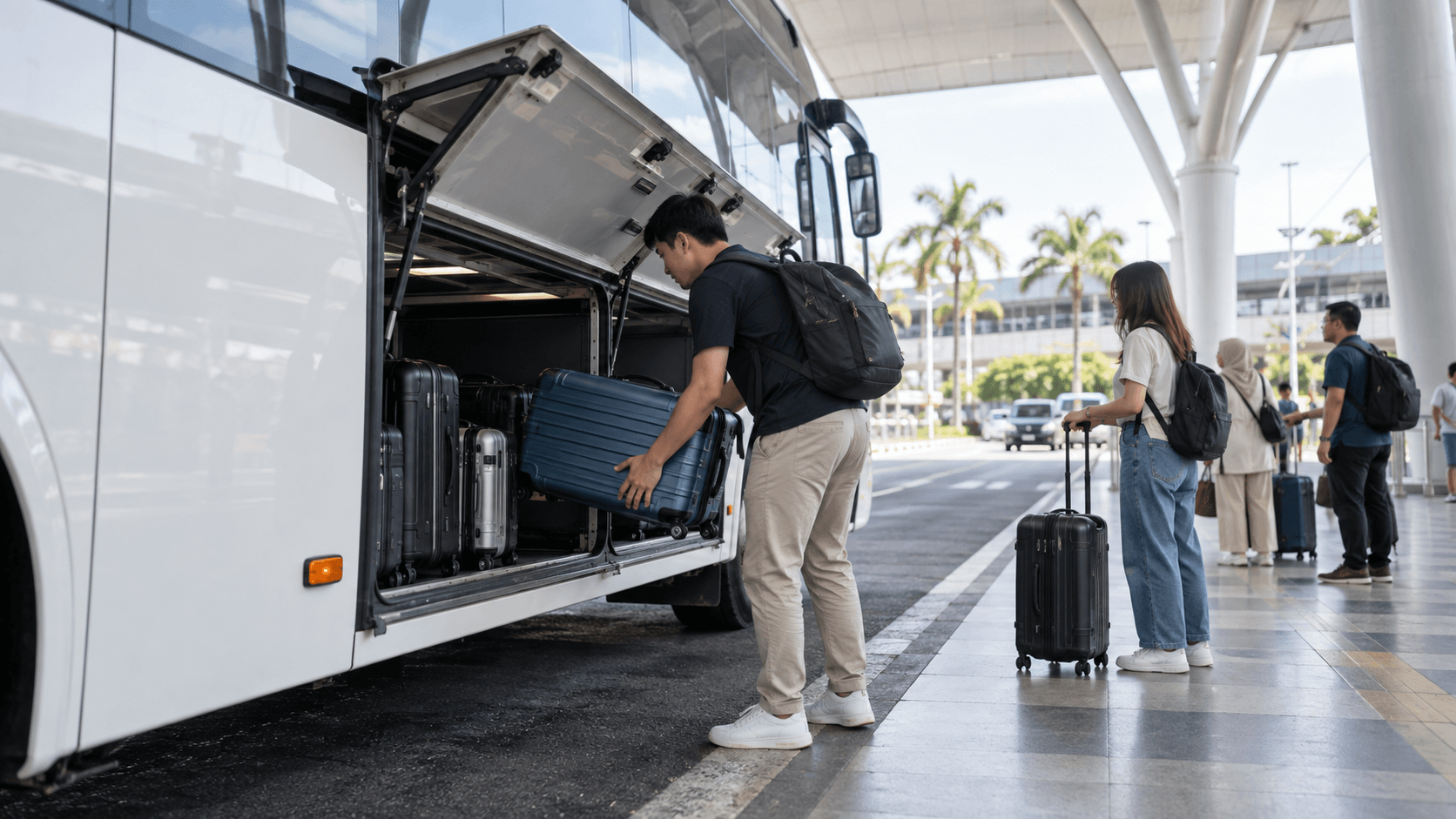
Budget roughly one to one-and-a-half hours for the road journey to central Kuala Lumpur as a planning allowance, then add waiting and the hotel connection. Traffic can make it longer. A coach timetable is not a promise about the time you will unlock your room.
We are not quoting a fixed adult bus fare because the live booking total for your departure is the useful number. Check payment options too; a foreign card that works online elsewhere is not proof it will work at every counter. Keep a practical backup rather than a wallet full of assumptions.
Carry passports, electronics, medicine and anything needed at check-in in the cabin. When collecting a case from the luggage hold, check its tag before leaving. Similar-looking bags are easy to confuse in a busy pickup area.
Grab, official taxis and transfers: compare per vehicle
For several adults, start with arithmetic. Three standard RM55 train singles total RM165 before city connections. That is a comparison baseline, not a claim that a car will always cost less. Open the app, select a vehicle with enough luggage capacity and compare the total quote.
Do not order while standing at baggage reclaim. First collect the bags, confirm the designated pickup zone and make sure your phone can receive messages. A driver cannot solve immigration delays from the curb.
Grab’s airport guide lists multiple T1 pickup points, including Level 1 doors and a separate EV location. The booking’s current pickup instructions take priority over an old screenshot of a door number. Read the official Grab airport guide, then check the terminal, door, vehicle registration and driver details in the app.
For an official airport taxi, Malaysia Airports distinguishes fixed-fare coupon taxis from metered taxis. Request the fare basis and vehicle category at the authorized counter. Its T1 information also lists a midnight surcharge for metered services between midnight and 6am; do not assume that every car product uses the same pricing. See the airport’s official transport information.
A prearranged transfer is especially useful when assistance matters more than choosing the lowest live quote. Before booking, confirm luggage capacity, child-seat availability if needed, flight-delay handling, included waiting time and the exact meeting method. A larger vehicle does not automatically include a child seat.
Late arrivals need a hotel plan, not just a ride
If you land late, tell the accommodation your likely arrival time and ask how check-in works after reception hours. This is particularly important for apartments: getting to the building is not the same as getting a key.
When comparing stays, review Kuala Lumpur hotel options on Trip.com, then verify reception hours and late-arrival arrangements with the property. A cheap room with uncertain access is not necessarily a cheap first night.
Keep a screenshot of the confirmed address, booking reference and host instructions. If mobile data fails, you still need a destination the driver can identify. Stay inside the terminal while resolving a failed payment or booking rather than wandering between pickup areas with luggage.
For the return flight, reverse the checks—not the guesswork
Confirm your departing terminal again. Build the airport arrival time from the airline’s check-in and baggage deadlines, then add transfer time and a disruption buffer. A train’s advertised ride duration should not become your entire hotel-to-check-in allowance.
For an early departure before workable rail connections, arrange a car and a backup contact the evening before. For a bus, allow for waiting and highway traffic. For a train, include the journey from your hotel to KL Sentral and the walk from the airport platform to your check-in area.
If Kuala Lumpur is one stop on a longer journey, our Singapore–Malaysia–Thailand itinerary helps place the city in the wider route. Keep the first arrival day light: a successful transfer, a meal and an uncomplicated check-in are a perfectly respectable opening act.