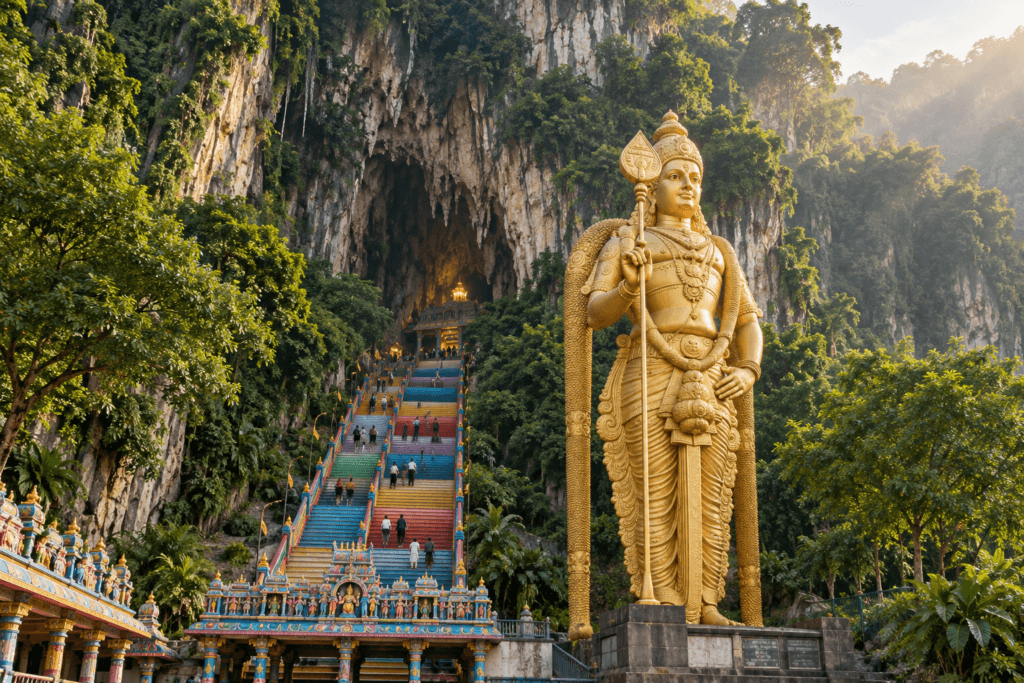
The photograph makes Batu Caves look simple: colourful stairs, a golden statue and a limestone cliff. The actual visit starts with less glamorous questions. Which train are you taking? Will your clothes pass the temple’s entrance check? And have you left enough energy for the walk back down?
Batu Caves works well as a focused outing from Kuala Lumpur, but it is a working Hindu temple complex, not a staircase built for holiday photographs. Plan the journey, dress respectfully and give the climb a little breathing room. You do not need an expensive bundle to make the visit worthwhile.
This guide compares KTM Komuter, Grab and a half-day tour, then follows the practical flow from packing your bag to getting back to the city. The aim is a good visit, not a personal speed record on 272 steps.
Affiliate disclosure: Some links below are affiliate links. If you book through them, Asia Travel Lab may earn a commission at no extra cost to you. Tours and hotel links are optional. Images are AI-generated editorial illustrations, not photographs of an actual visit.
Information checked on 9 October 2026. Train schedules, access arrangements, prices and tour conditions can change. Follow current temple signs and staff instructions on arrival.
First, separate the free temple visit from a paid tour
The main Temple Cave, also called Cathedral Cave, is the destination above the rainbow staircase. Tourism Malaysia’s Selangor visitor information lists Temple Cave admission as free. A paid transport package is not required to visit it independently.
That does not make the whole outing free. Budget for your journey, water, food and any optional attraction you deliberately choose. Ramayana Cave and Cave Villa are separate places, not compulsory upgrades for reaching the main cave. Check their current prices and opening arrangements at their own entrances before paying.
Likewise, a tour price mainly buys a transport-and-itinerary service. Read the itinerary to understand what is included. Do not interpret a booking page headed “Batu Caves tour” as evidence that the main temple has introduced a mandatory admission ticket.
Older guides also describe Dark Cave tours. Do not build your day around one unless a current operator explicitly confirms that it is running. A mention on a general tourism page is not the same thing as a bookable departure.
Pick your transport by the problem you want to avoid
| Option | Best fit | The trade-off |
|---|---|---|
| KTM Komuter | Independent travellers whose hotel connects conveniently to the railway | You need to plan around the actual timetable, including the return |
| Grab or another arranged car | A group, a direct hotel departure or a visit with a flexible return | Road traffic, changing quotes and finding the pickup point |
| Half-day tour | Travellers who prefer a planned transfer and additional stops | Less control over timing; pickup eligibility and itinerary need checking |
For one traveller staying close to KL Sentral, the train can be a sensible starting point. For a family leaving a hotel some distance from the station, compare the cost and effort of the entire journey. A cheap railway ticket loses some of its appeal if reaching the railway involves an awkward transfer in the heat.
You can mix methods. Train out and car back, or the reverse, may suit the day better than committing to the same transport twice. Check the return plan before leaving the hotel, then review it again once you have finished the climb.
KTM Komuter: read the schedule before leaving breakfast
For the independent rail route, use KTM Komuter towards Batu Caves, with KL Sentral as a convenient city departure point. This is not an MRT ride to a station with a similar name, and it is not the airport train. Follow KTM Komuter signs and confirm the destination on the departure display before boarding.
The official KTMB timetable page separates weekday services from weekend and public-holiday services. At the time of checking, it also contained a Batu Caves schedule marked for 3 October 2026 only. That special-date label matters: do not reuse it for an ordinary later Saturday.
Choose the current timetable for your travel date, find the KL Sentral departure row and read the Batu Caves arrival row in the same column. For the journey back, use the reverse-direction table. Save the relevant departures before you go; a list of outbound trains is not a return plan.
Do not assume that trains arrive every few minutes. Plan around a specific service, while leaving a margin for finding the platform and handling tickets. A journey estimate that only counts time aboard the train leaves out the hotel walk, station navigation and waiting.
Check the current fare and ticket/payment options with KTMB or at the station. We are not fixing a fare here because the exact origin and current ticket arrangements matter. Keep your ticket or accepted payment method accessible for the exit process, and follow signs for any designated coach.
At Batu Caves station, follow the pedestrian route towards the temple complex using on-site signs and your map. Do not make the visit depend on a particular numbered station exit copied from an old blog. Keep time for the final walk rather than treating arrival at the platform as arrival at the stairs.
Grab: convenient, but plan the pickup as well as the drop-off
Use the actual Batu Caves temple destination in the app, then check the map pin. Read the live quote and vehicle capacity before requesting a car. A fare someone paid last year is not a useful promise for your group this morning.
For the return, request the ride from a safe place where the driver can stop legally, and confirm the pickup point in the app. Stay reachable if the driver needs to clarify which side of the road you are on. Do not cross traffic simply because the moving car icon appears nearby.
Save enough phone battery and data for this part of the day. If the quote is higher than expected, compare it with the next train and the walk back to the station. Decide with the whole group before requesting and cancelling rides repeatedly.
A prearranged driver is another option if you want certainty about the return. Agree on waiting time, pickup place, vehicle size and any extra charges in advance. “Round trip” should describe both journeys clearly, not merely sound reassuring in a message.
A tour: buy convenience only if you want its itinerary
A half-day tour is useful when you prefer someone else to organise transfers, or when you want the additional stops. It is less suitable if your main goal is a long, unhurried temple visit on your own schedule.
You can compare the Kuala Lumpur Suburbs Batu Caves half-day tour on Klook. The checked listing offers meet-at-location and hotel-pickup options and describes a batik workshop stop. It also describes commentary before guests explore Batu Caves independently, so do not assume the guide accompanies every step of the climb.
Read the option you actually select. Confirm whether your hotel is within the pickup area, where an alternative meeting point is located, how much time is allowed at the caves and what happens if you do not climb. Check cancellation terms before paying. “Hotel pickup available” is not a promise that every address in Kuala Lumpur qualifies.
If a craft or shopping stop is not something you want, choose another itinerary or travel independently. A tour can simplify logistics, but it cannot remove the staircase or make unsuitable clothing acceptable.
Dress once at the hotel, not twice at the entrance
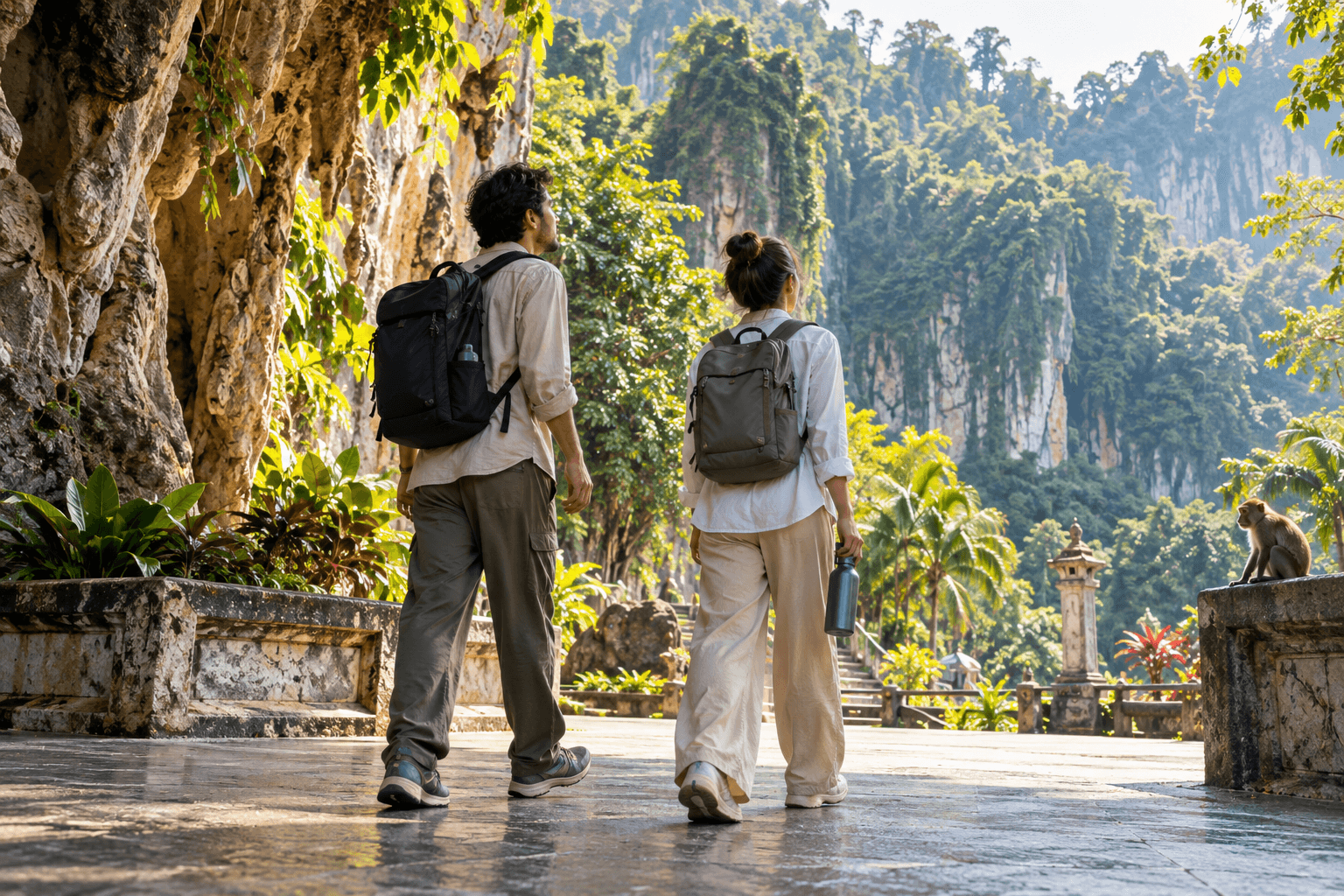
The lowest-friction Batu Caves outfit is a sleeved top and loose clothing that covers your knees. Long, lightweight trousers make the decision easy for any traveller. Cover your midriff too, and choose fabric that lets you move comfortably on stairs.
A local guide’s Batu Caves dress-code advice describes shoulder and knee coverage for the Temple Cave approach. Treat this as conservative preparation, then follow the current entrance instructions. Do not spend your arrival arguing over whether an outfit is technically long enough.
A scarf is a useful backup for shoulders, but a small scarf does not reliably solve shorts that leave your knees exposed. Bring an actual suitable layer if you need one. Do not rely on a particular sarong price or rental arrangement being available on the day.
Wear shoes with dependable grip and enough support for descending as well as climbing. Follow signs about removing shoes at individual sacred spaces. There is no reason to assume that being at a temple means the entire outdoor staircase should be climbed barefoot.
Pack lightly: drinking water in a closed bottle, a zipped bag, sun protection, a modest clothing backup if needed and a little cash for small purchases. Carrying every possible travel accessory up the steps is one way to discover which ones you could have left at the hotel.
Plan a morning-sized outing, not a twenty-minute photo stop
For a straightforward visit, set aside roughly one to two hours at the complex as a planning allowance, plus travel and waiting time. That is not a required duration or a guaranteed completion time. Extra attractions, queues, slower walking and religious activity can lengthen the visit.
An earlier daytime visit is a sensible choice when you want to reduce the amount of climbing in strong heat. It does not guarantee empty stairs. Check transport and current access before deciding on a very early arrival; there is little benefit in reaching a closed entrance with an excellent sunrise plan.
Published opening-hour claims vary, and this guide does not promise a fixed opening or closing time for every part of the complex. Plan within daylight hours and confirm access if your visit depends on an early or late boundary, a ceremony or an optional attraction.
Check MET Malaysia’s Gombak forecast, not just the icon for your Kuala Lumpur hotel. Give yourself room to delay the climb if conditions deteriorate. A cave destination still involves an exposed approach and stairs.
For a relaxed day, have breakfast, visit Batu Caves, return for lunch and leave the afternoon flexible. If you add a booked city attraction, put a generous gap between them. Train waiting or road traffic should not turn the temple visit into a race against your next voucher.
At the bottom of the stairs, make three quick checks
Clothing: look at the current entrance signs and adjust before joining the flow. If someone in your group cannot enter, resolve that together rather than discovering halfway up that you have separated without a meeting plan.
Energy: decide whether everyone wants to climb. Tourism Malaysia identifies the main cave approach as 272 steps. That number describes the approach, not a promise that all onward movement inside is flat.
Loose items: close your bag and put snacks away before moving onto the staircase. Keep your hands free enough to use a railing where appropriate. Holding an iced drink, a phone, sunglasses and someone else’s shopping bag is not an ideal stair-climbing technique.
Take photographs from places where you are not blocking worshippers or other visitors. If the staircase is busy, take the wider view from below and keep moving. Nobody needs your entire group to form a horizontal barrier while deciding which phone has the best camera.
Take the climb in sections
Set a comfortable pace and pause where you can do so without obstructing the route. Let faster people pass. Avoid stopping abruptly while looking through a camera, and keep children close enough that you can manage both their pace and the people around them.
Do not measure your ability by another visitor’s climb time. Heat, sleep, fitness, crowding and footwear all change how the steps feel. The descent deserves the same attention: tired legs and wet surfaces are reasons to slow down, not hurry to finish.
If you are struggling, turn back when it is safe to do so. You do not have to reach the upper cave to justify coming. The statue, limestone setting and ground-level temple surroundings are still part of the visit.
Inside the cave, leave room for worship
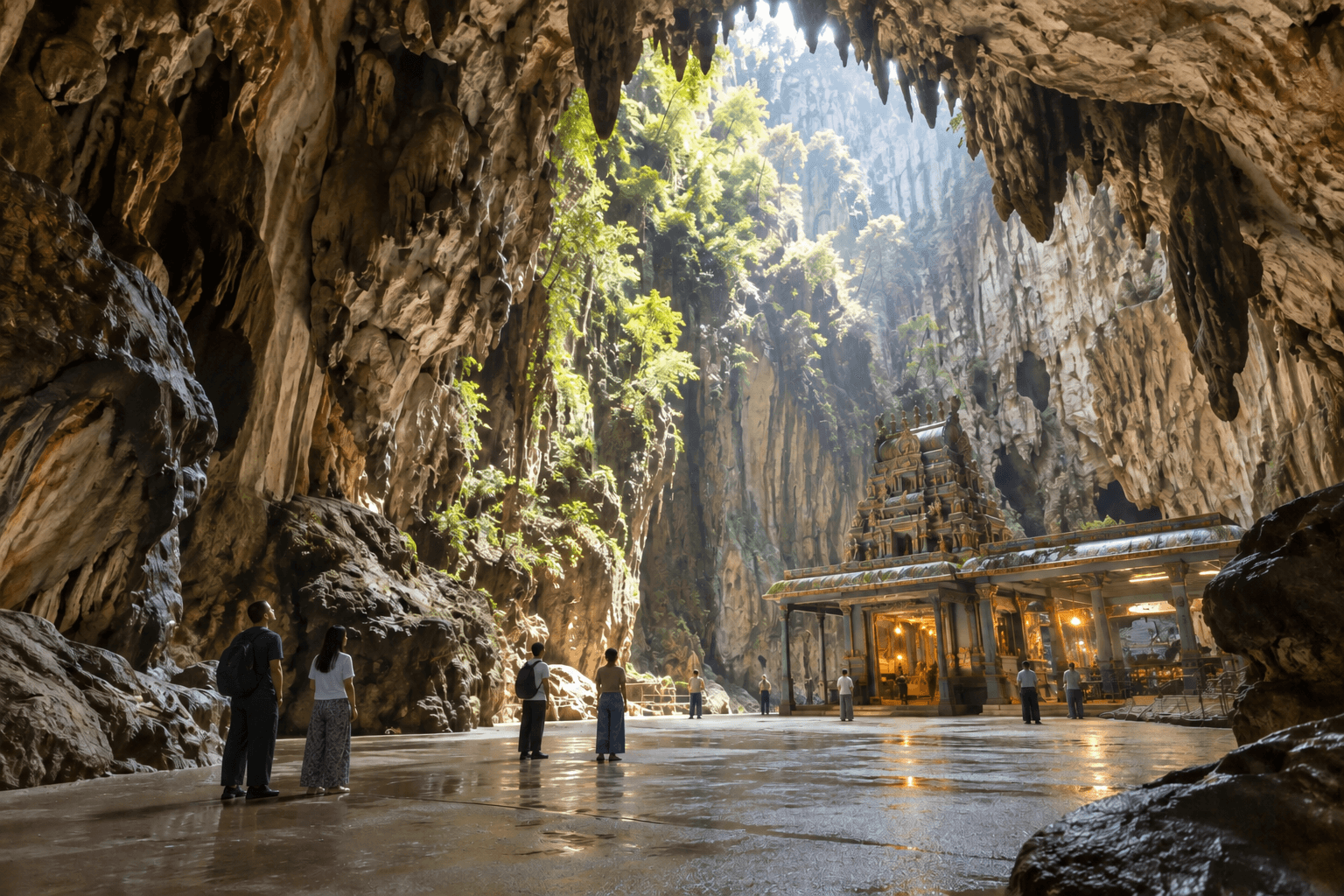
The shift from colourful stairs to a large limestone chamber is the point to slow down. Look up at the rock and daylight, but also look around at how people are using the space. Sacred areas are not simply more convenient backdrops.
Follow signs and attendants around shrines. Do not step into restricted areas, touch offerings or move objects for a photograph. Ask before photographing people at close range, especially worshippers, and respect any no-photography instruction.
Allow other people to pass without having to squeeze around your group. Keep voices low near prayers, and explain the same expectations to children before entering. Quiet observation is an experience in its own right; you do not need to turn every moment into a video.
Expect the walking surface to require attention, and watch where you place your feet. Keep enough water and energy for the return. Getting to the cave entrance is a milestone, not the end of the physical part of the day.
Monkeys, rain and access needs: change the plan when necessary
Monkeys are part of the environment, not props. Keep food out of sight, bags closed and a comfortable distance. Do not feed, touch, tease or pose closely with them. A cute expression does not make a wild animal your travel companion.
Avoid eating on the staircase and secure anything easy to grab. If an animal approaches, give it space rather than moving closer for a photograph. Ask staff for help if the situation prevents you from passing safely. Do not try to retrieve an item by chasing or confronting an animal.
In rain, assess the steps and visibility before climbing. A light shower is not the same situation as heavy rain or thunder. Wait somewhere suitable or shorten the visit when conditions make the route uncomfortable. Do not shelter somewhere that blocks an entrance or worship area.
With limited mobility, plan for the fact that the main cave approach involves a substantial staircase. Do not depend on proposed lift or escalator projects being open without direct current confirmation. A headline about a planned accessibility improvement is not an operational access route.
A ground-level visit can be a deliberate choice rather than a failed climb. Confirm suitable arrival, walking and toilet arrangements if these are important to you, and choose transport that supports the whole group. A stroller also needs a plan; do not assume it solves access to the upper cave.
Thaipusam deserves separate planning. A major pilgrimage is not an ordinary sightseeing day with slightly more traffic. Check the actual festival date, temple arrangements and special transport notices for the year of your visit. Past round-the-clock train announcements should not be reused as a normal service schedule.
Finish the visit with a realistic route back
After descending, stop for water and decide on the return before everyone becomes tired and hungry. If you are taking the train, check the next departure and allow time for walking to the station. If you are taking a car, agree on a safe pickup point and keep the booking phone available.
Choose food after checking the menu, price and accepted payment methods. Carrying a small cash backup is useful; do not assume every purchase can be made with the same contactless card used elsewhere in the city. Follow local rules around where food and drinks belong.
For your wider city base, read our Kuala Lumpur neighbourhood and hotel-location guide. Stay somewhere that supports the rest of your trip, rather than choosing an inconvenient hotel solely to be closer to this one outing.
Once you have chosen a neighbourhood, you can check Kuala Lumpur stays on Agoda or compare Kuala Lumpur hotels on Trip.com. Compare the same dates, room type, final total and cancellation deadline; neither link promises the lowest price.
If this is your arrival day, sort the transfer first using our KLIA-to-Kuala Lumpur transport guide. Leave luggage at your accommodation if permitted and assess your energy before adding a staircase visit. Batu Caves is easier to enjoy when you are not also carrying the airport journey on your shoulders.
The best plan is usually modest: suitable clothes, a transport option that fits your hotel, enough time to climb comfortably and a clear way back. Pay for a tour when its convenience and itinerary are useful—not because a free temple visit has been made to sound complicated.