
A Jiufen and Shifen day trip from Taipei works best when you decide what the day is for. If it is a waterfall, a small railway town and a slow tea break above the coast, two stops are enough. If it becomes six attractions, three transfers and an argument with the last bus, the itinerary has started managing you.
For an independent trip, our default is Shifen first, Jiufen later. Shifen Waterfall has a firm entry cutoff; Jiufen is better suited to a flexible late afternoon. A tour can make the connections easier, but only if its actual route gives you time at the places you care about.
Information checked October 4, 2026. Times in the sample itinerary are planning targets, not published train departures. Transport fares, tour prices and service arrangements must be checked for your travel date. Affiliate disclosure: Asia Travel Lab may receive a commission when you book through selected links, at no additional cost to you.
Choose the kind of day before choosing the ticket
| Your priority | Best starting plan | The trade-off |
|---|---|---|
| Tea, snacks and hillside lanes | Jiufen only, using a direct bus or train plus bus | You skip the waterfall and railway town |
| Both towns with control over stops | Shifen first, return through Ruifang, then Jiufen | Several connections and waiting periods |
| Both towns without arranging transfers | A tour whose selected package includes both | Fixed meeting times and shorter independent visits |
| Young children or a group needing assistance | A suitably arranged private vehicle | Higher quote; walking and stairs still remain |
| A late start or unsettled weather | One destination, with a clear return plan | Less coverage, more margin |
A driver removes transport changes. A driver does not remove Jiufen’s stairs. Keep those two promises separate when comparing packages.
The route in one line—and why Ruifang matters
Taipei → Ruifang → Shifen → Ruifang → Jiufen → Taipei.
For the standard rail-based approach, travel on Taiwan Railways to Ruifang and change for the Pingxi Line toward Shifen. After your Shifen visit, return to Ruifang and continue uphill to Jiufen by bus or an arranged taxi. Jiufen has no train station beside its Old Street.
The official Taiwan tourism guide identifies the Pingxi railway connection and Shifen’s location on the line. Use the Shifen tourism page for destination context and Taiwan Railways for current trains and fares. Do not treat an old tourism brochure’s departure table as today’s timetable.
Check four journeys before leaving: Taipei to Ruifang, Ruifang to Shifen, Shifen back to Ruifang, and the final return from Jiufen. The afternoon return from Shifen deserves particular attention. Missing it can shrink the Jiufen visit much more than a slow snack order.
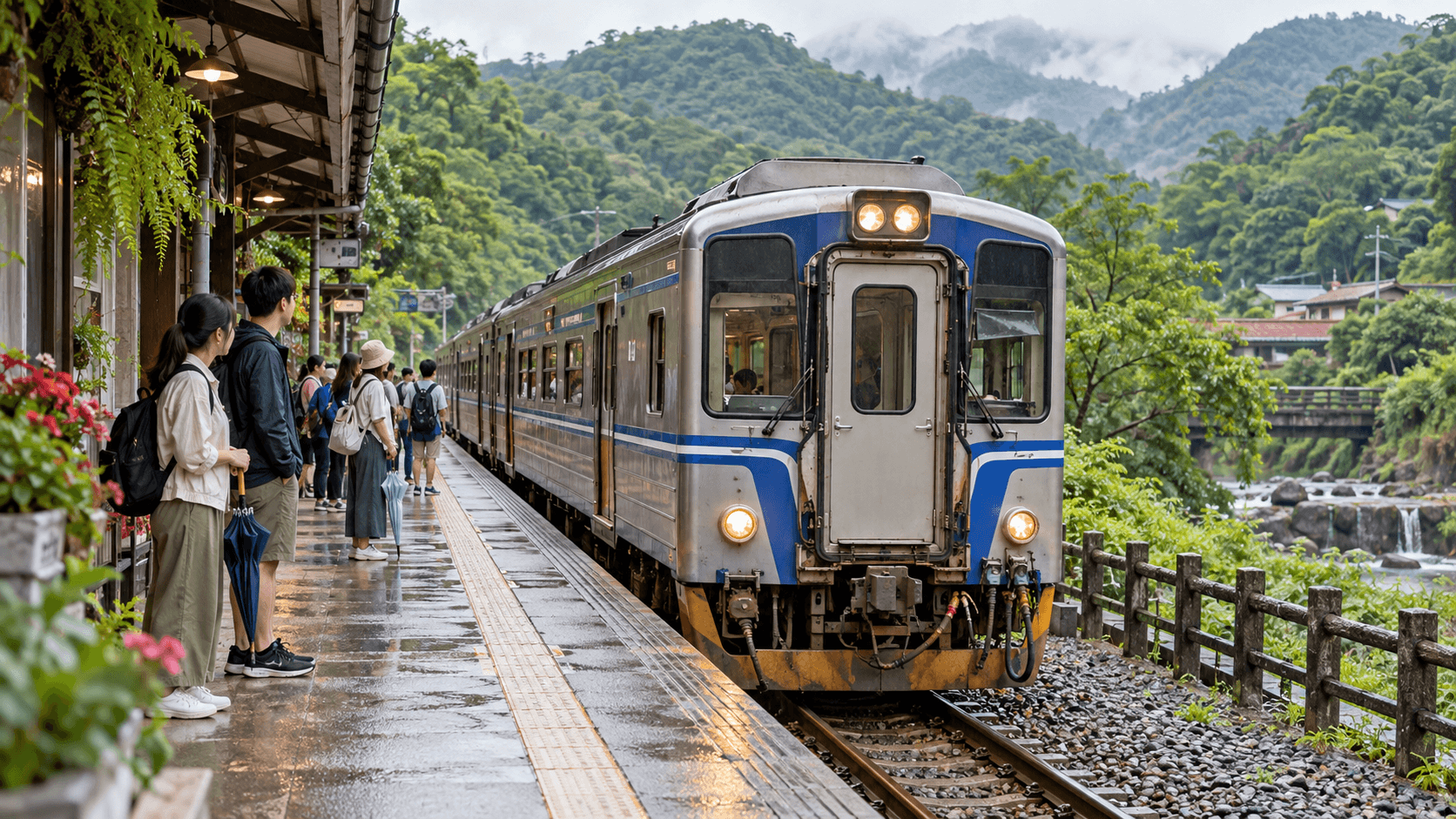
At each station, use the live board and staff instructions to identify the train and platform. Taiwan Railways, Taipei Metro and the airport MRT are different systems. “Go to Taipei Main Station” is a starting location, not a complete set of directions.
A realistic Shifen-first itinerary
Allow most of the day. The following is a flexible planning framework for an early departure, manageable walking pace and ordinary operations. Change it to fit the connections available on your date.
- Morning: leave Taipei, connect through Ruifang and reach Shifen with enough time for the waterfall walk and a short Old Street visit.
- Late morning to early afternoon: visit the waterfall, eat something simple and return for the train you identified earlier.
- Early to mid-afternoon: travel back through Ruifang and continue to Jiufen. Treat the transfer as part of the itinerary, not invisible travel time.
- Late afternoon: walk Jiufen’s lanes, choose a snack and take a seated tea break if that matters to you.
- Early evening: return using a service you have already checked, with a fallback if the first bus is full.
This leaves space for the things a timetable cannot predict: a toilet queue, a child needing a break, a crowded bus, a rain shower and the wrong staircase. None is an unusual travel failure. They are reasons to avoid designing a day that requires everything to happen perfectly.
If you are not ready to depart until late morning, shorten the plan. Go directly to Jiufen or prioritize Shifen alone. Arriving exhausted at a closed waterfall is not a particularly useful form of efficiency.
Shifen: protect the waterfall time first
The current New Taipei City attraction page lists October–May hours of 9am–5pm, with final entry at 4:30pm. June–September hours are 9am–6pm, with final entry at 5:30pm. Check the official Shifen Waterfall listing again before your trip, especially after severe weather.
Final entry is the time you must reach the entrance, not the time you should start walking from the railway station. Give yourself room for the approach, the viewing areas and the walk back. Our suggested allowance is around two to three hours for Shifen with the waterfall, food and a modest Old Street visit; that is an editorial estimate, not a mandatory visit length.
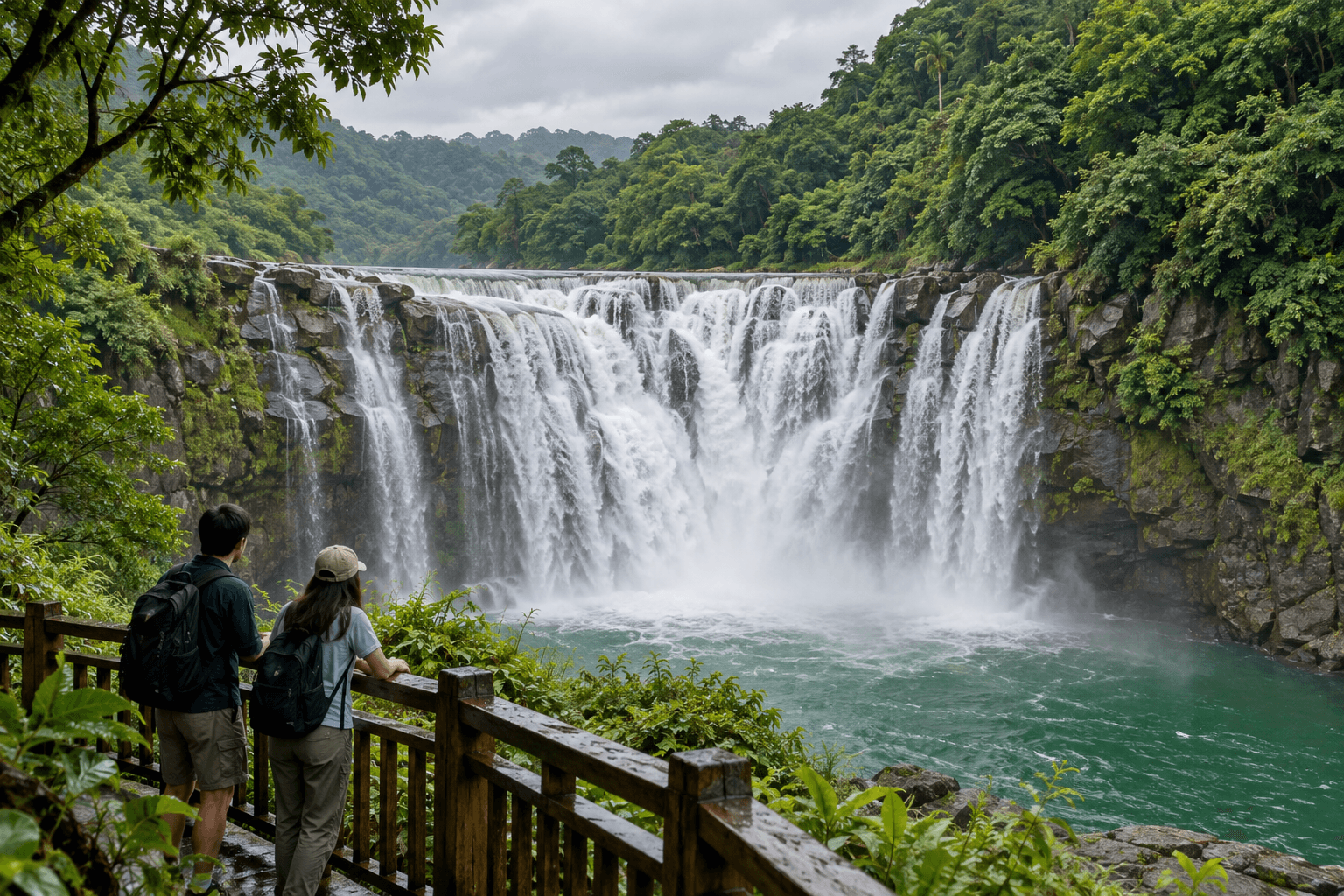
Decide the order locally. If a later arrival makes the entry cutoff relevant, walk to the waterfall first. If you have a comfortable morning margin, a short food stop can come before it. Keep checking that your return connection remains achievable.
Wear shoes with grip and carry water. Spray and rain make smooth surfaces slippery, and the approach deserves more respect than a pair of new city sandals might suggest. Keep your phone or camera dry without turning every photo stop into an equipment rescue.
Accessibility requires route-specific checking. New Taipei’s tourism department describes an approach from the visitor center that avoids stairs, but that does not prove every viewing area or the complete station-to-waterfall journey suits every mobility need. Ask about the current accessible entrance and surface conditions. The official access description is a useful starting point, not a substitute for confirming individual requirements.
The railway street is still a railway
The Old Street’s railway setting is part of its character, but rails are not a general-purpose photo studio. Stay in permitted pedestrian areas, obey staff and warning signals, and keep children close. Keep off the tracks whenever access is restricted or a train is approaching.
A lantern release is optional, not the price of admission to enjoying Shifen. If you choose one, use a legitimate operator, confirm the complete price before writing on the lantern and follow current local instructions. Do not attempt a release independently from railway tracks or in unsafe weather.
There is also an environmental trade-off: released materials do not disappear when they leave your photograph. Walking, eating, photographing the station from a safe position or buying a souvenir are equally valid ways to spend the visit. You can enjoy the town without releasing a lantern.
Ruifang to Jiufen: the connection that needs attention
Return toward Ruifang instead of assuming the two attractions connect like neighboring metro stops. Once there, follow current signs to the appropriate Jiufen-bound bus stop or use a prearranged taxi. Do not promise yourself an instant connection just because both journeys appear on the same map.
The official New Taipei transport guide identifies route 788 as one option through Jiufen. Check the actual destination and stop sequence before boarding; route variants and direction matter. Use the official 788 route information rather than accepting any bus with a familiar number.
Save “Jiufen Old Street / 九份老街” on your phone and confirm the stop with the driver if uncertain. For a taxi, agree on the destination and fare basis first. A cash quote for one journey is not necessarily the price of waiting, additional stops or a return ride.
Keep the bag small. A daypack lets you board, stand and move through lanes more easily than a suitcase. Leave larger luggage at your accommodation or use a storage service whose availability and collection deadline you have checked.
Jiufen: walk, snack, then sit down
Jiufen’s appeal is its hillside streets, food stops, teahouses and mountain-to-coast setting. The official city guide describes its former gold-mining background and association with A City of Sadness. Read the Jiufen Old Street guide for the destination’s own story rather than treating a film rumor as its identity.
Allow around two to three hours as a planning estimate, longer if you want a relaxed meal or tea session. Start with the main lane, then choose a manageable staircase or side lane. You do not need to photograph every lantern cluster to understand why the town is enjoyable.
Stairs, narrow passages and people stopping abruptly make the route slower than its map distance suggests. Keep a group meeting point that everyone can find independently. “Somewhere by the red lanterns” is, unfortunately, a fairly broad instruction.
Choose food in small rounds. Taro-ball desserts are one of the snacks highlighted by the official tourism guide; try one portion before committing the whole group to the same bowl. For any vendor, ask about ingredients if you have dietary restrictions. A photograph of a dish is not an allergen declaration.
For tea, check the menu, minimum order and any per-person service conditions before sitting. If the view is the reason you are paying more, confirm that the available table actually has it. A famous building’s exterior and a particular table’s experience are different purchases.
Use the tea stop as your recovery interval. Check the return route while seated, recharge the phone if possible and agree on a departure target. This is more pleasant than doing the same administration in a crowded bus queue with a wet sleeve.
Evening atmosphere does not mean every shop stays open
Jiufen has no single closing bell for all businesses. Tourism listings give general visiting hours, but individual restaurants, stalls and teahouses make their own decisions. Confirm any must-visit venue separately.
Later light can be atmospheric, but it is not a guarantee of clear coastal views or empty stairs. On a busy day, arriving earlier and taking a break may work better than joining every visitor aiming for exactly the same photograph.
What changes if you only want Jiufen?
You can simplify the day considerably. Route 965 links Taipei-area stops including Ximen and Beimen with Jiufen and Jinguashi; New Taipei City’s tourism department also identifies its Ruifang connection. Consult the official route overview and the bus operator’s current route page for the actual stop and direction.
A direct bus removes a rail transfer, not road traffic. Locate the exact boarding stop rather than guessing that every exit of the named MRT station leads to it. Save the return stop too, since it may be on the other side of the road or require a different approach.
For staying in Taipei, our Taipei hotel-area comparison explains the differences between Taipei Main Station, Ximending and other bases. If you are choosing accommodation around the day trip, compare Taipei hotel locations on Agoda. Inspect the walk to the departure point, not just a neighborhood label.
You can also check Taipei hotel options on Trip.com. Compare identical dates, room types and cancellation terms. Neither booking link implies a guaranteed lowest price.
When a tour makes more sense
A tour is useful if arranging connections is the part you least want to do. It can also help when you want multiple destinations, but inspect the selected package rather than its headline. A product may offer several routes with different stops, start times and lengths.
The current Klook listing includes several combinations involving Jiufen, Shifen and, on selected routes, Yehliu or Golden Waterfall. You can compare Jiufen and Shifen tour packages on Klook. Check the exact route, language, pickup or meeting point, return location and cancellation policy before paying.
Do not assume a “Shifen” stop includes enough time for the waterfall, or that “Jiufen” means an evening visit. Look for those details in the selected itinerary. Ask the operator if anything important remains unclear.
For a family or private group, confirm child seats if needed, luggage capacity and walking expectations. For any package, identify which activities, meals and admission charges are excluded. A low headline price can still be reasonable, but only if you know what you are comparing.
If your booking fails or remains unconfirmed, do not build the whole next day around it. Contact the platform or operator, keep the booking reference and avoid buying a duplicate until you understand whether the first transaction succeeded.
Rain, missed connections and the return to Taipei
Light rain calls for grippy shoes, a waterproof layer and fewer ambitious detours. Heavy rain, storm warnings or transport disruption may call for moving the trip to another day. A paid reservation does not make a closed path usable.
At the time of checking, Taiwan Railways’ status page listed the Pingxi Line as operating normally. That is a snapshot, not a forecast. Recheck railway service status before leaving and follow any local closure or replacement-transport instructions.
If you miss a connection, reduce the remaining plan before paying for an improvised rescue. Drop an optional tea stop, leave Jiufen earlier or choose one destination. Do not keep adding transport expense to preserve a timetable that no longer exists.
For the return, check both the last useful bus and any connecting train or metro. Boarding a bus to Ruifang does not by itself guarantee an onward train at the hour you arrive. Keep enough phone battery to change the plan and a practical payment backup.
Do not schedule the day trip immediately before a tightly timed flight. Our Taoyuan Airport and Taipei transfer guide covers the separate airport journey. The better ending here is a straightforward return, dinner near your hotel and shoes that have finished their shift—not a sprint through another station.