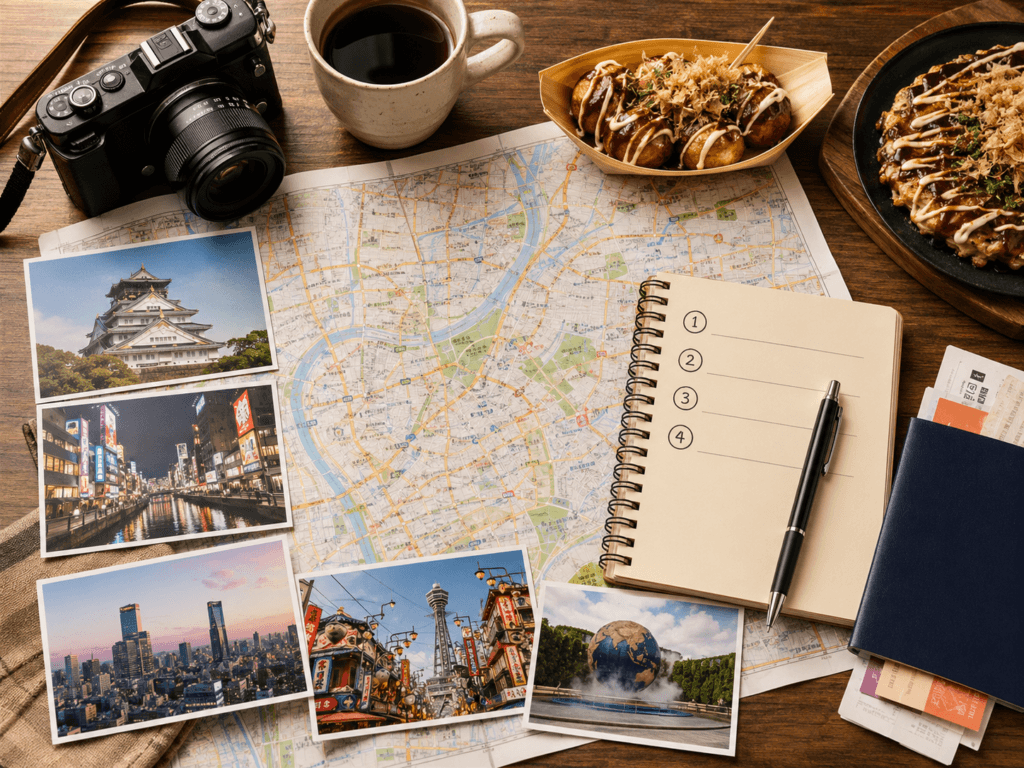
Planning an Osaka itinerary looks easy at first.
The city feels friendly.
The trains work well.
Food is everywhere.
Dotonbori glows at night like it has been personally assigned to feed you.
Then you add Osaka Castle, Umeda, Namba, Dotonbori, Kuromon Market, Shinsekai, Tsutenkaku, Universal Studios Japan, Nara, Kobe and maybe Kyoto because “it looks close.”
Suddenly your relaxed food trip is wearing running shoes.
Osaka is not hard to enjoy. It is hard to pace.
That is the key. Osaka can be a food city, a nightlife city, a base for Kansai day trips, a Universal Studios Japan trip, a shopping stop, or the easiest final city before flying out of Kansai International Airport. It can be all of those things, but not all at the same time without your itinerary starting to sweat soy sauce.
For most first-time visitors, the best Osaka itinerary is built around these areas:
Osaka Castle → Umeda → Namba → Dotonbori → Shinsekai
With 2 days in Osaka, focus on Osaka Castle, Umeda, Namba, Dotonbori, Kuromon Market and Shinsekai.
With 3 days in Osaka, add Universal Studios Japan or a day trip to Nara, Kobe or Himeji.
With 4 days in Osaka, give USJ its own full day and use the extra time for a slower food day or a Kansai day trip.
If Osaka is part of a longer Japan trip, start with our Japan itinerary 2026 guide before deciding how many nights to stay. If you are coming from Kyoto, read our Kyoto itinerary 2026 guide first so you can avoid building two back-to-back temple-and-food marathons. If you are starting in Tokyo, our Tokyo itinerary 2026 guide can help you balance city time before heading west.
Quick Answer: Best Osaka Itinerary
For most first-time visitors, the best Osaka itinerary is:
- Day 1: Osaka Castle, Umeda and Dotonbori
- Day 2: Namba, Kuromon Market, Shinsekai and Tsutenkaku
- Day 3: Universal Studios Japan or a day trip
- Day 4: Nara, Kobe, Himeji or a slow Osaka food day
Here is the simple version:
| Trip Length | Best Route | Best For |
|---|---|---|
| 2 days | Osaka Castle + Umeda + Namba + Dotonbori + Shinsekai | First-time highlights |
| 3 days | Add Universal Studios Japan or a day trip | Best first Osaka trip |
| 4 days | Add USJ and a Kansai day trip or slow food day | More relaxed Osaka |
| 1 day | Namba + Dotonbori + one extra area | Very short visit |
| 5 days or more | Osaka plus Kyoto, Nara, Kobe, Himeji and deeper food neighborhoods | Kansai base travel |
The sweet spot is 3 days. Two days works if you keep it focused. Four days is better if Universal Studios Japan is important, because USJ deserves a full day, not a squeezed half-day after sightseeing.
Is Osaka Good for First-Time Visitors?
Yes, Osaka is one of the best cities in Japan for first-time visitors, especially if you like food, nightlife, casual energy and easy transport.
Osaka is especially good for travelers who want:
- Street food
- Nightlife
- Shopping
- Easy trains
- Universal Studios Japan
- Day trips
- A more casual city mood than Tokyo
- Good airport access
- A strong base for Kansai
- Food-focused travel
- A lively final stop before flying home
Osaka feels less formal than Tokyo and less delicate than Kyoto. It is louder, hungrier and easier to relax in. This does not mean it is simple. It just means the city smiles while giving you too many food options.
For first-time visitors, Osaka works best as either:
- A 2-day city stop after Kyoto
- A 3-day base with USJ or a day trip
- A 4-day Kansai base with day trips and slower food time
Osaka is also a good place to end a Japan trip because Kansai International Airport is convenient, especially if you stay around Namba or Umeda.
The danger is underestimating it. Many travelers treat Osaka as “just one night for Dotonbori,” then realize the city had more layers hiding behind the takoyaki steam.
How Many Days Do You Need in Osaka?
You need at least 2 days in Osaka for a basic first visit.
A realistic guide:
- 1 day: Namba, Dotonbori and one nearby area
- 2 days: Best minimum for first-time highlights
- 3 days: Best first Osaka itinerary
- 4 days: Better if adding USJ and a day trip
- 5 days or more: Good for using Osaka as a Kansai base
If you only have one night, stay around Namba and focus on Dotonbori, Hozenji Yokocho and a food-heavy evening. Do not try to add Osaka Castle, Umeda, Shinsekai and USJ into one day unless your itinerary is powered by caffeine and poor judgment.
With 2 days, you can see the classic Osaka highlights.
With 3 days, you can add Universal Studios Japan or a day trip.
With 4 days, Osaka becomes much easier. You can give USJ its own day and still have time for Nara, Kobe, Himeji or a slower local food route.
Osaka rewards appetite, but it also rewards pacing.
Where to Stay in Osaka
Where you stay in Osaka matters because the city has several useful bases.
For most first-time visitors, these areas are easiest:
Namba
Namba is the best area for many first-time visitors.
It is good for:
- Dotonbori
- Food
- Nightlife
- Shopping
- Kuromon Market
- Hozenji Yokocho
- Airport access via Nankai trains
- Easy evening plans
Stay in Namba if you want the classic Osaka experience close to your hotel.
Namba is especially convenient if you are arriving from Kansai International Airport using Nankai railway. It also means your late-night food plans do not require a long train ride home.
This is the area for travelers who want Osaka to feel loud, bright and snack-adjacent.
Umeda
Umeda is practical, polished and transport-friendly.
It is good for:
- Osaka Station
- JR connections
- Shopping malls
- Umeda Sky Building
- Restaurants
- Day trips
- Kyoto and Kobe access
- A slightly cleaner business-city feel
Stay in Umeda if you want transport convenience and a more organized base.
Umeda is less food-chaotic than Namba, but it is very useful. It works well if your Osaka itinerary includes day trips, airport transfers through JR routes or a more comfortable hotel base.
Shinsekai / Tennoji
Shinsekai and Tennoji can be good for travelers who want a retro Osaka atmosphere and possibly better-value hotels.
They are good for:
- Tsutenkaku
- Kushikatsu
- Retro streets
- Tennoji Park
- Abeno Harukas
- Shin-Imamiya connections
- More local-feeling evenings
Stay here if you are comfortable with a slightly older and more casual atmosphere.
This area has character, but first-time visitors who want the easiest stay may prefer Namba or Umeda.
Osaka Bay / Universal City
Stay around Universal City if Universal Studios Japan is the main reason for your Osaka trip.
It is good for:
- USJ
- Families
- Early park starts
- Theme park-focused trips
It is less convenient for general Osaka sightseeing, so it works best if you plan a USJ-heavy stay.
Simple Recommendation
For most first-time visitors:
- Choose Namba for food, nightlife and first-time Osaka energy
- Choose Umeda for transport, shopping and day trips
- Choose Shinsekai / Tennoji for retro food atmosphere and value
- Choose Universal City if USJ is the main priority
The best Osaka base is not always the cheapest hotel. It is the place that lets your evenings end smoothly instead of turning every dinner into a train transfer.
2-Day Osaka Itinerary
A 2-day Osaka itinerary should focus on the city’s strongest first-time areas.
The best route is:
- Day 1: Osaka Castle, Umeda and Dotonbori
- Day 2: Namba, Kuromon Market, Shinsekai and Tsutenkaku
With only 2 days in Osaka, do not try to include every district, every food street and Universal Studios Japan unless you want your itinerary to start sweating soy sauce.
If USJ is a must, replace Day 2 with a full USJ day and accept that you will see less of Osaka itself.
Day 1: Osaka Castle, Umeda and Dotonbori
Day 1 gives you Osaka’s history, skyline and night food energy.
Morning: Osaka Castle
Start at Osaka Castle.
Osaka Castle is one of the city’s most famous landmarks and a good opening stop for first-time visitors. The castle park is spacious, and the main tower gives the day some history before the city becomes food, neon and shopping.
Things to do around Osaka Castle:
- Osaka Castle Park
- Osaka Castle Museum
- Castle tower exterior
- Observation level inside the museum
- Toyotomi Stone Wall Museum, if included with your visit
- Seasonal park walks, especially during cherry blossom season
Osaka Castle is more than a quick photo stop. If you enter the museum, allow time for the exhibits, the observation level and the nearby Toyotomi Stone Wall Museum.
The castle looks simple on an itinerary, then quietly asks for more time.
If you do not want to enter the museum, the park and exterior views can still be worthwhile. This is a good option if you are trying to save money or keep the morning lighter.
Afternoon: Umeda
After Osaka Castle, head to Umeda.
Umeda is Osaka’s polished transport and shopping district. It is a good contrast to the castle and works well before heading south to Dotonbori at night.
Things to do in Umeda:
- Umeda Sky Building
- Grand Front Osaka
- Osaka Station City
- Department stores
- Underground shopping streets
- Cafes and restaurants
Umeda Sky Building is one of the best Osaka skyline stops, especially around sunset or after dark. If you use an Osaka e-Pass, check the time rules carefully, because free admission is listed only until 3:00 p.m. Other passes may have different rules, so always check the current pass details before you go.
Umeda can feel more businesslike than Namba, but that is part of the balance. Osaka is not only neon canals and takoyaki trays. It also has sleek towers, stations and shopping complexes that enjoy making exits confusing.
Evening: Dotonbori
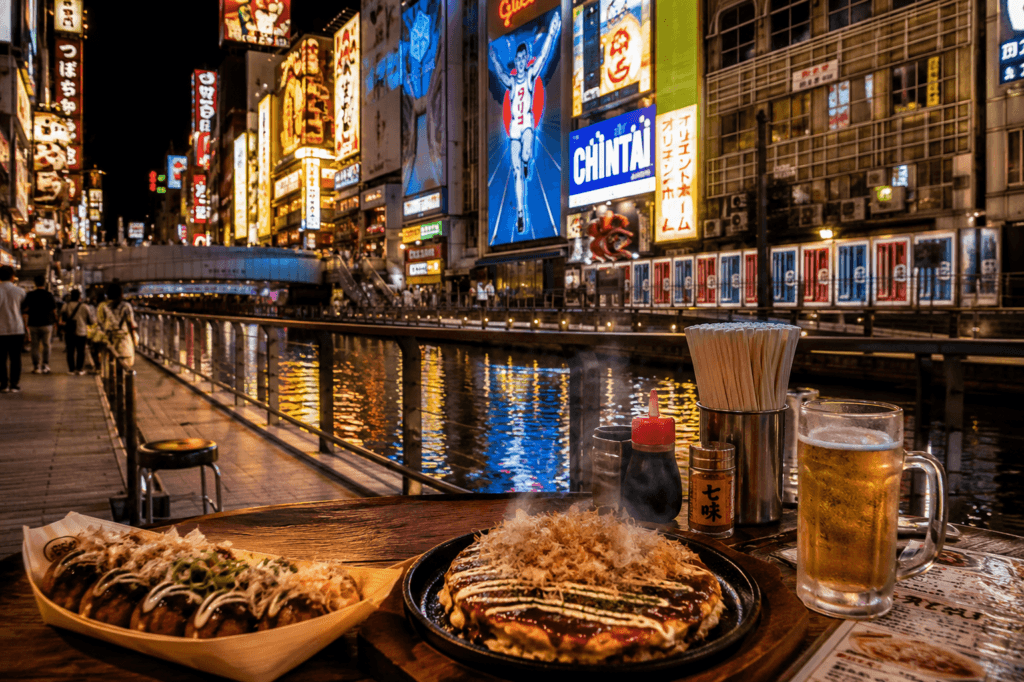
Finish Day 1 in Dotonbori.
Dotonbori works best at night. Come for the neon, canal views, takoyaki, okonomiyaki and Osaka’s loud, hungry evening energy.
Things to do in Dotonbori:
- Walk along the canal
- Try takoyaki
- Eat okonomiyaki
- Explore nearby Namba streets
- Visit Hozenji Yokocho
- Take photos around the main signs and bridges
- Enjoy the evening food atmosphere
Dotonbori is not the calmest place in Japan, but calm is not really what Dotonbori came here to sell.
This is the best first-night Osaka area because it gives you the city’s personality immediately. It is bright, busy, food-focused and slightly dramatic in the best way.
Day 2: Namba, Kuromon Market, Shinsekai and Tsutenkaku
Day 2 is a food and retro Osaka day.
This route stays mostly in southern Osaka, which makes the day easier to manage.
Morning: Kuromon Market and Namba
Start around Kuromon Market and Namba.
Kuromon Market is known for seafood, snacks, fruit, grilled foods and casual browsing. It can be touristy, but it is still a useful food stop if you go with realistic expectations.
Tips for Kuromon Market:
- Go earlier to avoid heavier crowds
- Bring some cash
- Eat where allowed
- Do not block narrow paths
- Treat it as a snack stop, not a full day
- Check prices before ordering seafood
After Kuromon, explore Namba.
Good Namba areas include:
- Namba Parks
- Hozenji Yokocho
- Dotonbori side streets
- Shinsaibashi, if you want shopping
- Den Den Town, if you like anime, gaming or electronics
Namba is the part of Osaka where your itinerary and your appetite start making separate plans.
Afternoon: Shinsekai and Tsutenkaku
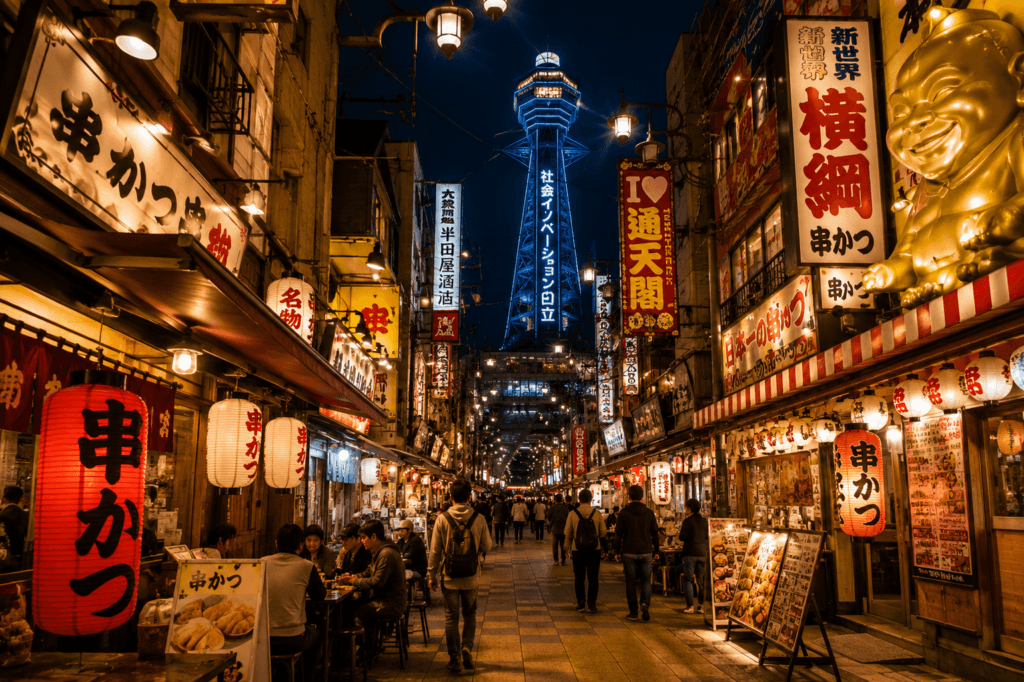
Head to Shinsekai in the afternoon.
Shinsekai and Tsutenkaku give Osaka a different flavor from Dotonbori: more retro, more local-feeling and very food-focused.
Things to do in Shinsekai:
- Tsutenkaku Tower
- Kushikatsu restaurants
- Retro shopping streets
- Janjan Yokocho
- Tennoji Park nearby
- Spa World area, if it fits your plans
If you visit Tsutenkaku, check the current entry process before you go. Some pass users may need to exchange their ticket for a timed reservation ticket at the Ticket Center after arriving.
Shinsekai can feel a little rougher around the edges than Umeda or Ginza-style Japan. That is part of its personality. It is colorful, retro and a good place to eat kushikatsu.
Do not dip twice if a restaurant has shared sauce rules. Osaka may be relaxed, but fried skewers still have laws.
Evening: Namba or Dotonbori Again
For your second night, return to Namba or Dotonbori if you want one more food night.
Another option is to stay around Shinsekai or Tennoji for a more local-feeling evening.
Good second-night ideas:
- Okonomiyaki dinner
- Kushikatsu in Shinsekai
- Ramen near Namba
- Hozenji Yokocho walk
- Shinsaibashi shopping
- Umeda night view if you skipped it on Day 1
Two days in Osaka is enough for a strong first taste. It will not show you everything, but it will show you the city’s rhythm: history in the morning, food by noon and neon after dark.
3-Day Osaka Itinerary
A 3-day Osaka itinerary is the best first-time route for most travelers.
The best route is:
- Day 1: Osaka Castle, Umeda and Dotonbori
- Day 2: Namba, Kuromon Market, Shinsekai and Tsutenkaku
- Day 3: Universal Studios Japan or a day trip
This gives Osaka enough space and lets you choose one major extra.
Day 1: Osaka Castle, Umeda and Dotonbori
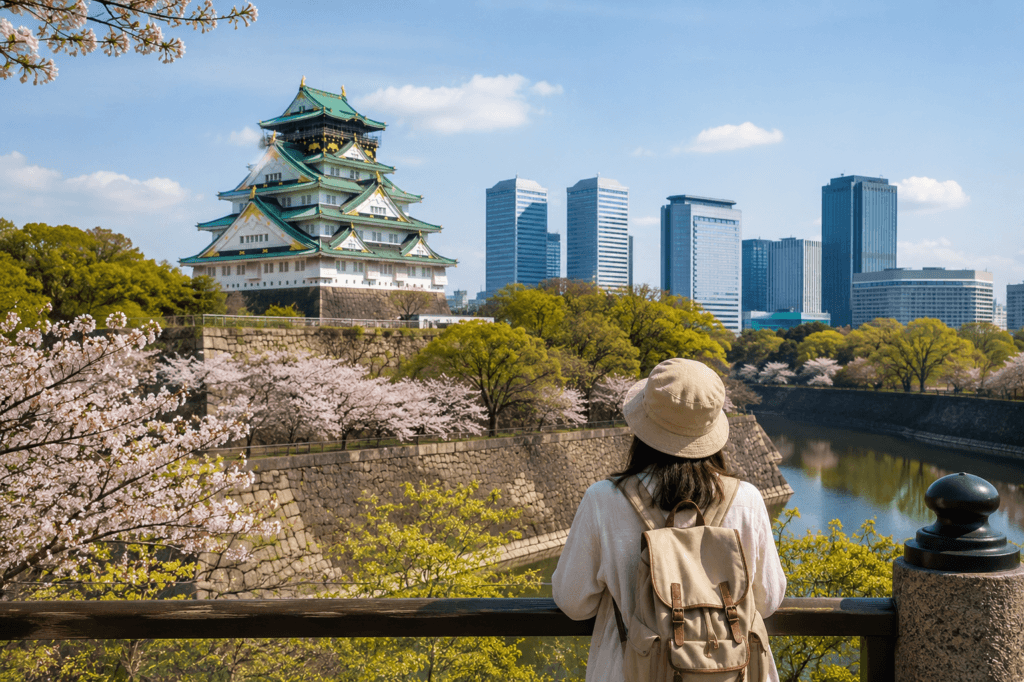
Use Day 1 for the classic Osaka route.
Suggested plan:
- Morning: Osaka Castle
- Afternoon: Umeda
- Evening: Dotonbori
This day works because each area feels different. Osaka Castle gives history, Umeda gives skyline and shopping, and Dotonbori gives the food-nightlife energy most travelers came to meet.
Start the day with structure. End it with sauce.
Day 2: Namba, Kuromon Market, Shinsekai and Tsutenkaku
Use Day 2 for southern Osaka.
Suggested plan:
- Morning: Kuromon Market and Namba
- Afternoon: Shinsekai and Tsutenkaku
- Evening: Namba, Dotonbori or Hozenji Yokocho
This day is more food-focused and casual. It is also a good day to use an attraction or transport pass if your planned stops match the pass coverage.
Do not buy a pass first and then build your day around it. That is how a rectangle of plastic becomes the boss of your vacation.
Day 3 Option A: Universal Studios Japan
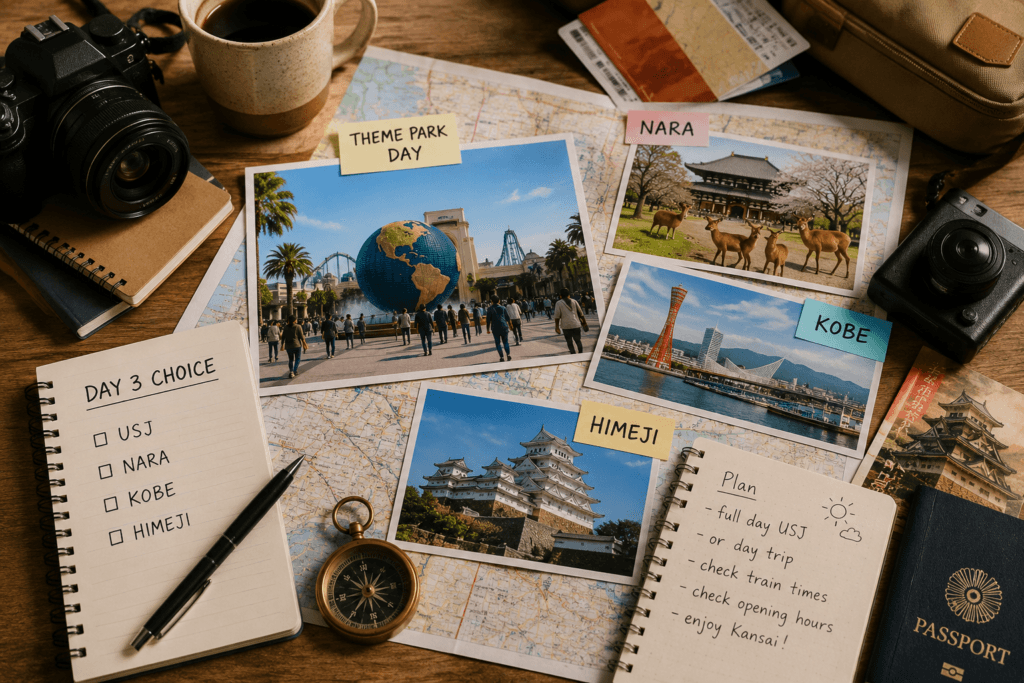
Universal Studios Japan deserves a full day, especially if Super Nintendo World is a priority.
From January 5, 2026, guests need to use the official app for Area Timed Entry Tickets and Standby Entry Tickets for Super Nintendo World. Do not treat USJ as a casual half-day add-on after Dotonbori.
Universal Studios Japan is also celebrating its 25th anniversary period from March 4, 2026 to March 30, 2027, so check the official event calendar before choosing your date.
Good USJ tips:
- Buy tickets early
- Download the official app
- Register your tickets if needed
- Check Area Timed Entry Ticket rules
- Arrive early
- Keep the evening flexible
- Do not schedule a heavy morning before USJ
- Check ride closures and park hours before your visit
USJ is fun, but it is also a full-body activity. Your feet will know the difference between “theme park day” and “just a few rides.”
If USJ matters to you, give it the day it deserves.
Day 3 Option B: Nara Day Trip
Choose Nara if you want temples, deer, parks and historic atmosphere.
Nara is one of the easiest day trips from Osaka and works well if you are not doing it from Kyoto.
Good Nara stops include:
- Todai-ji Temple
- Nara Park
- Kasuga Taisha
- Kofuku-ji area
- Higashimuki shopping street
Nara is calmer than Osaka, but the deer are not background decoration. They are charming animals with snack-related ambitions.
Day 3 Option C: Kobe Day Trip
Choose Kobe if you want a stylish waterfront day, food, city views and a different Kansai mood.
Good Kobe stops include:
- Kobe Harborland
- Kitano area
- Chinatown
- Kobe Port Tower area
- Mount Rokko or night views, if timing works
- Kobe beef, if it fits your budget
Kobe is easy from Osaka and feels more polished and relaxed.
Day 3 Option D: Himeji Day Trip
Choose Himeji if you want one of Japan’s most impressive castles.
Himeji Castle is a stronger castle experience than Osaka Castle if your main interest is historic architecture and original structures.
It requires more travel time, but it is worth considering if castles are a priority.
Which Day 3 Option Is Best?
Choose USJ if theme parks are a priority.
Choose Nara if you want temples and an easy classic day trip.
Choose Kobe if you want food, harbor views and a stylish city day.
Choose Himeji if you want a serious castle day.
For most first-time visitors, USJ or Nara will be the easiest choices.
4-Day Osaka Itinerary
A 4-day Osaka itinerary lets the city breathe.
The best route is:
- Day 1: Osaka Castle, Umeda and Dotonbori
- Day 2: Namba, Kuromon Market, Shinsekai and Tsutenkaku
- Day 3: Universal Studios Japan
- Day 4: Nara, Kobe, Himeji or a slow Osaka food day
This is the best option if you want USJ and still want to enjoy Osaka itself.
Day 1: Osaka Castle and Umeda
Use Day 1 for history and skyline.
Start with Osaka Castle, then continue to Umeda for shopping, cafes and views.
If you arrive in Osaka in the afternoon, flip the schedule and do Umeda or Dotonbori first, then save Osaka Castle for the next morning.
Osaka itineraries are flexible, but not infinite. Keep the first day realistic, especially if you are arriving from Kyoto, Tokyo or Kansai Airport.
Day 2: Namba, Dotonbori and Shinsekai
Use Day 2 for Osaka’s food-heavy core.
Suggested route:
- Kuromon Market
- Namba
- Hozenji Yokocho
- Shinsekai
- Tsutenkaku
- Dotonbori at night
This day is classic Osaka: snacks, shopping, old streets, retro towers and enough food decisions to make lunch feel like a committee meeting.
Day 3: Universal Studios Japan
Give USJ its own day.
This is especially important if Super Nintendo World, The Wizarding World of Harry Potter, seasonal events or major rides are important to you.
Do not plan a full Dotonbori night after USJ unless you enjoy dinner with the posture of a folding chair.
A light dinner near your hotel may be smarter.
Day 4: Day Trip or Slow Food Day
Use Day 4 based on your travel style.
Option A:
Nara
Best for temples, deer and a classic Kansai day trip.
Option B:
Kobe
Best for harbor views, food and a stylish city mood.
Option C:
Himeji
Best for castle lovers.
Option D:
Slow Osaka Food Day
Best if you want to enjoy Osaka without another train-heavy day.
A slow Osaka food day can include:
- Tsuruhashi for Korean food and markets
- Tenma for casual bars and local food
- Nakazakicho for cafes and small shops
- America-mura for youth culture
- Nakanoshima for riverside walking
- More time in Namba, Umeda or Shinsekai
Not every travel day needs to win a medal. Sometimes the best Osaka day is one where you eat slowly, walk nowhere impressive and still feel like the city understood the assignment.
Best Time to Visit Osaka
Osaka is a year-round city, but spring and autumn are usually the most comfortable seasons for first-time visitors.
Spring
Spring is one of the most popular times to visit Osaka.
Cherry blossoms can make Osaka Castle Park especially beautiful, and the weather is usually good for walking.
Good spring areas include:
- Osaka Castle Park
- Kema Sakuranomiya Park
- Nakanoshima
- Expo ’70 Commemorative Park
- Riverside walks
Spring is beautiful, but hotels can get more expensive. Book early if you are traveling around cherry blossom season.
Summer
Summer in Osaka is hot and humid.
It can still be fun, especially for nightlife, festivals, indoor attractions and food, but you need realistic pacing.
Good summer ideas:
- Start sightseeing early
- Use malls and cafes during hot hours
- Plan indoor attractions
- Keep USJ days flexible and hydrated
- Eat lighter during the day and enjoy evenings more
Osaka summer does not whisper. It arrives with humidity and asks whether you packed enough shirts.
Autumn
Autumn is one of the best times to visit Osaka.
The weather is usually easier for walking, food routes and day trips. It is also a good season for Nara, Kyoto, Kobe and Himeji day trips.
Autumn is a strong choice if your Osaka itinerary includes outdoor sightseeing and Kansai travel.
Winter
Winter can be a good time to visit Osaka.
It is colder, but the city is still easy to enjoy. Food, shopping, nightlife and indoor attractions work well in winter.
Winter is good for:
- Dotonbori nights
- Shopping
- USJ
- Hot food
- Day trips
- Fewer crowds than peak spring and autumn periods
Osaka in winter has one major advantage: hot food tastes even better when the air is cold.
How to Get Around Osaka
Osaka is easy to get around by train and subway.
Common transport options include:
- Osaka Metro
- JR lines
- Private railways
- Buses
- Taxis
- Walking
- Airport trains
Most first-time visitors will use Osaka Metro, JR and private railways depending on the route.
Osaka Metro
Osaka Metro is useful for most sightseeing.
Important areas include:
- Namba
- Umeda
- Shinsaibashi
- Shinsekai / Ebisucho
- Tennoji
- Osaka Castle area
- Dotonbori area via Namba or Shinsaibashi
The Midosuji Line is especially useful because it connects Umeda, Shinsaibashi, Namba and Tennoji.
If Tokyo’s train system feels like a giant puzzle, Osaka feels more like a smaller puzzle that still hides one piece under the sofa.
JR Lines
JR lines are useful for:
- Osaka Station
- Universal City
- Osaka Castle Park area
- Tennoji
- Airport routes, depending on your transfer
- Day trips
Use JR for USJ, some day trips and certain hotel bases.
Private Railways
Private railways are important in Osaka and Kansai.
You may use them for:
- Kansai Airport to Namba via Nankai
- Nara via Kintetsu
- Kobe via Hanshin or Hankyu
- Kyoto via Hankyu or Keihan, depending on route
Do not assume one pass covers everything. Osaka transport is easier than Tokyo in many ways, but it still has layers.
Taxis
Taxis can be useful for short rides, late nights, rain or luggage-heavy moments.
They are more expensive than trains, but sometimes they save enough time and energy to be worth it.
Use taxis strategically, not as your main transport plan.
Osaka Amazing Pass and Transport Tips
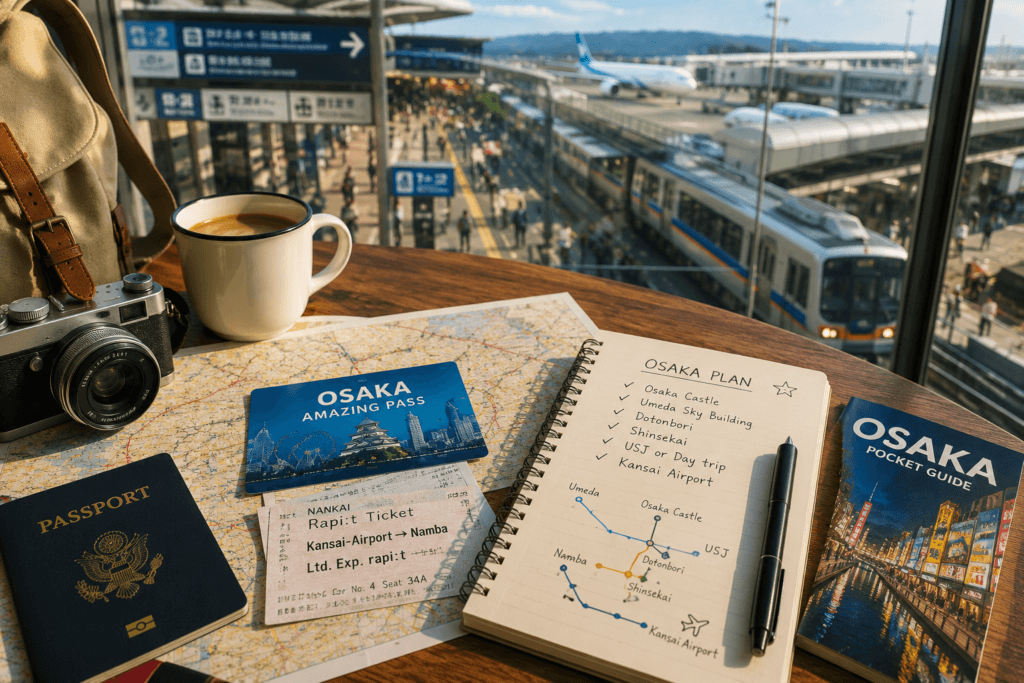
The Osaka Amazing Pass can be useful if your day includes several included attractions and train rides.
In 2026, the 1-day pass costs 3,500 yen and the 2-day pass costs 5,000 yen. It works best on a busy sightseeing day, not on a slow food-and-wandering day.
Do not buy it just because the name sounds powerful.
Before buying, check:
- Which attractions are included
- Which train and bus lines are included
- Whether you will visit enough paid attractions
- Whether the pass covers your route
- Whether any facility has time restrictions
- Whether screenshots or printed copies are accepted
- Whether your day is actually busy enough to make it worthwhile
A pass can save money, but only if your day fits the pass.
If your plan is mostly eating in Namba and wandering Dotonbori, you may not need it. If your plan includes multiple attractions, observatories, cruises and transport, it can make more sense.
The pass is a tool, not a tiny financial wizard.
Kansai Airport to Osaka
Osaka is one of the easiest Japanese cities for airport access if you choose the right base.
Kansai International Airport is the main international gateway for many Osaka travelers.
Kansai Airport to Namba
If you arrive at Kansai International Airport and stay around Namba, the Nankai Limited Express Rapi:t is one of the easiest airport transfer options. It connects Kansai-Airport Station and Nankai Namba in as little as 34 minutes.
This is one reason Namba is such a strong base for first-time visitors.
Namba works especially well if you want:
- Easy airport transfer
- Dotonbori nearby
- Nankai train access
- Food and nightlife
- Less arrival-day stress
Kansai Airport to Umeda
If you stay around Umeda or Osaka Station, check JR airport routes, airport buses or transfer options depending on your arrival time and hotel location.
Umeda is excellent for day trips and broader transport, but airport transfer may require a different route than Namba.
Arrival Day Advice
On arrival day, keep your plan simple.
Good arrival day ideas:
- Check in
- Eat near your hotel
- Walk around Namba or Umeda
- Visit Dotonbori if staying nearby
- Save major sightseeing for the next day
Do not land at Kansai Airport, transfer to Osaka, check in, visit Osaka Castle, ride to Umeda, eat in Dotonbori and then wonder why your first night feels like a luggage-based obstacle course.
Arrival day is for landing, eating and letting Osaka say hello.
Universal Studios Japan Tips
Universal Studios Japan can be one of the best parts of an Osaka itinerary.
It can also swallow an entire day without asking permission.
If USJ is important to you, plan it as a full day.
Super Nintendo World
Super Nintendo World is one of the most popular areas in the park.
From January 5, 2026, guests need to use the official app for Area Timed Entry Tickets and Standby Entry Tickets.
This means you should prepare before your visit:
- Download the official USJ app
- Check ticket rules
- Register your park ticket if needed
- Understand timed entry
- Arrive early
- Keep your phone charged
- Check park conditions on the day
Do not assume you can casually wander into Super Nintendo World whenever you feel like it. That kind of confidence belongs in a cartoon, not a theme park itinerary.
USJ 25th Anniversary in 2026
Universal Studios Japan is celebrating its 25th anniversary period from March 4, 2026 to March 30, 2027.
This can make 2026 an especially exciting year to visit, but it also means you should check the official event calendar before choosing your date.
Seasonal events, attraction rules, park hours and crowd patterns can change. If USJ is a priority, plan the park day before locking the rest of your Osaka itinerary.
Should You Add USJ to a 2-Day Osaka Itinerary?
Only if USJ is your top priority.
If you have 2 days in Osaka and choose USJ, your route becomes:
- Day 1: Osaka city highlights
- Day 2: Universal Studios Japan
That means you will skip some Osaka city sightseeing, and that is fine if USJ matters more.
Should You Add USJ to a 3-Day Osaka Itinerary?
Yes, 3 days works well.
You can do:
- Day 1: Osaka Castle, Umeda and Dotonbori
- Day 2: Namba, Kuromon Market and Shinsekai
- Day 3: Universal Studios Japan
This is one of the best first-time Osaka routes.
Should You Add USJ to a 4-Day Osaka Itinerary?
Yes, 4 days is ideal if you want USJ plus a day trip.
You can give USJ its own day and still have room for Nara, Kobe, Himeji or a slower Osaka food day.
Food to Try in Osaka
Osaka is one of Japan’s best food cities.
The city is often associated with kuidaore, the idea of eating until you drop. This is not medical advice, but Osaka does make the concept persuasive.
Classic Osaka foods include:
Takoyaki
Takoyaki are round octopus-filled batter balls, usually topped with sauce, mayonnaise, bonito flakes and seaweed powder.
Try them around Dotonbori, Namba or street food areas.
They are hot inside. Respect the steam. Many travelers learn this lesson in silence.
Okonomiyaki
Okonomiyaki is a savory pancake with cabbage and other ingredients, cooked on a griddle.
Osaka-style okonomiyaki mixes the ingredients into the batter before cooking.
It is filling, casual and perfect for dinner.
Kushikatsu
Kushikatsu are deep-fried skewers, especially associated with Shinsekai.
You can try meat, vegetables, seafood and other ingredients.
Follow the restaurant rules, especially around sauces and dipping.
Negiyaki
Negiyaki is similar to okonomiyaki but uses plenty of green onion.
It is a good option if you want something slightly lighter.
Kitsune Udon
Kitsune udon is a bowl of udon topped with sweet fried tofu.
It is simple, comforting and very Osaka-friendly.
551 Horai Butaman
551 Horai pork buns are a popular Osaka snack or quick meal.
You will often see travelers carrying the familiar boxes around stations.
The smell may enter the train before you do. This is not always subtle.
Where to Eat
Good food areas include:
- Dotonbori
- Namba
- Kuromon Market
- Shinsekai
- Tenma
- Tsuruhashi
- Umeda
- Hozenji Yokocho
- Local shotengai shopping streets
You do not need every meal to be famous. Osaka is often best when you follow a side street, choose a busy local place and let dinner happen without making it a research project.
Common Mistakes to Avoid
Mistake 1: Treating Osaka as Only One Night
One night can work, but Osaka deserves more if you want food, nightlife, USJ or day trips.
Two or three days is much better for first-time visitors.
Mistake 2: Adding USJ as a Half-Day
Universal Studios Japan needs a full day for most visitors.
Do not squeeze it between Osaka Castle and Dotonbori unless you enjoy theme parks as a stress test.
Mistake 3: Visiting Dotonbori Too Early
Dotonbori is better at night.
Go in the evening for lights, food and the full atmosphere.
Mistake 4: Buying Passes Without Doing the Math
The Osaka Amazing Pass can help, but only if your day includes enough included attractions and transport.
Check your route before buying.
Mistake 5: Staying Far from Useful Transport
A hotel far from Namba, Umeda or useful train lines can waste time.
Choose your base based on your itinerary.
Mistake 6: Skipping Day Trip Planning
Nara, Kobe and Himeji are easy from Osaka, but they still need time.
Do not add all of them to a short Osaka stay.
Mistake 7: Underestimating Food Time
Osaka meals are part of the itinerary.
Leave time to eat, wait, wander and change your mind. Food is not the gap between attractions here. Food is one of the attractions.
FAQ: Osaka Itinerary
How many days do you need in Osaka?
You need at least 2 days in Osaka for a good first visit. Three days is best for most first-time visitors, especially if you want to add Universal Studios Japan or a day trip.
Is 2 days enough for Osaka?
Yes, 2 days is enough for Osaka highlights if you keep the route focused. A good 2-day Osaka itinerary includes Osaka Castle, Umeda, Dotonbori, Namba, Kuromon Market and Shinsekai.
Is 3 days enough for Osaka?
Yes, 3 days is ideal for many first-time visitors. It gives you two city days plus one day for Universal Studios Japan, Nara, Kobe or Himeji.
Is 4 days too long in Osaka?
No, 4 days is not too long. It is ideal if you want Osaka city highlights, Universal Studios Japan and one Kansai day trip.
What is the best Osaka itinerary for first-time visitors?
The best first-time Osaka itinerary is Osaka Castle, Umeda and Dotonbori on Day 1, Namba, Kuromon Market and Shinsekai on Day 2, and Universal Studios Japan or a day trip on Day 3.
Should I stay in Namba or Umeda?
Stay in Namba for food, nightlife and Dotonbori. Stay in Umeda for transport, shopping and day trips. Both are good first-time bases.
Is Dotonbori worth visiting?
Yes, Dotonbori is worth visiting, especially at night. It is one of Osaka’s best areas for neon lights, canal views, takoyaki, okonomiyaki and nightlife.
Is Universal Studios Japan worth it?
Yes, USJ is worth it if theme parks are a priority. Give it a full day, download the official app and check Super Nintendo World timed-entry rules.
Is the Osaka Amazing Pass worth it?
It depends on your route. It can be worth it if you visit several included attractions and use covered transport in one day. It may not be worth it for a slow food-focused day.
What is the best time to visit Osaka?
Spring and autumn are usually the most comfortable seasons for Osaka. Winter is good for food, shopping and city travel. Summer can be hot and humid but still works with slower pacing.
Final Thoughts: Let Osaka Feed You, But Do Not Let It Rush You
Osaka is easy to enjoy.
That is exactly why travelers sometimes overfill it.
For 2 days, focus on Osaka Castle, Umeda, Namba, Dotonbori and Shinsekai.
For 3 days, add Universal Studios Japan or a day trip.
For 4 days, give USJ its own day and add Nara, Kobe, Himeji or a slower food route.
The best Osaka itinerary is not just a list of meals and neon signs. It is a rhythm: history in the morning, food by noon, skyline in the afternoon and Dotonbori after dark.
Osaka is friendly, loud, hungry and generous.
Let it feed you.
Just do not ask it to feed you, entertain you, send you to USJ and squeeze in three day trips before your suitcase has learned the hotel elevator.