
The fastest way from Hong Kong International Airport to the city is the Airport Express. The most convenient way to your hotel may be something else. Kowloon Station is not Tsim Sha Tsui, Hong Kong Station is not every hotel on Hong Kong Island, and the last few kilometres can turn a clean train journey into a luggage puzzle.
Choose the train when speed and predictable timing matter. Choose an airport bus when its stop is genuinely close to your hotel. Choose a taxi or arranged transfer when several people, heavy luggage or a late arrival make door-to-door travel more valuable. This guide starts with your destination rather than assuming everyone is heading to Central.
Fares and operating times checked against official sources on 1 October 2026. All prices below are in Hong Kong dollars. Door-to-door estimates are planning allowances, not operator guarantees.
Which transfer actually fits your hotel?
| Hotel area | Start by comparing | The detail that changes the answer |
|---|---|---|
| Central / Sheung Wan | Airport Express to Hong Kong Station | The final walk may include slopes, stairs or a local taxi |
| Tsim Sha Tsui / Jordan / Mong Kok | A21 bus versus Airport Express to Kowloon | Kowloon Station is not on Nathan Road |
| Wan Chai / Causeway Bay | A11 route versus train and onward connection | Exact bus stop and last-mile route |
| Lantau / Disneyland / airport hotel | A destination-specific route or taxi | Do not travel into the city just to come back west |
| Any area after rail service ends | Night bus or official taxi | Landing time is not the time you leave immigration |
Before flying, save the hotel name and Chinese address, its entrance location and one fallback route. A small hotel above shops may have a doorway that is easy to miss. Your map dot can be correct while your tired feet stand on the wrong side of the building.
Airport Express: current fares and what the journey includes
The Airport Express connects the airport with Tsing Yi, Kowloon and Hong Kong stations. MTR lists about 14 minutes to Tsing Yi, 22 minutes to Kowloon and 24 minutes to Hong Kong Station. These are train times, not hotel-arrival times. Add waiting, station exits and the onward journey.
The adult fares below come from MTR’s official Airport Express fare table. Ticket type matters: an e-wallet payment and a purchased QR ticket are not necessarily the same fare product.
| Destination | Adult Octopus / eligible card / specified e-wallet QR | Adult single Smart Ticket | Train ride |
|---|---|---|---|
| Hong Kong Station | HK$120 | HK$130 | About 24 minutes |
| Kowloon Station | HK$105 | HK$115 | About 22 minutes |
| Tsing Yi Station | HK$73 | HK$80 | About 14 minutes |
A discounted advance ticket can change the comparison. You can check Hong Kong Airport Express tickets on Klook. Select the correct destination and read the validity period, redemption method and refund terms. Compare the live offer with the relevant official fare rather than an old screenshot.
The last train is late, but not all night
MTR’s timetable effective from September 2026 lists the first city-bound train from Airport Station at 05:54 and the last at 00:48. For airport-bound travel, the first departure from Hong Kong Station is 05:50. Check the current timetable before travel and station notices on the day. As checked October 12, 2026, MTR also states that entry through the gates is not allowed less than five minutes before the last scheduled train. Arrive earlier than that cutoff to allow for ticketing and the platform walk; 00:48 is a train departure, not a safe station-arrival target.
A flight landing at 23:50 does not guarantee the train. Immigration, baggage and the walk to the rail area still sit between the aircraft and the platform. If you are close to the end of service, decide on a fallback before collecting your bag. Refreshing a map does not extend the timetable, despite how persuasive it feels.
The station choice: avoid buying the wrong last mile
Hong Kong Station for Central and onward Island travel
Hong Kong Station works well for Central-area accommodation and connections toward other parts of Hong Kong Island. However, the walk through a large station complex and the hotel’s final street approach still matter. Central and Sheung Wan have slopes, stairs and buildings on different levels.
With a small bag, walking or an onward MTR journey can be straightforward. With large suitcases, a taxi from the Airport Express station may be the better second leg. You keep the traffic-free airport journey and avoid carrying luggage through a crowded interchange.
For Wan Chai and Causeway Bay, compare the entire train-and-transfer route with a bus stop near the hotel. A faster arrival at Central is not necessarily a faster arrival at your room.
Kowloon Station for a taxi connection, not an automatic Tsim Sha Tsui arrival
Kowloon Airport Express station sits west of the main Nathan Road hotel corridor. It is convenient for properties around the station and a useful taxi connection point, but it is not the same place as Tsim Sha Tsui, Jordan or Mong Kok MTR stations.
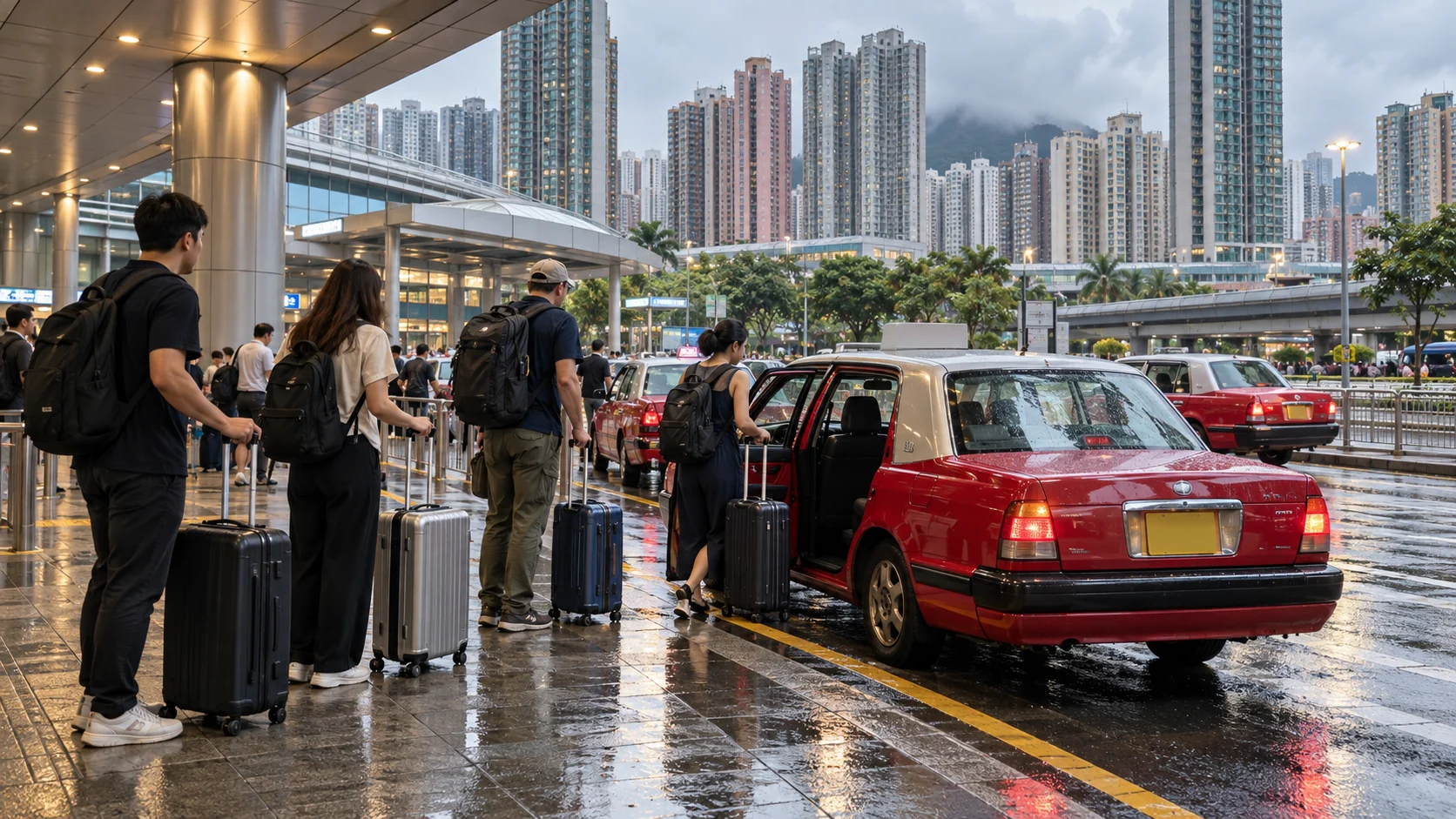
Do not assume a walk is sensible because two locations are both in Kowloon. Trace the actual route, including crossings and station exits. For many Nathan Road hotels, the A21 bus is worth comparing because it passes through the relevant neighborhoods. For groups, train plus taxi should be compared with a taxi directly from the airport.
Tsing Yi is a transfer choice, not the default visitor destination
Tsing Yi can make sense for specific accommodation or an onward rail plan. It should not be chosen merely because the ticket is cheaper. Work out the connection, luggage handling and total price first. Paying less for the first leg while adding an awkward second leg is a familiar way to make a holiday look efficient only on paper.
Airport buses: often the best fit for a convenient stop
Airport buses trade a longer, traffic-sensitive ride for lower fares and direct access to many hotel streets. The useful comparison is stop-to-door distance. A bus that takes longer on the road can still win if it avoids another transfer and a taxi queue.
A21 for the Nathan Road corridor
The current Citybus A21 route listing shows an adult airport fare of HK$34.60 and stops through Mong Kok, Yau Ma Tei, Jordan and Tsim Sha Tsui before Hung Hom. Choose the stop from the live route list, then map the walk to the hotel. Do not copy a stop number from a years-old blog: route patterns and notices can change.
Allow roughly an hour to an hour and a half as a cautious planning range for central Kowloon, with more time during congestion. This is an editorial allowance rather than a fixed schedule. The bus may arrive sooner; the city is also capable of having other ideas.
A11 for parts of Hong Kong Island
Citybus lists HK$41.90 for the full A11 airport route. It is worth checking for accommodation along its Island corridor, including relevant stops around Central, Wan Chai and Causeway Bay. Confirm your hotel’s exact stop using the operator’s current route search; other airport routes may fit a particular address better.
Do not assume the return stop is directly opposite the arrival stop. One-way streets, route direction and road layouts can place it elsewhere. Save the airport-bound stop before your final day rather than discovering it with a suitcase and a departure countdown.
Bus payment and luggage
Check the operator’s payment instructions for your route and keep a backup. An Octopus card is convenient, while cash should be prepared in the correct amount if you choose that method. Contactless logos do not mean every foreign card or phone wallet will work in every situation.
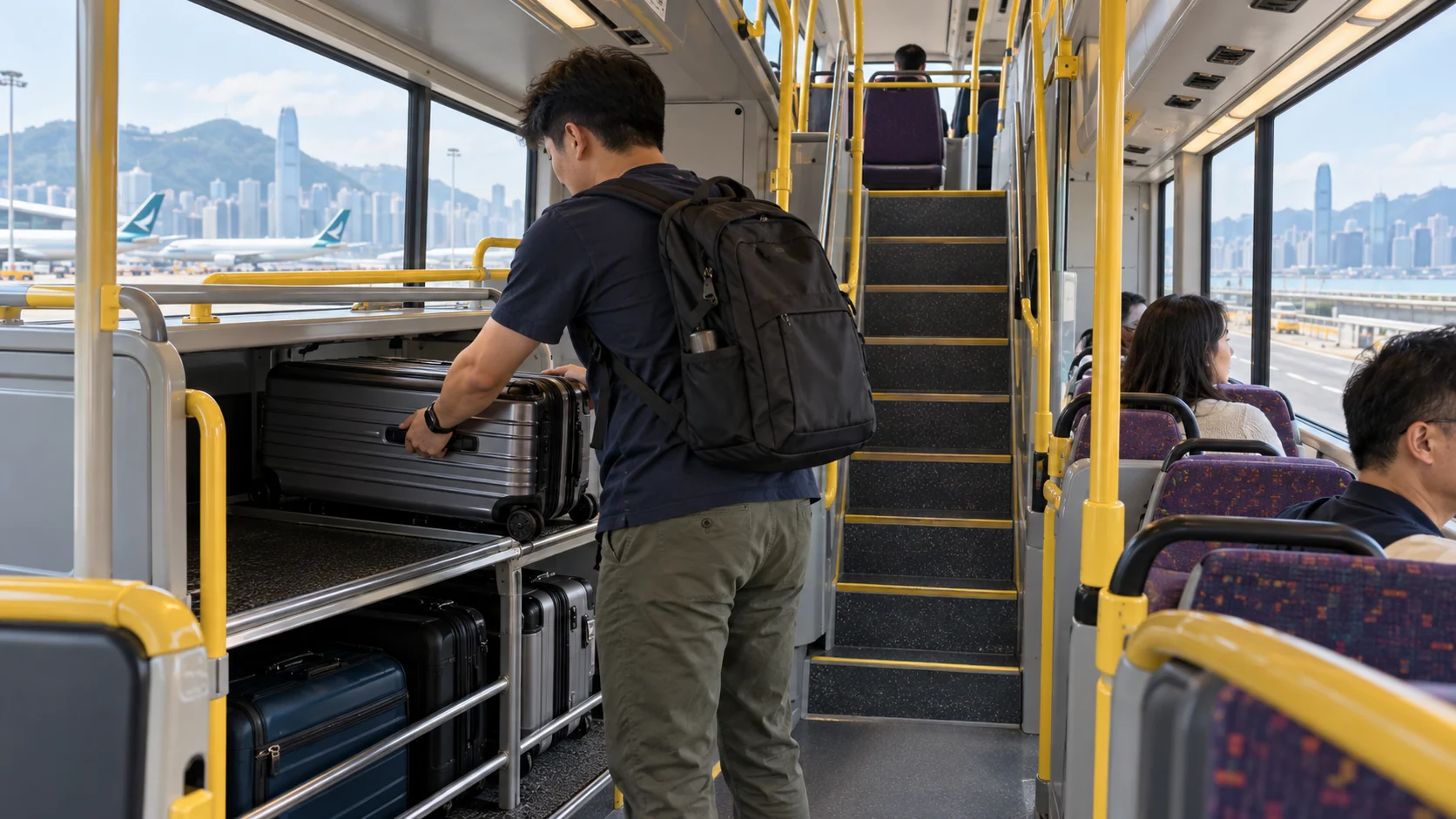
Use the designated luggage rack, keep valuables with you and remember which side of the rack holds your bag. If you go upstairs for the view, set an arrival reminder and return downstairs before the stop. Hong Kong’s skyline is excellent; missing your luggage while admiring it is less excellent.
Taxis and arranged transfers: compare a group total
Use the official airport taxi rank rather than accepting an unsolicited offer inside the terminal. Hong Kong taxis are divided into operating areas. Red urban taxis are the usual choice for hotels in Kowloon and on Hong Kong Island; green New Territories and blue Lantau taxis have different permitted areas. The Transport Department’s operating-area guide explains the distinctions.
Ask the queue staff to confirm the right taxi for your destination. Show the Chinese hotel address and request a receipt. The final bill can include the meter, applicable road charges and luggage extras. Use the airport’s taxi information page for the current destination estimate rather than treating one quoted city-centre fare as universal.
For three adults going to Hong Kong Station, the standard eligible-card train fare alone totals HK$360 before the hotel connection. For three traveling to Kowloon, it totals HK$315. That does not prove a taxi is cheaper, but it is the correct starting point for a group comparison. Add the likely last-mile ride, then compare the direct vehicle total.
Check vehicle capacity honestly. Passenger seats and luggage space are different limits. A family with a stroller and several large cases may need a larger arranged vehicle even when a standard taxi technically has enough seats.
A booked transfer is useful for late arrivals, accessibility requirements or a large group. Confirm the meeting point, flight-delay policy, waiting allowance and actual luggage capacity. Save the driver’s contact instructions offline. Do not book a sedan and hope the supplier interprets “four suitcases” as a creative challenge.
After midnight: build the fallback before landing
If you leave the terminal after the last train, compare a current night-bus route with an official taxi. Night services can have different stops, fares and frequency from the daytime A routes. Check the airport and bus operator’s live listings for your exact destination.
A night bus is sensible if its stop is close, the next departure is reasonable and you can manage the final walk. A taxi is easier when the hotel sits on a hill, reception needs a precise arrival time or several people share the cost. Waiting an hour to save a modest group amount may be less appealing after a long flight than it looked while planning.
Confirm late check-in before flying. Transport can get you to the building; it cannot open an unstaffed guesthouse door without the code you forgot to download.
Your return journey needs a different calculation
The first train from Hong Kong Station at 05:50 is useful for some morning flights, but it may be too late for an early departure once terminal walking, bag drop and security are included. Plan backward from the airline’s required airport-arrival time. Do not work backward from takeoff alone.
In-town check-in is available only for specified airlines, flights, travel documents and station service hours. MTR’s current in-town check-in table distinguishes Hong Kong and Kowloon station availability. Verify your airline and flight directly before building the day around dropping bags in the city.
Likewise, do not assume an automatic complimentary hotel shuttle. MTR publishes a hotel-provided shuttle list. Confirm that your property participates and check its own schedule. A shuttle mentioned in a review from years ago is not a current reservation.
Before choosing a hotel, test its airport route
If accommodation is still undecided, our Hong Kong hotel-area guide compares Tsim Sha Tsui, Central, Mong Kok and other practical bases. The easiest airport arrival should support the holiday rather than determine every day of it.
You can compare Hong Kong hotels on Agoda and check Hong Kong hotel rates on Trip.com. Read the arrival instructions, entrance location and late check-in rules before comparing the final room total.
Affiliate disclosure: these links may earn us a commission at no extra cost to you. We include them where they help with the transfer or booking decision.
Quick answers
What is the fastest transfer from Hong Kong Airport?
The Airport Express takes about 24 minutes to Hong Kong Station. It is the quickest predictable city connection, but add the onward journey to your hotel.
Is the A21 better than the Airport Express for Tsim Sha Tsui?
Often, if the A21 stop is close to your hotel and road traffic is manageable. The train is faster to Kowloon Station, but that station is not Tsim Sha Tsui.
Can I use a contactless bank card on the Airport Express?
MTR now lists eligible contactless-card use at designated Airport Express gates. Follow the operator’s eligibility guidance and use the same card or device consistently. Have a backup if your foreign card fails.
Does the Airport Express operate all night?
No. The current city-bound service from Airport Station runs from 05:54 until 00:48. Check live notices before travel, especially when landing close to the last departure.
Should a family take a taxi?
Compare the full group train fare plus the hotel connection with a direct vehicle. Luggage, stroller space and arrival time can matter more than a small price difference.
Choose by the hotel door: train for predictable speed, bus for a convenient stop, taxi for a shared door-to-door journey. Save one fallback, keep the address offline and leave enough time for the final transfer. The airport train may be fast; your room is still somewhere beyond its platform.