
Da Nang and Hoi An are only about 30 kilometers apart, which makes the accommodation decision look harmless. It is not. Stay in the wrong place for your priorities and you may spend every evening in a car, arrive at the beach after the best morning light, or discover that your “Old Town hotel” is close only in the emotional sense.
Here is the short answer. Stay in Da Nang for the beach-city balance, easier airport access, modern hotels and efficient day trips. Stay in Hoi An for early mornings, lantern-lit evenings, a walkable historic center and a slower trip. If you have four nights or more, splitting the stay usually gives you the best version of both places. With three nights or fewer, choose one base and avoid turning a short holiday into a luggage relay.
This guide was checked in September 2026 using current Da Nang tourism, airport and Hoi An heritage information. Hotel prices, transfer fares and pedestrian hours can change, so confirm the details for your travel dates before paying.
The Decision in One Table
| What matters most? | Choose Da Nang | Choose Hoi An |
|---|---|---|
| Best overall fit | Beach, city food, airport convenience, modern facilities | Old Town atmosphere, walking, cafes, heritage and slower evenings |
| Airport transfer | Usually 10–20 minutes, depending on area and traffic | Roughly 40–60 minutes by road |
| Evening experience | Han River, bridges, seafood and urban nightlife | Lantern streets, riverside walks and pedestrian Old Town |
| Beach access | My Khe and the long urban coast; widest hotel choice | An Bang or Cua Dai; quieter but separated from Old Town |
| Walking | Good within one neighborhood, but the city is spread out | Excellent around Ancient Town; poor if your resort is far outside it |
| Bad-weather backup | Stronger: malls, museums, cafes and more indoor options | Atmospheric in light rain, inconvenient in prolonged heavy rain or flooding |
| Day-trip logistics | Better for Ba Na Hills, Son Tra, Hue and early flights | Better for My Son, countryside, cooking classes and Old Town mornings |
| Trip length | Best one-base option for 2–3 nights | Best if the historic town is the emotional center of the trip |
My default recommendation: for four nights, spend two nights in Hoi An and two in Da Nang. Put Hoi An first if your arrival is before late afternoon. Put Da Nang last when you have an early flight. That final 15-minute airport ride feels much better than starting a 50-minute transfer while quietly checking the departure board every three minutes.
What Staying in Da Nang Actually Feels Like
Da Nang is a real coastal city, not simply the airport attached to Hoi An. The beach stretches along the east side, the Han River divides the urban center, and accommodation ranges from inexpensive side-street hotels to large beachfront resorts. Taxis and ride-hailing cars are easy to find in the main visitor areas. The trade-off is scale: beach, markets, riverfront, railway station and airport are not one walkable cluster.
A Da Nang morning can start with sunrise at My Khe, move to a bowl of mì Quảng, continue to the Marble Mountains and still leave time for the river after dark. That flexibility is the city’s main advantage. You do not have to make every day a formal excursion.

Da Nang is also more forgiving when plans change. If the sea is rough or rain cancels a mountain day, you still have the Cham Sculpture Museum, markets, cafes, spas, restaurants and shopping. Hoi An has indoor attractions too, but several days of hard rain can make its walking-based appeal feel much smaller.
Choose My Khe or An Thuong for the easiest first stay
For most first-time visitors, the area behind My Khe Beach is the safest choice. You can walk to the sand, find breakfast and dinner without planning, and reach the Han River by a short car ride. The An Thuong streets toward the southern end have apartments, cafes, bars and international food. They are convenient, though not the quietest or most traditionally Vietnamese part of the city.
Do not trust “beachfront” without checking the map and recent guest photos. Many hotels face the coastal road rather than opening directly onto sand. Families should check the exact road crossing, pool access and room noise. A 300-meter walk is easy on a map and less charming with a stroller, six lanes of traffic and wet beach gear.
Choose the Han River or Hai Chau for food and transport
The west bank around Hai Chau, Han Market and Bach Dang Street works better if the beach is optional. You are closer to local dining, city markets, the airport and railway station. The Dragon Bridge and river lights give evenings a clear direction without requiring a taxi for every meal.
The compromise is obvious: you cannot step out for a swim. My Khe is usually a short ride rather than a walk. River-facing rooms can also pick up traffic or event noise, so read the newest reviews instead of assuming a high floor has signed a peace treaty with the street.
Choose Non Nuoc or southern resorts only to slow down
The resort strip near Non Nuoc Beach and the Marble Mountains sits between central Da Nang and Hoi An. It can look like a perfect halfway solution. In practice, it works best for travelers who plan to use the resort and take occasional cars in both directions. It is not a substitute for staying inside two walkable centers.
Choose this area for pools, beach time, family facilities and a self-contained stay. Avoid it if your list is full of markets, independent restaurants and late-night wandering. Saving 15 minutes on the Hoi An road does not help much if every bowl of noodles requires another vehicle.
What Staying in Hoi An Actually Feels Like
Hoi An earns its overnight stay before 9:00 a.m. and after the day-trip groups begin leaving. Early morning brings bicycles, deliveries, coffee and yellow streets without a constant line of raised phones. In the evening, the riverfront becomes busier and more commercial, but staying nearby lets you walk home instead of negotiating a return car at the same time as everyone else.
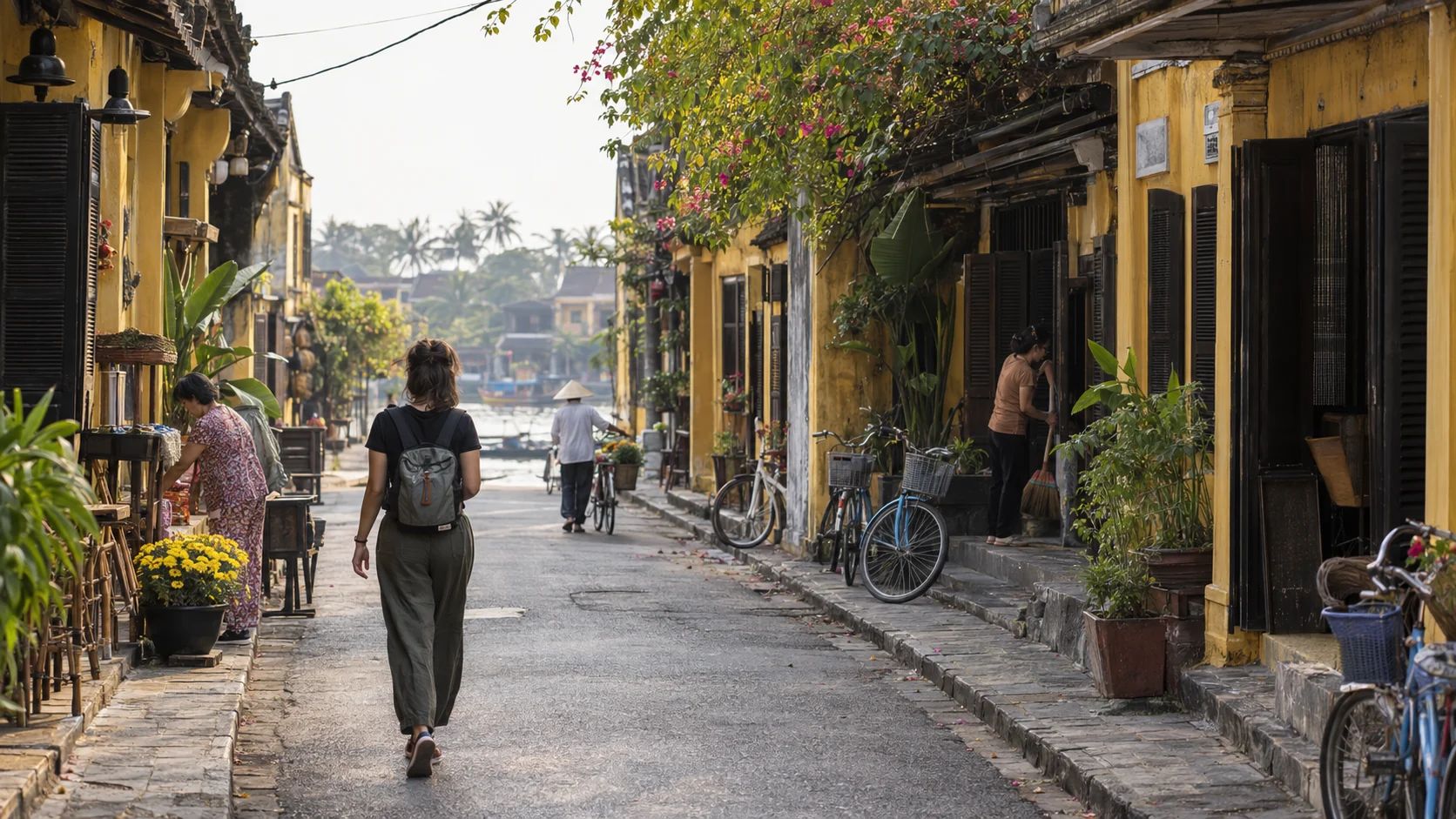
The historic core is compact and pedestrian-friendly during restricted traffic hours. Current 2026 heritage information lists pedestrian operations in Ancient Town from 09:00 to 21:30 in summer and until 21:00 in winter, with slightly later-starting restrictions on Phan Chau Trinh Street. These arrangements can be adjusted for events or local conditions.
The current heritage ticket costs VND 80,000 and includes the general Ancient Town landscape plus selected monuments. It is valid during a stay of up to three days, so keep the ticket stub. The fee is not a hotel charge and should not be confused with paying simply to eat dinner or walk back to your room.
Stay just outside Ancient Town, not necessarily inside it
The most useful Hoi An base is often a five-to-fifteen-minute walk from the protected core. Look around Cam Pho, the northern and eastern edges of the Old Town, or the quieter river approaches. You get easy access without placing your bedroom directly above the busiest evening streets.
Check the route on satellite view. “Near Ancient Town” can mean a pleasant flat walk, a bridge crossing or a road with uncomfortable traffic. During pedestrian hours, cars may not reach the hotel entrance. Ask the property where a transfer will drop you and how far you must roll luggage over paving stones.
Choose Cam Chau for a quieter middle ground
Cam Chau sits between the historic center and the beach side. Villas and small resorts often offer pools, gardens and bicycles. It is a good choice for couples and families who want a calmer property while keeping Old Town within a short ride.
It is not fully walkable for everyone. Midday heat, rain and dark roads can turn the promised 20-minute stroll into a quick taxi decision. Confirm whether bicycles, a scheduled shuttle or dependable ride-hailing pickup are available.
Choose An Bang for beach life, not Old Town convenience
An Bang Beach has guesthouses, small hotels, seafood restaurants and a relaxed evening scene. It is a strong choice when your mental picture of Hoi An includes swimming and slow breakfasts. It is several kilometers from Ancient Town, so you will use a bicycle, taxi or hotel shuttle for heritage visits.
This is the classic location-label trap. A property can honestly be in Hoi An while still being nowhere near the lantern streets. Check the actual map pin, not only the destination name. The same warning applies to large coastal resorts north and south of town.
The Best Base by Traveler Type
First trip to central Vietnam
If you have only three nights, choose Da Nang when convenience and variety matter most. Choose Hoi An if the Old Town is the reason you booked the trip. Do not split a three-night stay unless changing hotels is unusually easy for you.
Couples
Hoi An usually wins for two quiet nights: early walks, smaller hotels and dinner without a return transfer. Add Da Nang if you want a polished beachfront resort or more nightlife. Romantic does not automatically mean a river room; check mosquitoes, construction and evening music in recent reviews.
Families with children
Da Nang is the practical default. Larger hotels, pools, beach access, short airport rides and plentiful taxis reduce friction. Hoi An works well when you book a property with a pool and reliable transfers, but strollers meet uneven paving and pedestrian-zone drop-offs. An Bang can be excellent for relaxed families who do not need to enter Old Town every day.
Solo travelers
Choose Da Nang for transport freedom, a larger food scene and more city energy. Choose Hoi An for a compact, social guesthouse stay and evenings on foot. Late at night, use a car rather than riding an unfamiliar scooter route between the two cities.
Remote workers
Da Nang has the deeper pool of apartments, coworking spaces, gyms and practical services. An Thuong is the easy starting point. Hoi An is calmer and can be wonderful for a slower month, but inspect desk setup, internet reviews and flood access before committing to a long stay.
Travelers with an early departure
Sleep in Da Nang on the final night. Da Nang International Airport is close to the city center, while Hoi An is about 30 kilometers away. A 7:00 a.m. flight is already rude enough without adding a pre-dawn intercity transfer.
Should You Split the Stay?
Split the stay when you have enough time to experience two different daily rhythms, not because the places appear as two boxes on a checklist.
- Two nights: choose one base. Da Nang is easier; Hoi An is more atmospheric.
- Three nights: stay in one place and make one day or evening trip.
- Four nights: two nights in each is the best balanced first-trip plan.
- Five nights: two in Hoi An and three in Da Nang gives more weather flexibility.
- Six nights or more: split freely, or add a distinct beach-resort section rather than changing between similar city hotels.
A hotel change consumes more than the driving time. You pack, check out, store bags, wait for the next room and re-learn the neighborhood. Assume a move will interrupt four or five hours even when the car journey itself takes under an hour.
The cleanest sequence is Hoi An first, Da Nang second. You land, take the longer transfer while travel energy is already spent, enjoy the heritage town, then move north for beach and city time before a shorter airport departure. Reverse the order if you arrive late at night; sleeping near the airport and moving in daylight is calmer.
Booking Hotels Without Falling for the Destination Label
Administrative and booking-platform labels can be confusing in 2026. Some Hoi An-area properties may appear under the wider Da Nang city label after local administrative changes. The map still matters more than the address heading. Check the driving distance to Hoi An Ancient Town, My Khe Beach and Da Nang Airport before judging a hotel’s location.
Before booking, verify:
- the exact map pin and walking route;
- whether “beachfront” requires crossing a major road;
- airport pickup price and late-arrival surcharge;
- pool opening hours and whether construction is mentioned in recent reviews;
- pedestrian-zone luggage drop-off in Hoi An;
- cancellation conditions during storm season;
- whether breakfast, taxes and extra beds are included in the displayed total.
Affiliate disclosure: This article contains selected booking links. If you book through one, Asia Travel Lab may earn a commission at no extra cost to you. Compare the final total, room conditions and cancellation policy before paying.
For a beach-city base, compare Da Nang hotels on Agoda or Da Nang hotels on Trip.com. For a walkable heritage stay, compare Hoi An hotels on Agoda or Hoi An hotels on Trip.com. These links are comparison starting points, not endorsements of whichever room has the most enthusiastic infinity-pool photograph.
Moving Between Da Nang and Hoi An
The road journey is about 30 kilometers and normally takes 40–60 minutes. Traffic, rain and pickup location change the result. A taxi or ride-hailing car commonly costs roughly VND 350,000–430,000 one way in current local tourism guidance, while hotel cars may charge more for waiting, child seats or late-night service.
Ask the driver to confirm whether tolls, airport pickup and waiting are included. At Hoi An, the car may stop outside a pedestrian zone rather than at the lobby. Send the exact hotel map pin, especially when property names are similar.
A shared shuttle costs less but follows set departures and pickup points. It is sensible for one traveler with ordinary luggage and a forgiving schedule. It is less attractive after immigration when the next bus is an hour away. You can check the current Da Nang–Hoi An shared shuttle schedule on Klook; verify the terminal, luggage allowance, hotel stop and arrival buffer for your selected date.
Weather Can Change the Correct Answer
Da Nang and Hoi An share the same central-coast weather system, but location changes how you experience it. In the clearer beach months, Da Nang’s long coast is a major reason to stay. During sustained autumn rain, a beachfront room may provide a magnificent view of water you are not entering.
Hoi An is beautiful in a short shower. Reflections on yellow walls are photogenic; wet luggage and flooded access roads are less poetic. The Thu Bon River area can experience high water during the wettest periods. If traveling during storm season, choose flexible rates, ask the hotel about flood access and keep the final night in Da Nang before a flight.
Do not make the decision from a national “best time to visit Vietnam” chart. Vietnam is long, and central-coast rain does not follow the same timetable as Hanoi or Ho Chi Minh City. Check Da Nang and Hoi An forecasts together shortly before travel.
Three Itineraries That Do Not Waste the Location
Three nights, one base
Da Nang: arrive and walk the river; use day two for the beach and Marble Mountains; visit Hoi An from late afternoon through evening on day three. This is efficient, but you miss Hoi An’s quiet morning.
Hoi An: arrive and settle near Ancient Town; use day two for heritage streets and cafes; choose An Bang, countryside or My Son on day three. This feels slower but gives up Da Nang’s urban depth.
Four nights, balanced split
Nights 1–2 Hoi An: explore after sunset, then see Ancient Town early the next morning. Use the second afternoon for An Bang or a cooking activity. Nights 3–4 Da Nang: transfer after lunch, stay near My Khe or the Han River, then use a full day for the beach, Son Tra or Marble Mountains.
Five nights with breathing room
Two nights Hoi An + three nights Da Nang is the most resilient plan. It allows one weather-affected day without erasing the beach or heritage section, and it puts you closer to the airport at the end.
This central-Vietnam stop fits naturally into our Thailand and Vietnam itinerary. If you are still deciding how much of the region to combine, use the broader Asia itinerary guide for first-time travelers. The comparison between East Asia and Southeast Asia also explains the wider budget, weather and transport trade-offs.
Final Verdict
Choose Da Nang when you want the easiest, most flexible base: airport, beach, restaurants, modern hotels and day-trip transport. It is the safer answer for short stays, families, remote workers and early departures.
Choose Hoi An when the trip is about atmosphere rather than logistics. Staying overnight gives you the town at the hours when it feels most lived-in and least like a day-trip stage set.
Choose both only when you have at least four nights. Two nights in each is not redundant. The places are close on the map and very different at 7:00 a.m.
Frequently Asked Questions
Is it better to stay in Da Nang or Hoi An?
Da Nang is better for beaches, transport, airport access and a larger city experience. Hoi An is better for Old Town walks, heritage atmosphere and quieter mornings. For four nights or more, split the stay.
Can I stay in Da Nang and visit Hoi An for the day?
Yes. The drive usually takes 40–60 minutes. Visit from mid-afternoon through evening if lanterns are your priority. Staying overnight is better if you want quiet streets before tour groups arrive.
How many nights do I need in Hoi An?
Two nights suit most first visits. That gives you one evening, one early morning and a full day for Ancient Town, An Bang Beach, countryside or a cooking activity.
Which part of Da Nang is best for first-time visitors?
My Khe and An Thuong suit travelers who want the beach and easy dining. Hai Chau and the Han River suit travelers who prioritize markets, local food, the railway station and quicker airport access.
Should I stay near Hoi An Ancient Town or An Bang Beach?
Stay near Ancient Town for walking and evening atmosphere. Stay at An Bang for a beach-led holiday and expect to use a bicycle, shuttle or taxi when visiting the historic center.
Is Hoi An close to Da Nang Airport?
Hoi An is about 30 kilometers from the airport. Allow roughly 40–60 minutes by car, plus extra time in heavy rain, traffic or when your hotel is inside a pedestrian zone.
Do I need a ticket to visit Hoi An Ancient Town?
Current 2026 heritage information lists a VND 80,000 visitor ticket covering the general heritage area and selected monuments, valid for a stay of up to three days. Keep the stub and confirm the current rules at an official ticket point.