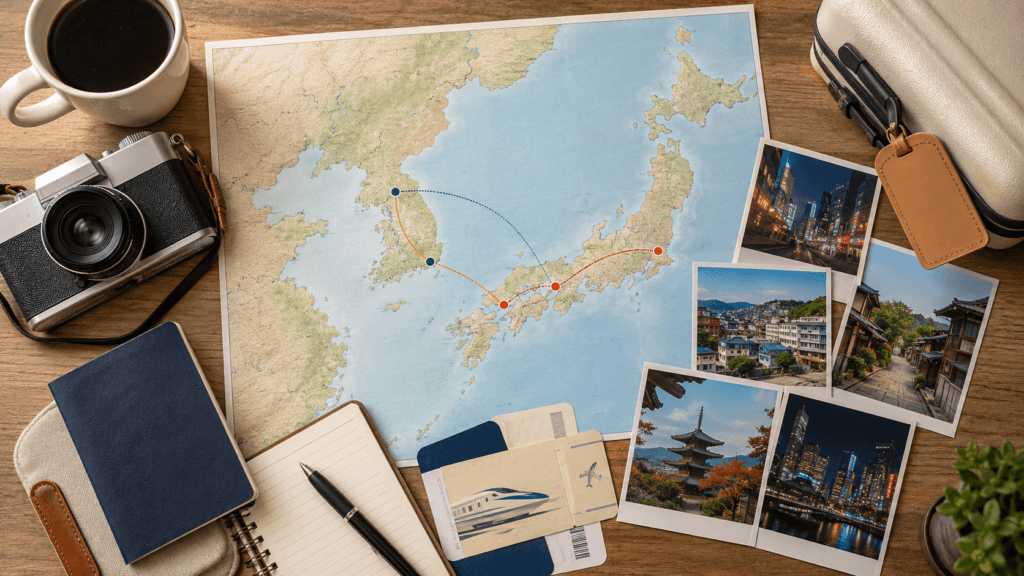
Planning a Japan and Korea itinerary is one of the easiest ways to visit two Asian countries in one trip.
Japan gives you temples, trains, ramen, sushi, anime, old streets and huge cities that seem to have their own weather system. South Korea gives you palaces, Korean BBQ, cafes, shopping, K-pop, skincare, night views and neighborhoods that can quietly steal your afternoon.
The two countries are close, well connected by flights and easy to combine for first-time visitors. But the route still needs a little discipline.
The goal is not to collect cities like airport fridge magnets. The goal is to enjoy both countries without needing a vacation from your vacation.
This guide keeps the route practical: how many days you need, where to start, when to fly, when to take trains, and how to enjoy Japan and Korea without turning the trip into a luggage relay race.
For a broader regional comparison, you may also want to read our East Asia vs Southeast Asia guide. If you are still choosing your overall Asia route, start with our Asia travel itinerary 2026 guide first.
Quick Answer: Best Japan and Korea Itinerary
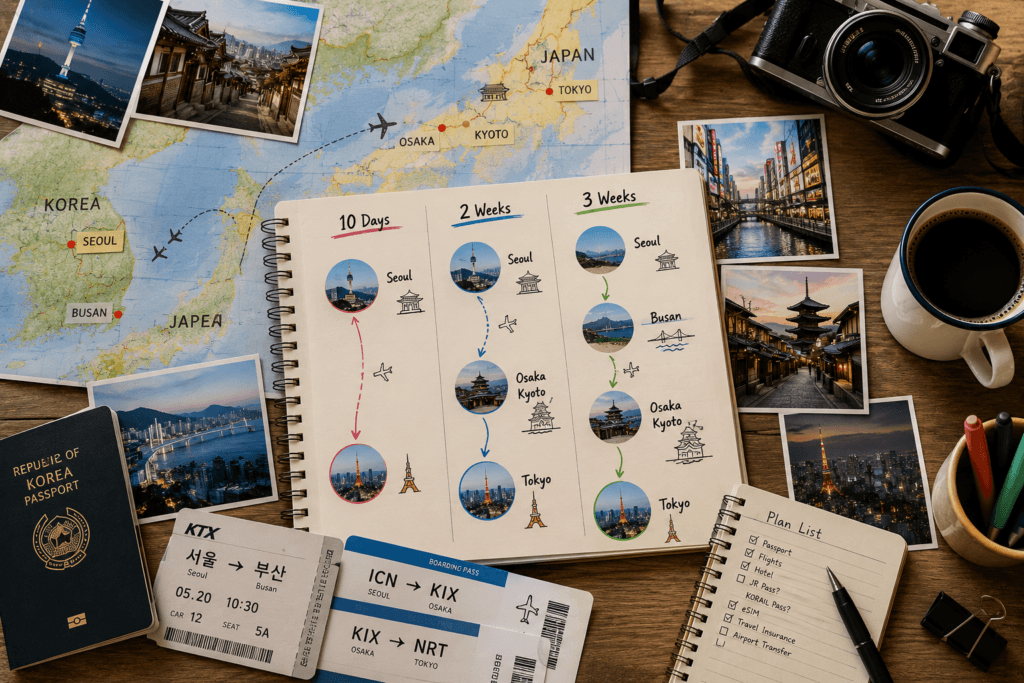
For most first-time visitors, the best Japan and Korea itinerary is:
Seoul → Osaka/Kyoto → Tokyo
This route works especially well for a 2-week trip.
If you only have 10 days, keep it simple:
Seoul → Tokyo
If you have 3 weeks, add Busan and slow the Japan section down:
Seoul → Busan → Osaka/Kyoto → Tokyo
Here is the simple version:
| Trip Length | Best Route | Best For |
|---|---|---|
| 10 days | Seoul + Tokyo | Short trip, city travel, pop culture |
| 2 weeks | Seoul + Osaka/Kyoto + Tokyo | Best first-time route |
| 2 weeks alternative | Seoul + Busan + Tokyo | More Korea-focused trip |
| 3 weeks | Seoul + Busan + Osaka/Kyoto + Tokyo | Best balanced route |
| 1 month | Korea + Japan slow route | Travelers who want more depth |
The sweet spot is 2 weeks. It gives the trip enough room to breathe without making your calendar look like a train timetable with feelings.
Is Japan and Korea a Good First Asia Trip?
Yes, Japan and South Korea are one of the best two-country combinations in Asia for first-time visitors.
This route is especially good if you want:
- Big cities
- Food
- Shopping
- Pop culture
- Easy transport
- Clean and organized travel days
- A mix of tradition and modern life
- Short international flights
- Strong airport connections
Japan and Korea also feel different enough to make the trip exciting. Seoul and Tokyo are both huge modern cities, but they do not feel the same. Kyoto and Osaka add a different side of Japan, while Busan adds coastal energy to Korea.
This itinerary is ideal for travelers interested in K-pop, anime, gaming, beauty, cafes, temples, palaces, street food and city neighborhoods.
It is not the cheapest Asia route. Thailand and Vietnam will usually be better for budget travelers. But for comfort, convenience and variety, Japan and Korea are hard to beat.
How Many Days Do You Need for Japan and Korea?
You can visit Japan and Korea in 10 days, but 2 weeks is much better.
A realistic guide:
- 7 days: Choose only one country
- 10 days: Seoul + Tokyo
- 2 weeks: Seoul + Osaka/Kyoto + Tokyo
- 3 weeks: Seoul + Busan + Osaka/Kyoto + Tokyo
- 1 month: Add more cities, day trips and slower stays
For a first trip, do not try to include Seoul, Busan, Tokyo, Kyoto, Osaka, Nara, Hiroshima and Mount Fuji in 10 days.
It looks impressive in a notes app. It feels less impressive when you are dragging luggage through your fourth train station before breakfast.
If you only have 10 days, focus on the two capitals.
If you have 2 weeks, add Osaka and Kyoto.
If you have 3 weeks, add Busan and give each country more breathing room.
Should You Start in Japan or Korea?
There is no single correct direction. The best route depends on flight prices, airport convenience and where you want to end your trip.
Start in Korea If…
Start in South Korea if:
- Your best flight arrives in Seoul
- You want an easier first landing
- You care more about K-pop, K-beauty or Korean food
- You want to end with Japan’s bigger shopping cities
- You plan to visit Busan before flying to Japan
A Korea-first route often looks like this:
Seoul → Busan → Osaka/Kyoto → Tokyo
This is smooth if you have 3 weeks. Seoul is a good arrival city because Incheon Airport is well connected and Seoul is easy to use as a base. From there, you can take the train to Busan, then fly to Japan.
Start in Japan If…
Start in Japan if:
- Flights into Tokyo or Osaka are cheaper
- You want to use Japan’s train network first
- You want to finish with Seoul shopping, cafes or skincare
- You are visiting Kyoto and Osaka before Korea
- Your return flight is better from Seoul
A Japan-first route often looks like this:
Tokyo → Kyoto/Osaka → Seoul
This works well for 10 days to 2 weeks. You can start with Japan’s biggest city, move through western Japan, then fly to Seoul for the final part of the trip.
My Recommendation
For most first-time visitors, I prefer:
Seoul → Osaka/Kyoto → Tokyo
This route starts with Korea, gives you Japan’s cultural side in the middle and ends with Tokyo, which is an easy final city for shopping, food and international departures.
But if your flight prices strongly favor the opposite direction, follow the flights. Airfare often has stronger opinions than travel bloggers.
10-Day Japan Korea Itinerary: Seoul + Tokyo
If you only have 10 days, keep your Japan and Korea itinerary simple.
Seoul and Tokyo are already big enough to fill the trip without inviting three more cities to sit on your suitcase.
The best route is:
Seoul → Tokyo
This gives you two major cities without adding too many travel days.
Day 1: Arrive in Seoul
Arrive in Seoul and keep the first day light.
Focus on:
- Airport transfer
- Hotel check-in
- A simple dinner
- A short walk near your hotel
Do not plan a palace, market, shopping district and night view on arrival day. Jet lag does not respect ambition.
If you are landing at Incheon, a future Incheon Airport to Seoul guide can help you choose between train, bus, taxi and airport transfer.
Days 2 to 4: Explore Seoul
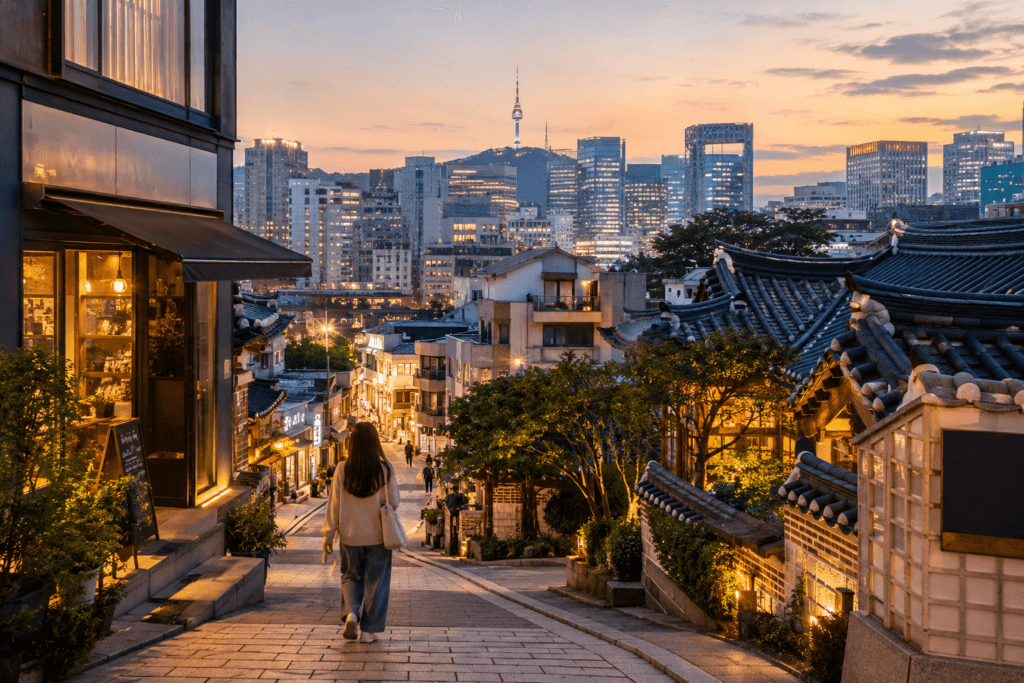
Spend your first full days exploring Seoul.
Good first-time areas include:
- Gyeongbokgung Palace
- Bukchon Hanok Village
- Insadong
- Myeongdong
- Hongdae
- Seongsu-dong
- Han River
- N Seoul Tower
Seoul is spread out, so group nearby neighborhoods together. Gyeongbokgung, Bukchon and Insadong work well on the same day. Myeongdong and N Seoul Tower also pair naturally.
A Seoul subway guide is useful before arrival because Seoul is easy once you understand the system, but mildly confusing when you are standing at the wrong exit holding coffee and hope.
Day 5: Seoul Flexible Day
Use this day for whatever matches your travel style.
Good options include:
- Shopping and skincare
- Cafe hopping
- A K-pop or pop culture route
- A palace and traditional village day
- A day trip from Seoul
- More food neighborhoods
This flexible day matters. Seoul has a way of making travelers add three new places to the list every morning.
Day 6: Fly from Seoul to Tokyo
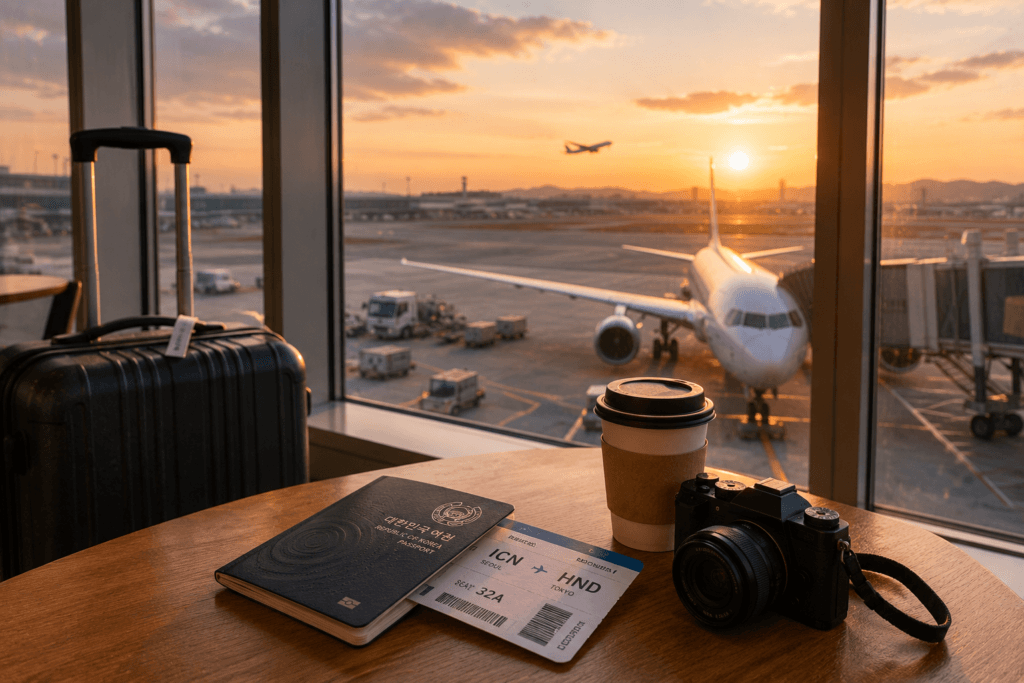
Fly from Seoul to Tokyo.
For most travelers, flying is the easiest way to travel between South Korea and Japan. You can use Incheon or Gimpo on the Korea side, and Narita or Haneda on the Tokyo side.
Gimpo to Haneda can be very convenient if prices and schedules work, because both airports are closer to the city than Incheon and Narita.
Do not fill this day with major sightseeing. International travel days are sneaky; they look short on paper and then quietly eat your afternoon.
Days 7 to 9: Explore Tokyo
Spend three full days in Tokyo.
Good first-time areas include:
- Shibuya
- Shinjuku
- Harajuku
- Asakusa
- Ueno
- Ginza
- Akihabara
- Tsukiji outer market
- teamLab or another major attraction
Tokyo is huge, so avoid crossing the city too many times in one day. Pick one or two main areas per day and explore properly.
Tokyo rewards wandering. Some of the best moments happen between the famous spots.
Day 10: Depart from Tokyo
Use the final day for a relaxed breakfast, last shopping or one nearby neighborhood before your flight.
This 10-day route is short, but it works because it does not try to do too much.
2-Week Japan Korea Itinerary: Seoul + Osaka/Kyoto + Tokyo
For most first-time visitors, 2 weeks is the best length for a Japan and Korea itinerary.
The best route is:
Seoul → Osaka/Kyoto → Tokyo
This route gives you Korea’s capital, Japan’s traditional and food-focused west, and Japan’s biggest modern city.
Days 1 to 4: Seoul
Start with four days in Seoul.
Suggested plan:
- Day 1: Arrival and easy dinner
- Day 2: Gyeongbokgung, Bukchon and Insadong
- Day 3: Myeongdong, N Seoul Tower and shopping
- Day 4: Hongdae, Seongsu-dong, Han River or cafe neighborhoods
This gives you a balanced first look at Seoul: history, food, shopping, cafes and city views.
If you want a deeper Korea section later, a Seoul 5-day itinerary can help you stretch this part without stuffing the schedule.
Day 5: Fly to Osaka
Fly from Seoul to Osaka.
Most travelers will use Incheon or Gimpo to Kansai International Airport.
After arrival, keep the evening simple. Stay in Osaka if you want food, nightlife and easy train access. Stay in Kyoto if you want a quieter traditional atmosphere, though hotel prices can be higher in peak seasons.
For a first trip, Osaka is often the easier base.
Days 6 to 8: Osaka, Kyoto and Nara
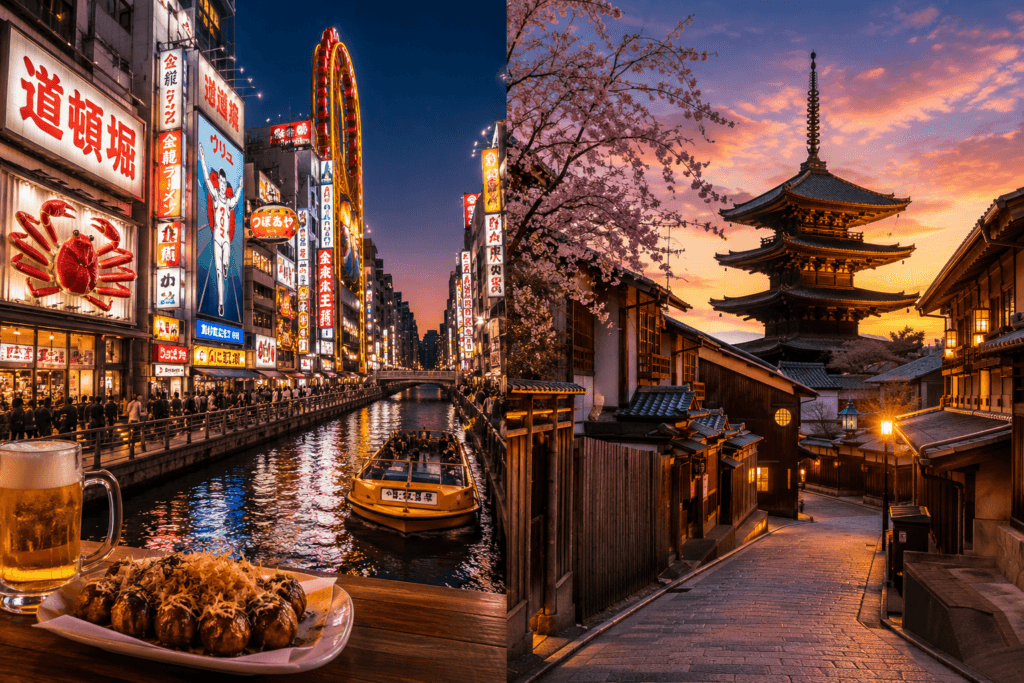
Use these days for western Japan.
A simple plan:
- Day 6: Osaka food and neighborhoods
- Day 7: Kyoto temples and old streets
- Day 8: Nara day trip or more Kyoto
Osaka is great for food and casual city energy. Kyoto is better for temples, gardens and traditional streets. Nara is an easy day trip if you want temples, deer and a slower atmosphere.
Do not try to visit every famous Kyoto temple in one day. Kyoto is beautiful, but even beauty becomes suspicious after your fifth staircase and third wrong bus stop.
Day 9: Travel to Tokyo
Travel from Osaka or Kyoto to Tokyo.
The Shinkansen is the classic option. You can also fly, but the train is usually easier city-to-city because you avoid airport transfers.
This is also where many travelers wonder if they need a JR Pass. Do not buy a nationwide JR Pass automatically. For this route, individual train tickets or regional passes may work better depending on your exact plans.
Days 10 to 13: Tokyo

Spend four days in Tokyo.
Suggested plan:
- Day 10: Shibuya and Harajuku
- Day 11: Asakusa, Ueno and Akihabara
- Day 12: Shinjuku, cafes, shopping or nightlife
- Day 13: Flexible day, museums, themed attractions or day trip
Tokyo is a city where interests matter. Anime fans, food lovers, fashion travelers, museum people and cafe hunters can all build very different Tokyo days.
Leave one flexible day. Tokyo always has one more neighborhood hiding in its sleeve.
Day 14: Depart from Tokyo
Use your final day for last shopping, airport transfer and a calm goodbye to Japan.
This 2-week itinerary is the best overall Japan and Korea route for most travelers because it has variety without being too rushed.
2-Week Alternative: Seoul + Busan + Tokyo
If you want to see more of South Korea, choose this route:
Seoul → Busan → Tokyo
This is a good option if your trip is more Korea-focused or if you want a coastal city before Japan.
Days 1 to 5: Seoul
Spend five days in Seoul.
You can follow a similar plan:
- Palaces and traditional neighborhoods
- Shopping and skincare
- Cafe neighborhoods
- Food markets
- Han River or city views
- A flexible final Seoul day
Five days gives Seoul more room. You can move slower and avoid turning every day into a subway marathon.
Days 6 to 8: Busan
Take the train from Seoul to Busan.
Busan gives the trip a different mood: beaches, seafood, coastal views and a more relaxed city rhythm.
Good first-time stops include:
- Haeundae Beach
- Gwangalli Beach
- Gamcheon Culture Village
- Jagalchi Market
- Haedong Yonggungsa Temple
If your route includes Seoul and Busan, a KORAIL Pass may be worth comparing with individual train tickets. It is usually unnecessary if you only stay in Seoul.
A Busan 3-day itinerary can help organize this part later.
Day 9: Fly from Busan to Tokyo
Fly from Busan to Tokyo.
Busan’s Gimhae Airport has international routes to Japan, and this can save you from backtracking to Seoul.
Days 10 to 14: Tokyo
Spend the final five days in Tokyo.
This route is simpler than adding Kyoto and Osaka. It works best if you want Korea to be the main focus and Japan to be mostly Tokyo.
3-Week Japan Korea Itinerary: Seoul + Busan + Osaka/Kyoto + Tokyo
If you have 3 weeks, this is the best balanced route:
Seoul → Busan → Osaka/Kyoto → Tokyo
This route gives you two strong Korean cities and three major Japan travel styles: Osaka food, Kyoto culture and Tokyo modern city life.
Days 1 to 6: Seoul
With six days in Seoul, you can move at a better pace.
Suggested plan:
- Day 1: Arrival
- Day 2: Gyeongbokgung, Bukchon and Insadong
- Day 3: Myeongdong, N Seoul Tower and shopping
- Day 4: Hongdae, Seongsu or Yeonnam
- Day 5: Han River, museums, markets or local neighborhoods
- Day 6: Day trip or flexible day
This is enough time to enjoy Seoul beyond the first famous sights.
Days 7 to 9: Busan
Take the train to Busan and spend three days there.
Suggested plan:
- Day 7: Arrive, then visit Gwangalli or Haeundae
- Day 8: Gamcheon Culture Village and Jagalchi Market
- Day 9: Haedong Yonggungsa Temple or beach day
Busan gives your itinerary a coastal break before Japan. It is also a good way to avoid making the trip feel like only capital cities.
Day 10: Fly to Osaka
Fly from Busan to Osaka if possible. This route can be more efficient than returning to Seoul first.
Arrive in Osaka and keep the evening light.
Days 11 to 14: Osaka, Kyoto and Nara
Spend four days in western Japan.
Suggested plan:
- Day 11: Osaka food and neighborhoods
- Day 12: Kyoto temples and old streets
- Day 13: More Kyoto or Arashiyama
- Day 14: Nara day trip or Osaka flexible day
Four days gives this region more breathing room than the 2-week route.
Day 15: Travel to Tokyo
Take the train from Osaka or Kyoto to Tokyo.
Again, compare individual Shinkansen tickets, regional passes and your total Japan route before buying any rail pass.
Days 16 to 20: Tokyo
Spend five days in Tokyo.
Suggested plan:
- Day 16: Shibuya and Harajuku
- Day 17: Asakusa, Ueno and Akihabara
- Day 18: Shinjuku and west Tokyo
- Day 19: Ginza, Tsukiji, museums or shopping
- Day 20: Day trip or flexible day
Possible day trips include Hakone, Kamakura, Nikko or Yokohama, depending on your interests and season.
Day 21: Depart from Tokyo
Use the final day for airport transfer, last meals and shopping.
This 3-week route is the best version if you want Japan and Korea to feel balanced instead of rushed.
Best Time to Visit Japan and Korea
The best time to visit Japan and Korea together is usually:
- April to May
- October to November
Spring and autumn work well because both countries are good for walking, city travel and seasonal scenery.
Spring
Spring is beautiful in both Japan and Korea. Cherry blossoms, mild weather and outdoor neighborhoods make this a very popular time.
The downside is crowds and higher hotel prices. Cherry blossom season is not a secret. The whole internet received the memo.
Summer
Summer can be hot, humid and rainy in both countries.
It is still possible to travel, but expect heat, occasional heavy rain and more indoor breaks. Choose hotels near transport and plan slower days.
Autumn
Autumn is one of the best times for this route. The weather is comfortable, and fall colors can be beautiful in Japan and Korea.
Kyoto, Seoul and popular foliage areas can get crowded, so book accommodation early.
Winter
Winter is cold, especially in South Korea and northern Japan.
But winter can still be excellent for city lights, hot food, shopping, cafes, snow trips and fewer crowds in some areas.
How to Travel Between Japan and Korea
For most travelers, flying is the easiest way to travel between Japan and South Korea.
Common flight routes include:
- Seoul/Incheon to Tokyo/Narita
- Seoul/Gimpo to Tokyo/Haneda
- Seoul/Incheon to Osaka/Kansai
- Busan/Gimhae to Osaka/Kansai
- Busan/Gimhae to Fukuoka
- Tokyo/Narita or Haneda to Seoul/Incheon or Gimpo
Choose airports based on your full route, not only the cheapest fare.
A cheap flight can become less attractive if it lands far from your hotel, arrives late at night or forces you to backtrack.
What About Ferries?
There are ferry options between parts of Korea and Japan, especially around Busan and Fukuoka. But for most first-time visitors, flights are easier.
Ferries can be interesting if you are building a slower route around Busan and Kyushu, but they are not usually the simplest choice for Seoul, Tokyo, Kyoto and Osaka itineraries.
Do You Need a JR Pass or KORAIL Pass?
Do not buy a nationwide JR Pass automatically.
For a Japan and Korea itinerary, the JR Pass is not always good value, especially if your Japan route is mainly Osaka/Kyoto to Tokyo with limited long-distance train travel.
Before buying a JR Pass, compare:
- Individual Shinkansen tickets
- Regional rail passes
- Domestic flights
- Your exact number of long-distance train rides
- Whether you are entering Japan through Osaka or Tokyo
If you are only taking one major Shinkansen ride from Osaka or Kyoto to Tokyo, individual tickets may be better.
For South Korea, a KORAIL Pass may be useful if your route includes multiple long-distance train rides, such as Seoul to Busan and possibly Gyeongju. But if you only stay in Seoul, you do not need it.
The simple rule:
- Japan city-only route: probably no JR Pass
- Osaka/Kyoto + Tokyo only: compare first
- Multiple long-distance Japan train rides: pass may help
- Seoul only: no KORAIL Pass
- Seoul + Busan + Gyeongju: compare KORAIL Pass
Train passes can save money, but only when they match your actual route. They are not magic tickets. They are math in travel clothing.
Entry Rules and Travel Paperwork in 2026
Before booking, check entry requirements for both Japan and South Korea based on your passport.
South Korea
For South Korea, travelers from visa-free countries should check whether K-ETA applies to their passport before departure. South Korea has extended temporary K-ETA exemption for eligible travelers until December 31, 2026.
Even if you are exempt, check official rules before travel because requirements can differ by nationality.
Japan
For Japan, many travelers can enter visa-free depending on nationality. Travelers who need a short-term tourism visa may be able to use the JAPAN eVISA system depending on nationality and residence.
Always confirm visa rules through official sources before booking international flights.
Passport and Travel Checks
Before departure, check:
- Passport validity
- Visa or electronic travel authorization rules
- Proof of onward travel
- Accommodation address for arrival forms
- Travel insurance
- Mobile data or eSIM
- Airport transfer options
This part is not glamorous, but it keeps the trip from getting ambushed by paperwork at the worst possible moment.
Budget Tips for a Japan and Korea Trip
Japan and Korea are not the cheapest countries in Asia, but you can control costs with smart planning.
Save Money on Accommodation
Stay near public transport instead of chasing only the most famous neighborhood.
In Seoul, areas like Myeongdong, Hongdae, Jongno and Seoul Station can be convenient depending on your route.
In Tokyo, choose areas with strong train access rather than only focusing on Shibuya or Shinjuku.
In Osaka, staying near Namba, Umeda or major stations can save time.
Save Money on Food
Food can be affordable if you mix restaurants with casual meals.
Good budget-friendly options include:
- Korean kimbap shops
- Korean food courts
- Japanese convenience stores
- Ramen shops
- Udon and soba shops
- Department store food halls
- Local bakeries
- Street food areas
You do not need expensive meals every day. Some of the best food in Japan and Korea comes without tablecloths or ceremony.
Save Money on Transport
Avoid unnecessary hotel changes. Every move costs time and sometimes money.
For Tokyo and Seoul, pick a good base and use public transport.
For Japan trains, compare individual tickets before buying a pass.
For Korea trains, compare KTX tickets and KORAIL Pass only if you have multiple intercity rides.
Common Mistakes to Avoid
Mistake 1: Adding Too Many Cities
The biggest mistake is trying to see Seoul, Busan, Tokyo, Kyoto, Osaka, Nara, Hiroshima and Mount Fuji in one short trip.
Pick fewer places and enjoy them properly.
Mistake 2: Treating Travel Days Like Sightseeing Days
Flying from Korea to Japan or taking the Shinkansen across Japan takes time.
Do not expect to do three major attractions on a transfer day.
Mistake 3: Buying Rail Passes Too Quickly
A rail pass is useful only if it saves money for your exact route.
Do the math before buying.
Mistake 4: Ignoring Airport Locations
Tokyo has Narita and Haneda. Seoul has Incheon and Gimpo. Osaka uses Kansai International Airport.
Airport choice can change your travel day more than the flight time itself.
Mistake 5: Visiting During Peak Season Without Booking Early
Spring and autumn are beautiful, but hotels can get expensive.
Book early if you are traveling during cherry blossom or autumn foliage season.
FAQ: Japan Korea Itinerary
Is Japan and Korea a good first Asia trip?
Yes. Japan and South Korea are one of the best two-country combinations for first-time visitors to Asia. They are close, well connected and ideal for cities, food, shopping, culture and pop culture.
How many days do you need for Japan and Korea?
You need at least 10 days for a simple Seoul and Tokyo trip. Two weeks is better for Seoul, Osaka/Kyoto and Tokyo. Three weeks is ideal if you also want to add Busan.
Is 10 days enough for Japan and Korea?
Yes, 10 days is enough if you keep the route simple. Seoul and Tokyo are the best choices for a short Japan and Korea itinerary. Adding too many extra cities will feel rushed.
Should I visit Japan or Korea first?
Either direction can work. Start where flights are cheaper or more convenient. For most first-time visitors, Seoul to Osaka/Kyoto to Tokyo is a smooth route, but Tokyo to Kyoto/Osaka to Seoul also works well.
Can I visit Seoul, Tokyo and Kyoto in 2 weeks?
Yes. A good 2-week route is Seoul for 4 days, Osaka/Kyoto for 4 days and Tokyo for 5 days, with travel days between them.
Is Busan worth adding to a Japan and Korea itinerary?
Busan is worth adding if you have at least 2 weeks and want to see more of South Korea. It is even better with 3 weeks. If your trip is only 10 days, skip Busan and focus on Seoul and Tokyo.
Do I need a JR Pass for a Japan and Korea itinerary?
Not always. If your Japan route only includes Osaka/Kyoto to Tokyo, individual train tickets may be better. Compare your exact route before buying a JR Pass.
Do I need a KORAIL Pass in South Korea?
You do not need a KORAIL Pass if you only stay in Seoul. It may be worth comparing if you plan to travel from Seoul to Busan or include several long-distance train rides.
What is the best month to visit Japan and Korea?
April, May, October and November are usually the best months for a Japan and Korea itinerary. Spring and autumn offer good weather, but they can also be crowded and expensive.
How do you travel between Japan and South Korea?
Flying is the easiest option for most travelers. Common routes include Seoul to Tokyo, Seoul to Osaka, Busan to Osaka and Busan to Fukuoka.
Final Thoughts: Japan and Korea Are Easy to Combine, But Do Not Rush
A Japan and Korea itinerary is one of the best East Asia trips for first-time visitors.
The countries are close, the cities are exciting and the route can be very smooth if you do not overload it.
For 10 days, choose Seoul and Tokyo.
For 2 weeks, choose Seoul, Osaka/Kyoto and Tokyo.
For 3 weeks, add Busan and slow the whole trip down.
The best Japan and Korea itinerary is not the one with the most cities. It is the one where you actually have time to enjoy the cities you choose.
Seoul, Busan, Osaka, Kyoto and Tokyo are not going anywhere.
The ramen, BBQ, temples, cafes, night views and train platforms will still be there when you arrive. They are not running away. Your itinerary should not either.