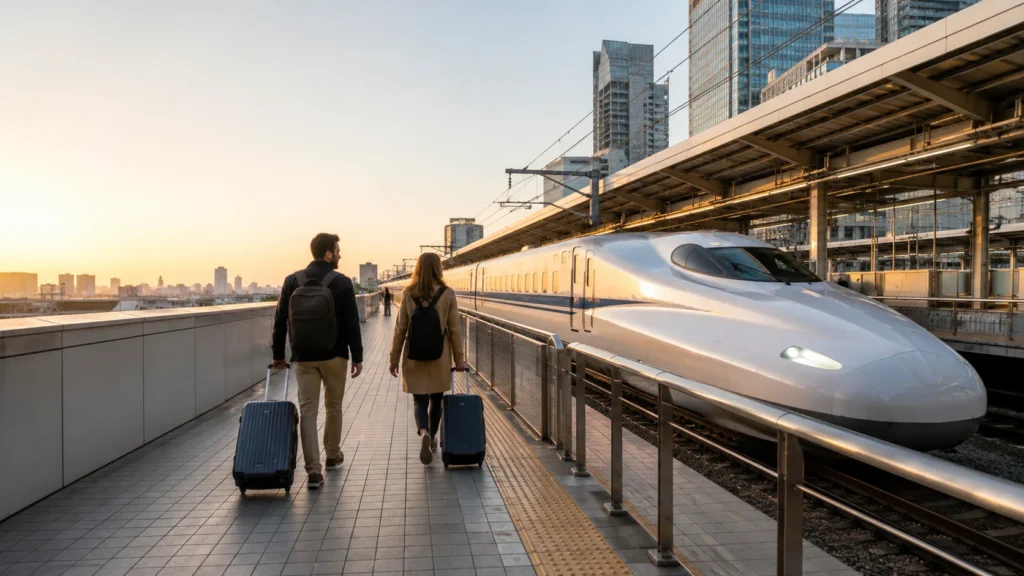
The Tokyo-to-Kyoto Shinkansen is easy once you are on it. The harder part happens before the platform: Tokyo or Shinagawa, Nozomi or Hikari, paper ticket or QR code, and where the large suitcase goes.
For most travelers, the best answer is a reserved ordinary-class seat on a Nozomi from Tokyo or Shinagawa to Kyoto. The ride takes roughly 2 hours 10 minutes, direct trains run frequently, and a regular one-way reserved fare is about ¥14,000. The exact price varies by travel season and booking product, so check the final amount before paying.
This guide follows the decisions in the order you actually make them. Information was checked on September 6, 2026 against JR Central, SmartEX and Japan Rail Pass sources.
The Five-Minute Booking Answer
| Decision | Best default | Choose something else when… |
|---|---|---|
| Departure station | Tokyo Station | Shinagawa is easier from Shibuya, Shinjuku or southern Tokyo |
| Train | Nozomi | You are using a Japan Rail Pass without the Nozomi supplement |
| Seat | Reserved ordinary car | You are traveling off-peak and want maximum flexibility |
| Fuji view | Seat E in an ordinary car | You prefer two-seat-side convenience over chasing a weather-dependent view |
| Luggage | Normal seat for bags up to 160cm total dimensions | Reserve an oversized-baggage seat for bags over 160cm and up to 250cm |
| Booking method | SmartEX if your card registers successfully | Use a JR ticket machine or staffed counter if online payment fails |
The train is normally better than flying. Airports add transfers, security and waiting; buses take much longer.
If Tokyo and Kyoto are part of a longer first trip, build the route with our Japan itinerary for 7 days, 10 days and 2 weeks before buying separate tickets.
First Decision: Tokyo Station or Shinagawa?
Both stations are on the same Tokaido Shinkansen line. Choosing the nearer one can save more time than choosing a train that arrives five minutes earlier.
Use Tokyo Station when you stay on the east or north side
Tokyo Station usually works best for Marunouchi, Ginza, Nihombashi, Asakusa, Ueno and much of eastern Tokyo. It is the first stop for westbound Tokaido Shinkansen trains, so you have more time to find your car and settle in.
Follow signs for the Tokaido and Sanyo Shinkansen, not the Tohoku, Joetsu or Hokuriku lines. Give yourself 25 to 30 minutes inside Tokyo Station on a first visit.
Use Shinagawa when you stay on the west or south side
Shinagawa can be easier from Shibuya, Shinjuku, Ebisu, Roppongi, Haneda Airport and southern Tokyo. The station is smaller than Tokyo Station, and the Shinkansen transfer is generally less theatrical.
Do not travel north to Tokyo Station simply because your ticket search defaulted there. A Nozomi that leaves Tokyo stops at Shinagawa a few minutes later. Board at Shinagawa and save the cross-city detour.
Our where to stay in Tokyo guide explains how the city’s neighborhoods affect these transport days. A cheap hotel can become less cheap after three inconvenient station crossings and one taxi taken in surrender.
Nozomi, Hikari or Kodama?
All three use the same line and arrive at Kyoto. They do not use your time in the same way.
Nozomi: the sensible default
Nozomi is the fastest and most frequent option. Most Tokyo–Kyoto journeys take about 2 hours 10 minutes, with no change. If you buy an ordinary standalone ticket, this is usually the train to choose.
During major peak travel periods, all Nozomi seats are reserved. JR Central applies this policy around selected holiday periods, including Golden Week, Obon and New Year dates. Do not arrive with a non-reserved-seat plan copied from an old article.
Hikari: useful for Japan Rail Pass holders
Hikari makes more stops and commonly takes around 2 hours 35 to 45 minutes. The nationwide Japan Rail Pass covers Hikari without an extra Nozomi ticket, so it is often the practical pass-holder choice.
Hikari trains are less frequent. Search by arrival time, not just departure time, and avoid an unnecessary transfer.
Kodama: rarely the best full-route choice
Kodama stops at every station and takes close to four hours. It suits smaller-station stops or certain discounts, not a normal Tokyo–Kyoto journey.
What Does the Tokyo-to-Kyoto Shinkansen Cost?
A regular adult one-way reserved ordinary-class ticket is roughly ¥14,000 on Nozomi. Non-reserved seating is slightly cheaper when offered. Green Car costs substantially more and buys a wider seat, quieter cabin and a 2+2 layout rather than ordinary class’s 2+3 layout.
Treat ¥14,000 as a planning figure, not a guaranteed checkout total. Reserved-seat prices change slightly between off-peak, regular, peak and highest-peak periods. Discounted SmartEX products also have limited inventory and their own change conditions.
The old SmartEX round-trip discount ended on March 31, 2026. Ignore older instructions that still tell you to select it.
Early-purchase products may be cheaper, but read the train restriction before buying. A discount loses its charm when your plans change and the ticket cannot follow.
Is the Japan Rail Pass worth it for this route?
Not for a simple Tokyo–Kyoto round trip by itself. As of April 2026, a seven-day ordinary nationwide Japan Rail Pass costs ¥50,000. Two regular one-way tickets are far below that.
The pass may work for a broader route with several long-distance journeys. Calculate every major segment first.
The pass normally covers Hikari and Kodama on this line. To use Nozomi, pass holders need a separate ONLY WITH JAPAN RAIL PASS NOZOMI MIZUHO Ticket; the Tokyo–Kyoto supplement is ¥4,960 each time. That supplement does not replace the pass. It works only with a valid pass.
How to Buy the Ticket Without Losing an Hour
Option 1: SmartEX
SmartEX is JR Central’s official online reservation service. It lets you select a train and seat, then board with an assigned IC card or QR ticket. Registration is free.
Standard reservations open at 10:00 a.m. one month before travel. SmartEX also accepts limited long-range requests, with the final train and seat confirmed closer to departure. Last-minute bookings generally close four minutes before departure.
Some foreign cards fail during registration or authentication. Try another eligible card, then use an official station machine or counter.
If you link an IC card, use the same card at the Shinkansen gate. A mobile Suica and a physical Suica are different credentials even if they live in the same emotional family. Each traveler needs an individual QR ticket or assigned IC card.
Option 2: station ticket machine
English-language reserved-seat machines are available at major JR stations. Select the Tokaido Shinkansen, Kyoto, date, train and seat. Most tourists need both the base fare and limited-express ticket.
Buy before the travel morning during cherry blossom season, autumn weekends and Japanese holidays. Same-day seats often exist, but adjacent seats and oversized-baggage spaces can disappear first.
Option 3: staffed JR ticket office
Use the counter for a rail pass, repeated card failure or oversized-luggage help. Bring the date, departure window, traveler count and destination.
A third-party seller can be convenient when your foreign card does not work with the official service. Compare the final price, cancellation terms and ticket collection method—not just the bright “book now” button.
Affiliate disclosure: If you book through this link, we may earn a commission at no extra cost to you. If the official service rejects your card, compare Tokyo–Kyoto train tickets on Trip.com. Check the final price and cancellation conditions before paying.
Reserved or Non-Reserved Seat?
A reserved seat is the better default for first-time visitors. You know the train, car and seat, and you do not need to queue early hoping a group can sit together.
Non-reserved seating can work on a quiet weekday when one traveler values flexibility. It becomes less attractive with children, multiple bags or a fixed Kyoto check-in. During designated peak periods, Nozomi operates with reserved seats only.
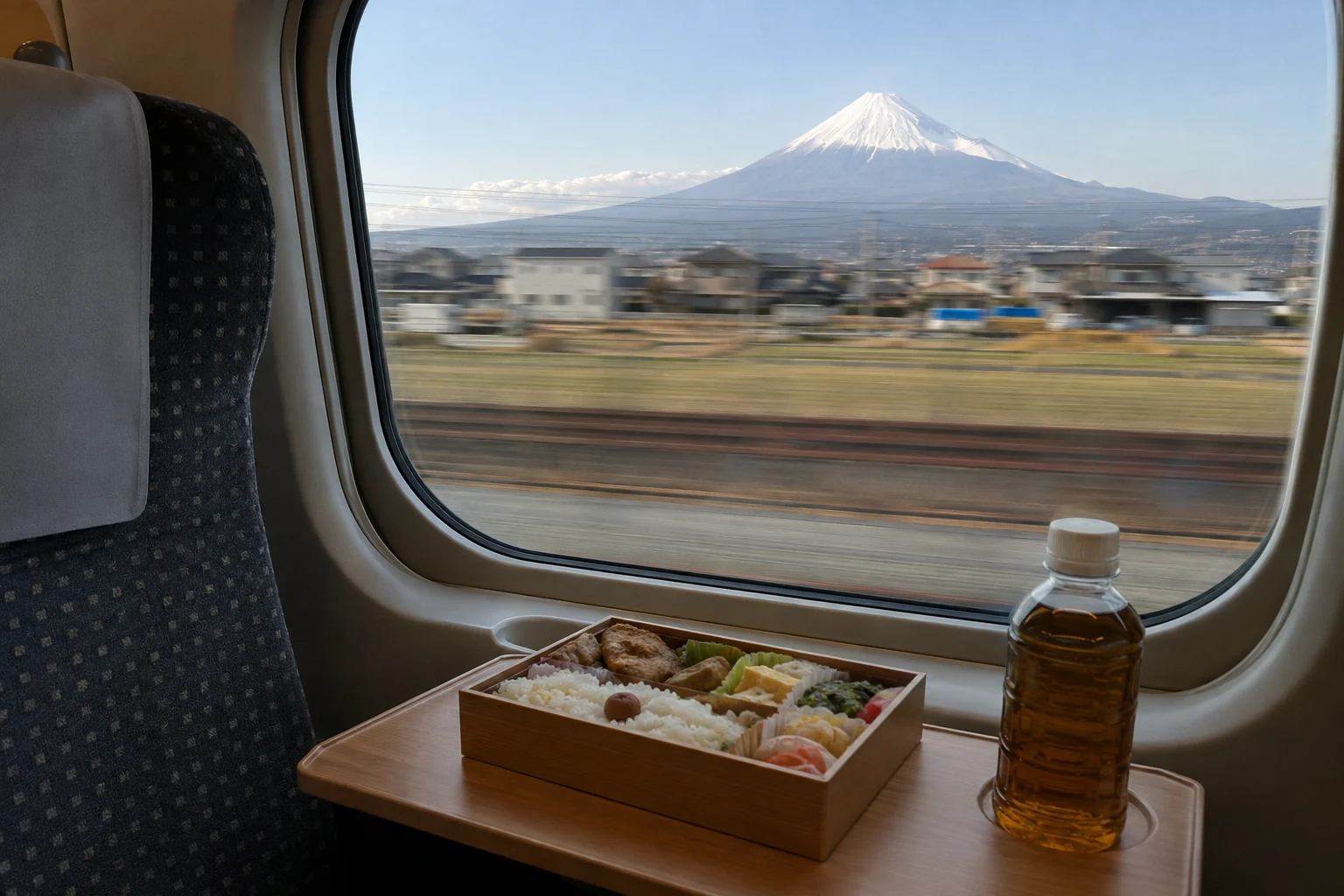
Ordinary cars use a 2+3 layout. The two-seat side is convenient for couples; the three-seat side includes the usual Mount Fuji view when traveling west.
Which seat has the Mount Fuji view?
Choose seat E in ordinary class from Tokyo toward Kyoto. In Green Car’s 2+2 layout, choose the equivalent right-side window seat, usually D.
Fuji appears roughly 40 to 50 minutes after leaving Tokyo, depending on the service. Weather decides whether you see a mountain or a bright wall of cloud. Keep the window area tidy, lower screen brightness, and do not lean across a stranger who booked the view before you did.
The Luggage Rule You Need to Measure at Home
Add your suitcase’s length, width and height.
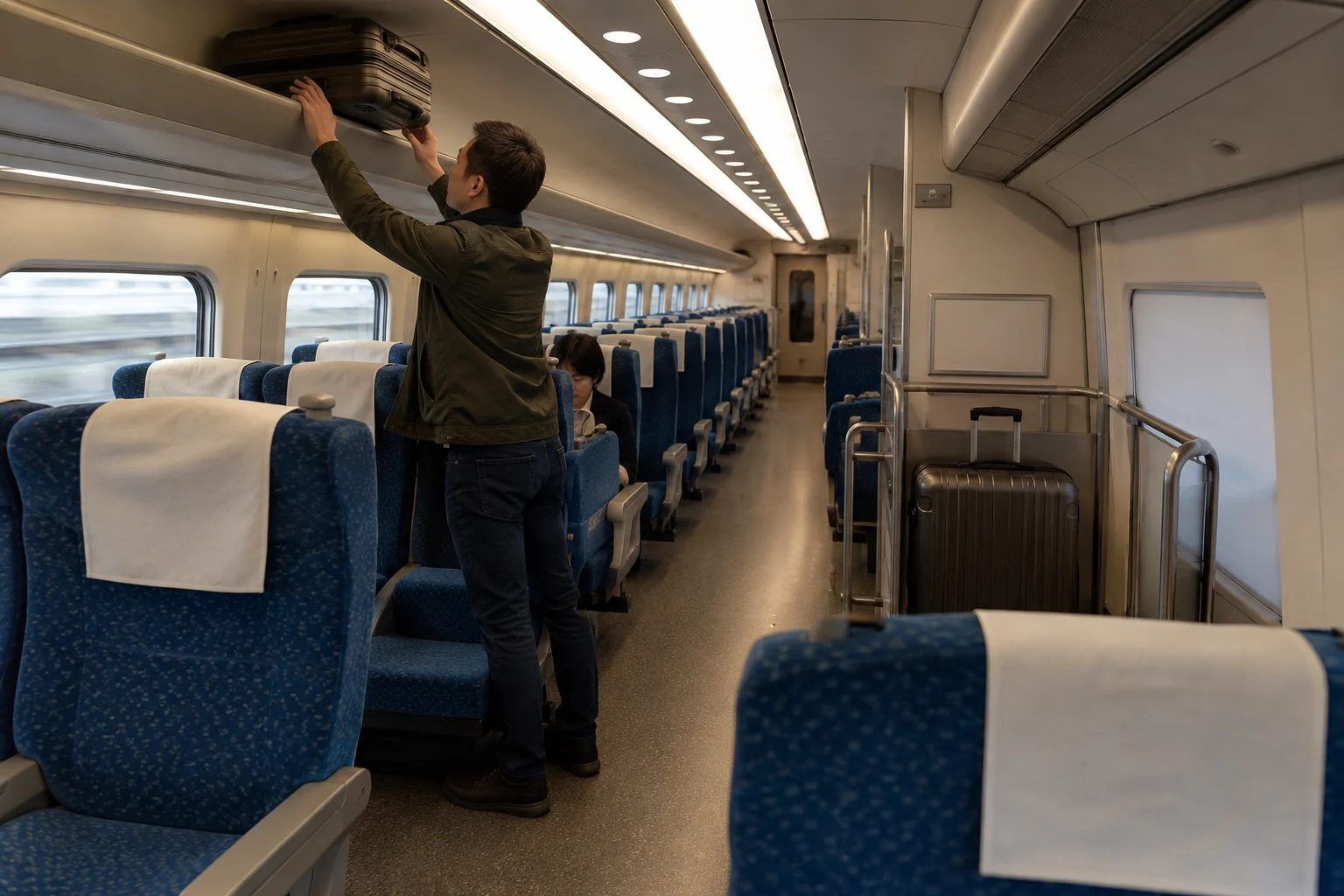
- 160cm or less: no oversized-baggage reservation is required. Use the overhead rack, space at your feet if safe, or available storage areas.
- More than 160cm and up to 250cm: reserve a seat with an oversized baggage area or compartment.
- More than 250cm: it cannot be brought aboard under the Shinkansen oversized-baggage rules.
Traveling with oversized baggage without the required reservation can lead to a ¥1,000 fee, and staff may move the bag to a designated location. The oversized space behind the last row is for passengers who reserved the associated seats; it is not a public suitcase parking lot.
If your large bag does not need to travel with you, hotel-to-hotel luggage forwarding is often easier. Send it at least a day ahead when required and keep one night of clothing, medication and chargers in a smaller bag. Same-day delivery exists on limited routes, but never assume it applies to your hotels without confirmation.
Travel Day: A Sequence That Actually Works
- Check the operating status. Heavy rain, typhoons and rare technical disruptions can change the plan.
- Reach the correct station 30 minutes early. Add more time if collecting tickets or navigating Tokyo Station for the first time.
- Buy food before reaching the platform. Station bento shops can queue at meal times. Trains do not have a dependable full food service for every seat.
- Find the car-position marker. Queue at the platform marker for your numbered car.
- Board promptly and store luggage. Stops are efficient, not meditative.
- Keep the ticket or boarding slip. You may need it at Kyoto’s exit or for a local-line connection.
The departure boards use train names and numbers, such as Nozomi 215. Match the number as well as the time. Several white trains going west is not a sufficiently precise identification system.
Arriving at Kyoto Station
Kyoto Station is central, but Gion, Higashiyama and Arashiyama are not beside it. Go to the hotel first unless an attraction fits the route naturally.
Follow signs for the Central Exit for buses, taxis and many north-side hotels. The Hachijo Exit serves the south side and some airport buses. Check the hotel address before following the crowd.
Kyoto buses can be crowded with luggage. If your room is not ready, use your hotel’s baggage storage or a station locker before sightseeing. Dragging a suitcase onto a packed bus is possible. It is also a fast way to become the main character in everyone else’s commute.
Use our Kyoto itinerary to group temples by area, and check the where to stay in Kyoto guide before deciding whether Kyoto Station or Gion is the better base.
When to Book
Book as soon as plans are stable for:
- cherry blossom weeks in late March and early April;
- Golden Week;
- Obon in August;
- autumn foliage weekends in November;
- the year-end and New Year period;
- any journey requiring several adjacent seats or oversized-baggage space.
Outside those periods, one or two days ahead is often enough. If missing one train would break a timed activity or hotel check-in, book it.
Common Booking Mistakes
Choosing Shin-Osaka instead of Kyoto. Kyoto has its own Shinkansen station. Shin-Osaka is for Osaka and onward connections.
Buying only one component of a paper ticket. A conventional purchase can involve a base-fare ticket and a Shinkansen limited-express ticket. Use both at the gate as instructed.
Assuming every IC card pays the whole fare by stored value. An IC card can act as the registered boarding credential for an online booking, but tapping an unlinked Suica with a ¥2,000 balance does not magically purchase a ¥14,000 reserved seat.
Ignoring the 160cm luggage threshold. Measure all three sides before departure, including wheels and handles.
Booking the last sensible train. One local-line delay, wrong Tokyo Station corridor or leisurely convenience-store visit can erase the buffer.
Expecting Fuji on demand. Book seat E for the chance, not the guarantee.
Frequently Asked Questions
How long is the bullet train from Tokyo to Kyoto?
The fastest Nozomi services take roughly 2 hours 10 minutes. Hikari usually takes about 2 hours 35 to 45 minutes, while all-stop Kodama services take close to four hours.
How much is the Shinkansen from Tokyo to Kyoto in 2026?
Budget about ¥14,000 one way for an adult reserved ordinary-class Nozomi seat. The exact fare varies with the season, seat type and booking product.
Can I use Suica on the Tokyo-to-Kyoto Shinkansen?
Yes, an eligible IC card can be assigned as the boarding credential for a SmartEX reservation. The Shinkansen fare is charged through the reservation, not simply deducted from a small stored-value balance. You can also collect paper tickets or use an eligible QR ticket.
Is Nozomi covered by the Japan Rail Pass?
Not by the pass alone. Pass holders must buy a separate Nozomi/Mizuho ticket before boarding; the Tokyo–Kyoto supplement is ¥4,960. Hikari and Kodama are covered under the pass conditions without that supplement.
Should I book the Shinkansen in advance?
Yes during holidays, spring blossom season, autumn weekends, or when you need adjacent or oversized-luggage seats. On an ordinary weekday, booking one or two days ahead is often sufficient, but a reservation removes unnecessary travel-day risk.
Can I take large luggage on the Shinkansen?
Yes. Bags with total dimensions over 160cm and up to 250cm require a reservation for an oversized-baggage seat or compartment. Bags over 250cm are not accepted under these rules.
Is it better to fly from Tokyo to Kyoto?
Usually no. Kyoto has no major commercial airport, so a flight requires airport transfers at both ends. The Shinkansen runs city center to city center and is normally faster door to door.