
A beautiful hotel can still be the wrong Phu Quoc hotel. If you want dinner outside the resort every evening, a secluded villa may turn each meal into a transport decision. If you came for two days of northern attractions, a southern beach address can spend too much of the holiday on the road.
Choose the area before comparing pools. Start with three questions: do you want to walk out for food, spend most days at the property, or organize the trip around a particular attraction cluster? Those answers are more useful than a list of hotels arranged by star rating.
This guide compares Duong Dong, Long Beach, Ong Lang, the northern resort area and the south around An Thoi and Khem Beach. Recommendations are planning judgments, not personal stay reports. We are not ranking specific hotels or promising that a particular beach, shuttle or facility will be available on your dates.
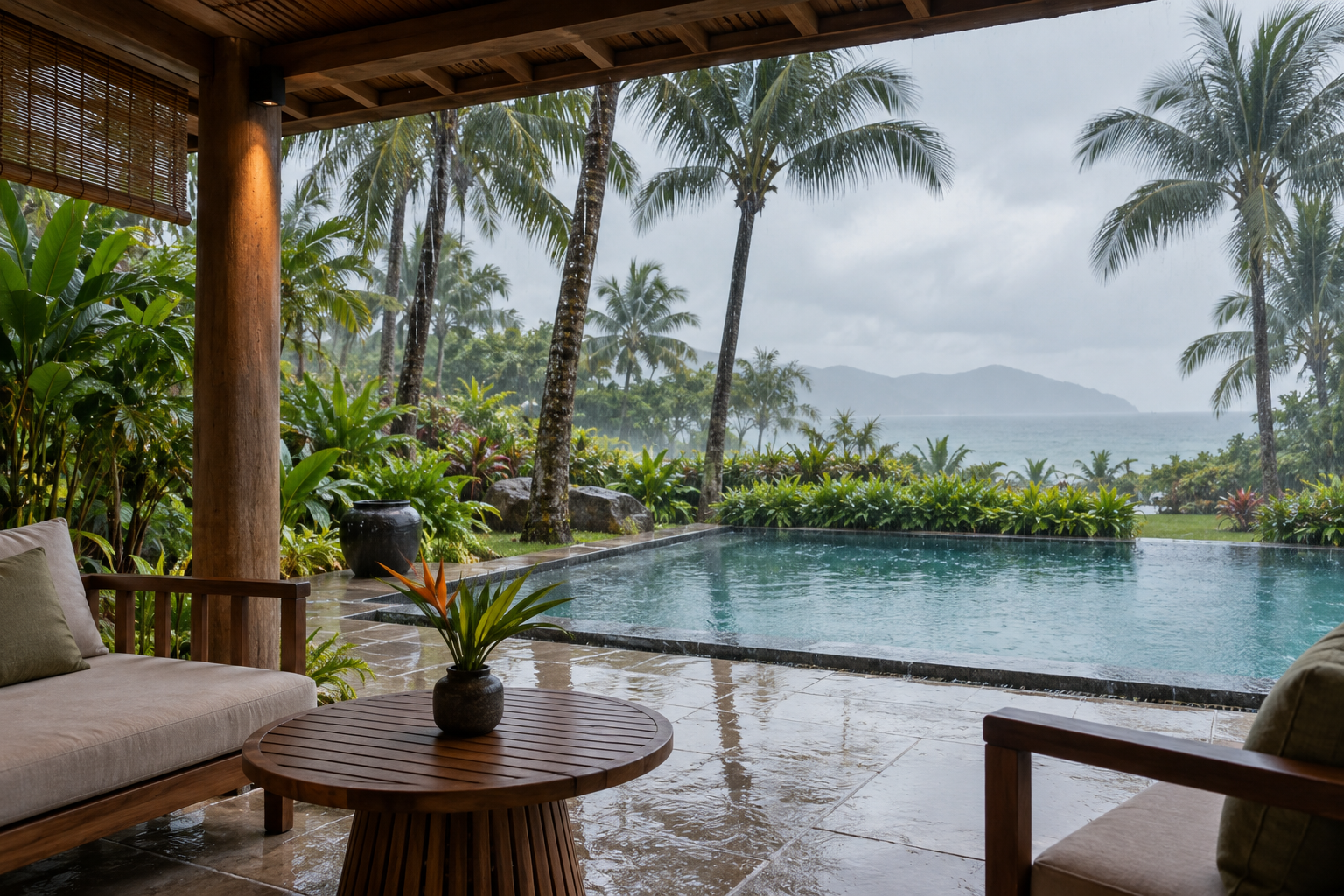
Information checked on October 13, 2026. Hotel rates, room policies, transport, beach conditions and attraction operations can change. Images are AI-generated illustrations of fictional Vietnamese-island-inspired scenes, not photographs of Phu Quoc streets or actual hotels.
Affiliate disclosure: Some booking links below are affiliate links. Asia Travel Lab may earn a commission if you book through them, at no additional cost to you. Compare the final price and conditions before purchasing.
The short answer: match the base to your ordinary evening
For a first visit mixing meals outside, a little sightseeing and beach time, begin your search around Duong Dong and the nearby Long Beach area. Then inspect the exact location. A hotel somewhere on a long beach strip is not automatically a short walk from town.
For a resort-first holiday, compare Ong Lang with beach properties farther north or south. The important question is whether you would still enjoy the property on a day when you do not leave it. For attraction-led travel, select the relevant end of the island rather than a supposedly convenient middle that suits nobody’s priorities.
| Area to investigate | Best starting fit | What to check before booking |
|---|---|---|
| Duong Dong | Town meals, market visits and independent evenings | Noise, walkable routes and whether beach access exists. |
| Long Beach / Bai Truong | Beach-and-town compromise or a resort stay | The exact part of the strip, not just the area label. |
| Ong Lang | A quieter beach-focused base | Nearby meals, road access and transfer arrangements. |
| Bai Dai / Ganh Dau northern area | Northern attractions and resort time | Actual attraction transfers and travel to other island areas. |
| An Thoi / Khem Beach southern area | Southern excursions or a southern beach resort | Town versus resort location, beach access and pickup points. |
The words “best location” need a destination attached. Best for which dinner, which beach entrance, which pickup? Write down your two most important places before opening the hotel map.
Duong Dong: choose it for usable evenings, not a beach fantasy
Duong Dong is the sensible search area when you want town life to be part of the trip. Vietnam Tourism’s Phu Quoc destination guide places the night market near Duong Dong. That makes this area relevant for travelers who want to go out for a meal without treating every evening as a full excursion.

Look at the route between the hotel and your likely evening destinations. A short distance on a map can still involve a busy road, awkward crossings or a poorly lit approach. If walking is essential, ask the property specific questions and inspect recent guest comments about the route.
A town hotel is not necessarily beachfront. If the listing uses sea-view photographs, establish whether the water is accessible from the property, across a road or somewhere else entirely. A balcony view and an easy swim answer different needs.
Noise also needs room-level checking. Ask whether your room faces a road, entertainment venue or internal courtyard. “Quiet hotel” in an old review is less informative than a current explanation of the exact room category you are booking.
This is where we would start for a traveler who enjoys choosing dinner spontaneously and expects only occasional resort-style lounging. We would look elsewhere if a large pool, a direct beach entrance and long afternoons within the hotel are the main reasons for coming.
Long Beach: a useful compromise, with a very important map check
Long Beach, also called Bai Truong, is the west-coast strip running south from Duong Dong. The Accor destination overview distinguishes it from Ong Lang in the northwest and Khem Beach in the south. Those are separate accommodation searches, not interchangeable beach names.
The northern part of a Long Beach search and a resort farther along the coast can give you different holidays. Do not assume every result combines an easy town walk with secluded resort space. Decide which compromise you actually want.
If you want both outside restaurants and beach time, shortlist properties only after checking their precise pin and the route to nearby food. If you want to stay mostly inside a resort, put more weight on room comfort, shaded space, dining and the beach entrance than on proximity to the night market.
Ask what “private beach” means in practical terms: where guests access it, whether reaching it involves a road or shuttle, and whether hotel facilities at the shore are included. The answer matters more than the phrase.
Also distinguish the hotel from similarly named apartments or privately managed units within a larger development. A residence may not include every facility shown in photographs of the neighboring resort. Confirm the pool, breakfast, reception and housekeeping arrangements for your actual booking.
For a flexible first stay, Long Beach is a useful comparison area. It is not a shortcut that removes the need to inspect the listing. Geography has a habit of ignoring marketing copy.
Ong Lang: choose a calmer base deliberately
Ong Lang is worth considering when beach-focused downtime matters more than repeated evenings in town. The national tourism beach guide identifies Ong Lang among the island’s beach options. That does not establish the condition, access or suitability of every hotel frontage.
Compare a beachfront property with one inland from the shore as two different products. For an inland stay, ask about the walking route, public beach entrance and any transfer. For a beachfront stay, ask what is actually available at the beach during your visit.
Build a small evening plan before booking: one meal at the property, one alternative nearby and a way back if you go farther out. You do not need a reservation for every dinner. You do need to know whether leaving the property is straightforward.
Ong Lang can suit couples, families or longer stays when they deliberately want fewer outings. It is a less convincing choice when the group wants a different town restaurant every night but dislikes arranging transport.
A quiet setting is not an automatic guarantee of a quiet room. Construction, event space and building position still matter. Ask the hotel about current work and whether the room category you want is affected. Do this before selecting a non-refundable rate, not after the welcome drink.
Northern parks or southern excursions? Let the repeated journey decide
Bai Dai and Ganh Dau: northern attractions change the equation
The operator’s VinWonders location guide places the park at Bai Dai in the northern part of the island and identifies the neighboring Vinpearl Safari and Grand World cluster. If several days revolve around this area, investigate a northern base first.
Do not turn “near the attractions” into “walkable to every entrance.” Ask about the actual transport between your hotel and the attraction you intend to visit, including the final return after your planned departure time. A daytime shuttle is only useful if it matches your day.
Check hotel-and-ticket packages carefully. Which attraction is included, for how many people, on which dates, and with what entry rules? A large resort’s marketing photograph does not prove that a discounted room rate includes park admission.
For a short stay with just one northern outing, staying farther south may still be reasonable. For repeated northern visits, count the repeated journeys before deciding that a cheaper room elsewhere is better value.
An Thoi and Khem Beach: southern interests, different kinds of stay
Sun World’s Hon Thom overview locates the attraction in the An Thoi archipelago south of Phu Quoc. Vietnam Tourism also describes An Thoi island excursions as a southern outing. This makes the south a relevant search when those activities are central to your holiday.
Separate a town-oriented stay around An Thoi or Sunset Town from a beach resort around Khem Beach. Being in the south does not mean that your room is beside the cable-car entrance, the tour departure or a usable beach.
For a boat excursion, confirm whether the operator collects from the hotel and whether your area incurs an additional charge. “Pickup included” may describe a defined zone, not the entire island.
For evening entertainment, check the current schedule and your return arrangements. We are not building a hotel recommendation on a promised nightly show or a fixed cable-car timetable. Those details belong to your actual travel date.
A southern resort is a strong candidate when you want a beach-centered stay and a few southern outings. It is less attractive if most of the itinerary is in the northern entertainment area and you want to avoid long repeated transfers.
The five checks that matter more than another pool photograph
1. The actual sleeping arrangement. Enter every guest’s age and number before comparing rates. A room for two does not become a family room because the photograph includes a sofa. Confirm extra beds, child meals and any additional charges.
2. Access and room position. Ask about steps, lifts and distances inside the property if these affect your group. A sprawling garden resort can require considerable movement between room, breakfast and beach. Request relevant assistance rather than assuming the word “resort” answers accessibility questions.
3. Food on an ordinary day. Establish which meals are included and which restaurants or facilities that applies to. Look at a realistic daily food budget. An inexpensive room can become an expensive stay if your preferred meal choices require paid transport every time.
4. Current operations. Check notices and recent reviews for renovation, pool closures, beach work and neighboring construction. Ask the property directly about anything material. Do not treat a complaint from years ago as proof of a present problem, or an old promotional gallery as proof that everything is operating.
5. Flexibility. Compare refundable and non-refundable options with the actual cancellation deadline, local time and payment rules. Check late arrival and luggage storage. If payment appears unsuccessful, inspect confirmations and booking history before placing a duplicate order.
For date-specific comparisons, start with Phu Quoc accommodation on Agoda, then compare the same room and conditions against Phu Quoc hotel options on Trip.com and the hotel’s direct offer. Both links cover the island; narrow the map to your chosen base.
Use identical dates, guest details, meal inclusions and cancellation conditions. Compare the final payable amount and any charges payable at the property. A low starting price without your dates is not a useful holiday budget, and no platform is guaranteed cheapest for every room.
Treat the airport transfer as part of the hotel choice
Before buying an arrival transfer, ask whether the hotel already provides one with your specific rate. Establish whether it is shared or private, needs advance booking, runs at set times, and covers your flight arrival. A complimentary service you cannot use has limited practical value.
If arranging transport separately, enter the full hotel address, flight details, local arrival time, passenger count and luggage accurately. Two similarly named properties can have very different pickup destinations. Confirm child-seat availability directly when needed rather than assuming that a larger vehicle includes one.
You can compare Phu Quoc airport transfers on Klook for your exact address and group. Inspect waiting time, flight-delay conditions, meeting point, cancellation and any additional charges. We have not converted a destination-page “from” price into a fixed island-wide fare.
For other outings, request current quotes and schedules from your hotel or chosen operator. If you plan to rely on a shuttle, save its actual stops and last return. A bus existing somewhere on the island is not proof that it serves your hotel when you need it.
Compare the whole stay: room, meals, airport transport and likely excursions. Sometimes a better-located room costs more but reduces daily coordination. Sometimes a self-contained resort is the point of the holiday and leaving it repeatedly defeats the purpose.
Weather and split stays: leave room for a change of plan
The national tourism destination page identifies November–April as the generally favorable period and May–October as the rainy season. This is a seasonal guide, not a forecast for a particular beach or day. Check current warnings and local conditions before swimming or taking a boat excursion.
For an October trip, prioritize a property with comfortable indoor or covered space and sensible cancellation terms. Do not assume that every day will be wet, but do not build the entire stay around perfect sea conditions either. A pool and a boat ticket cannot negotiate with the weather.
A split stay is worth considering when your trip has two substantial clusters: for example, northern attractions followed by southern resort time. For a very short visit, another checkout, bag transfer and check-in can consume more time than it saves. Count usable days, not only nights on the booking screen.
Make the beach stay fit the wider trip with our Vietnam itinerary options. If you are choosing between destinations rather than hotels, our Da Nang versus Hoi An base comparison addresses a different kind of Vietnam stay. It is not a weather forecast for Phu Quoc.
For a journey combining Thailand and Vietnam, use the Thailand–Vietnam route guide to assess the bigger sequence before adding flights. Avoid planning a tightly timed excursion on the morning of an important departure.
Choose the base, then let the room compete
Pick Duong Dong for town-focused evenings, inspect Long Beach for a beach-and-town compromise, and compare Ong Lang when quieter downtime is the aim. Investigate the north for repeated northern attractions and the south for southern excursions or a southern beach resort.
Then check the exact map pin, usable beach access, meals, transfer arrangements and room conditions. Keep two or three comparable options, not twenty unrelated properties scattered across the island.
The right place to stay in Phu Quoc is the one that makes your ordinary day easy. A spectacular lobby is a pleasant bonus. Knowing how you will get dinner is the part you will appreciate every evening.