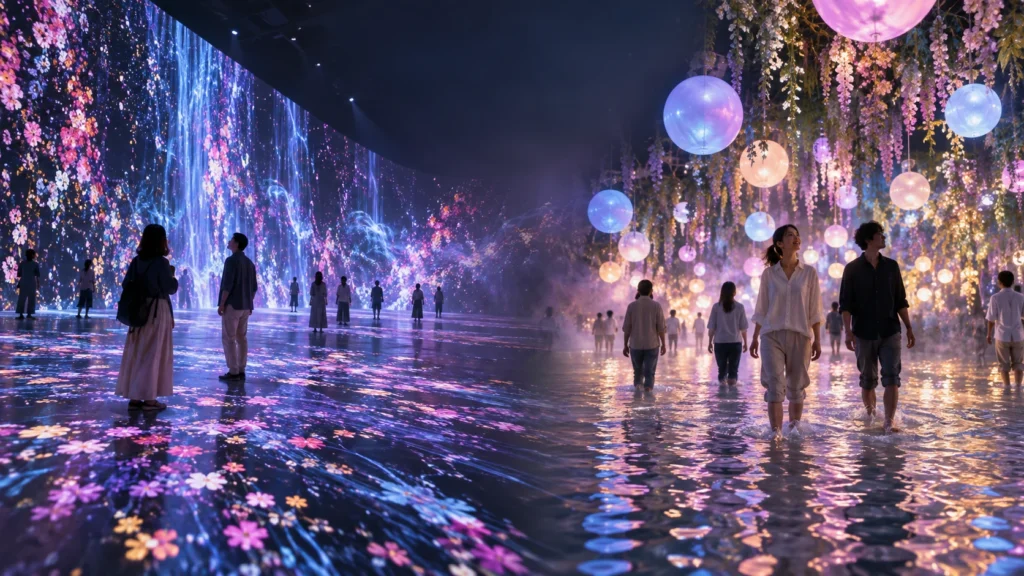
Tokyo has two famous teamLab museums, and the names do not help nearly as much as they should. teamLab Borderless is a dry, map-free digital-art maze in central Tokyo. teamLab Planets is a more linear, physical experience in Toyosu where you remove your shoes, walk through water and move through the installations in a set order.
If you have time for only one, choose Borderless for a longer, exploratory art museum in a central location. Choose Planets for the more tactile, dramatic and easy-to-follow experience. Planets is also the one to book before it closes: the current official exhibition term runs through the end of 2027, while Borderless is permanent.
This comparison was checked on September 8, 2026 against the official teamLab and teamLab Planets ticket information. Prices, hours and individual artworks can change, so verify your exact date before paying.
The 60-Second Decision
| Question | teamLab Borderless | teamLab Planets |
|---|---|---|
| Best for | Explorers, art-focused visits, central Tokyo itineraries | First-time teamLab visitors, families with active children, highly physical immersion |
| Location | Azabudai Hills, near Kamiyacho | Toyosu, near Shin-Toyosu |
| Visit style | Free roaming; no map and no fixed route | Mostly one-way sequence through Water, Garden and expanded interactive areas |
| Shoes | Keep them on | Shoes, socks and tights come off |
| Water | No water-walking requirement | Water may reach adult knee height |
| Time to allow | About 2–3 hours for most travelers | About 1.5–3 hours, depending on crowds and play time |
| Adult ticket | From ¥3,600; dynamic pricing | From ¥3,600; dynamic pricing |
| Weather fit | Excellent; underground access from two stations | Indoor visit, but the approach from Toyosu is more exposed |
| Nearby pairing | Azabudai Hills, Tokyo Tower, Roppongi | Toyosu Market, Odaiba, Ginza |
| Exhibition term | Permanent | Scheduled through the end of 2027 |
My default recommendation: book Borderless if the museum itself is the main event. Book Planets if you want the most immediately memorable experience or need a clear route that does not ask your group to make decisions every three minutes.
The Difference You Actually Feel Inside
The two museums share digital light, mirrors, flowers and reactive artwork. The similarity mostly ends there.
Borderless feels like getting pleasantly lost
There is no visitor map. Artworks move beyond individual rooms, combine with other works and change as people pass. You choose an opening, discover a room, double back and notice that the corridor no longer looks quite the same.
That freedom is the reason to visit. It is also the main source of traveler friction. One person in a group may want to search every dark corner while another is already wondering if the exit has become conceptual art.
Do not rush in a straight line. Move slowly around the perimeter of major rooms, look behind curtains and through unmarked openings, and revisit spaces after 20 or 30 minutes. The work changes over time. Borderless rewards curiosity more than efficient box-ticking.
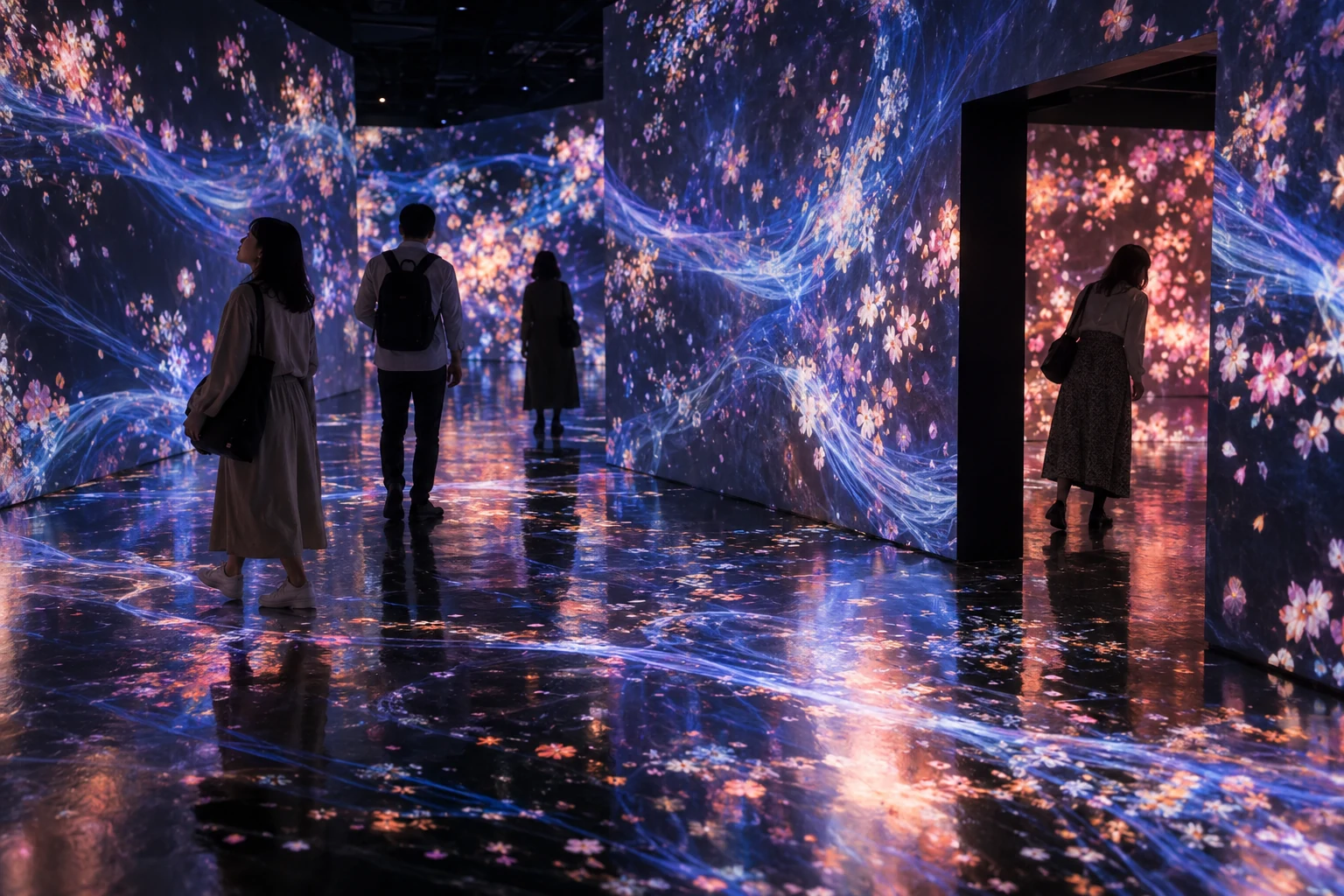
Allow roughly 2–3 hours. There is no official visit-time limit after admission, but re-entry is not permitted. Use the restroom before settling into a long exploration, and do not leave the museum expecting to return after lunch.
Planets feels like entering a designed sequence
Planets controls the order. You put your belongings in a locker, remove footwear, then move through spaces that change how the ground, water, light and your own balance feel. The route is easier to understand and harder to customize.
The 2025 expansion added Athletic Forest, Catching and Collecting Forest, and Future Park experiences, making Planets broader than the older “walk through water and take flower photos” description still circulating online. It remains more physical than Borderless. You climb an incline, cross uneven or soft surfaces, enter dark spaces and may spend extra time in interactive areas.
This is the better first choice for travelers who want a strong beginning-middle-end experience. It is less suitable for anyone who dislikes wet feet, unstable surfaces or being carried forward by the crowd.
Pick Borderless If These Sound Like You
Choose Borderless when:
- you prefer wandering to following a prescribed route;
- you want the larger-feeling, more art-led visit;
- you are staying around Shinjuku, Shibuya, Roppongi, Ginza or central Tokyo;
- rain is heavy and an almost entirely underground arrival matters;
- you are wearing clothing or shoes that would make the Planets water section annoying;
- you want to combine the museum with Tokyo Tower or an evening in Roppongi.
Borderless is especially good for repeat visitors to Tokyo. The museum does not depend on a single signature room, and seasonal or evolving works give you reasons to slow down instead of recreating the same photograph as everyone in the queue.
It is also the easier choice in cold weather if the thought of taking off socks and putting them back on slightly damp feet has already reduced your enthusiasm. A small practical victory is still a victory.
Pick Planets If These Sound Like You
Choose Planets when:
- this is your first teamLab experience and you want maximum immediate impact;
- you enjoy physical, participatory installations more than open-ended exploration;
- children in your group need spaces where they can move and interact;
- your day already includes Toyosu Market, Odaiba or the Ginza waterfront side of Tokyo;
- your group prefers a route that is difficult to debate;
- you want to visit before the current Toyosu exhibition term ends in 2027.
Planets is not simply the shorter “Instagram option.” The expanded interactive areas add real play time, and some visitors now spend close to three hours. Still, the route is more legible than Borderless, which helps when one traveler loves digital art and another mainly agreed because the photos looked shiny.
Tickets: Buy the Slot, Not Just the Museum Name
Both museums use date-specific admission and dynamic adult pricing. As checked in September 2026, adult Entrance Passes start at ¥3,600. Ages 13–17 are ¥2,800 and ages 4–12 are ¥1,500. The youngest-child category is free, but the English age wording differs between current venue pages, so confirm eligibility in the ticket selector before checkout. Premium or flexible products cost far more, so compare the conditions before assuming the expensive button is the sensible one.
Popular morning, weekend and holiday slots can sell out. Buy after the day’s route is stable, then save the QR ticket somewhere available without dependable mobile data. A screenshot is useful backup, although you should keep the original ticket link as well.
Officially purchased standard tickets for both museums can generally be moved to another available date or time up to three times, with changes required at least two hours before the reserved entry time. They are generally not refundable. Third-party booking rules can differ.
Affiliate disclosure: If you book through one of the following links, we may earn a commission at no extra cost to you. Check the final price and cancellation or change conditions for your date: compare teamLab Borderless tickets on Klook or teamLab Planets tickets on Klook. Klook is listed by both venues as an authorized sales channel, but the official ticket site may have different inventory or change rules.
Which time slot is best?
The earliest available entry is the safest choice for lower crowd pressure. It will not give you an empty museum—thousands of other people also own alarm clocks—but it reduces the backlog created through the day.
For Borderless, the first slot also leaves enough time to revisit rooms without watching the clock. For Planets, early entry makes the locker room, water route and interactive zones feel less compressed.
If morning inventory is gone, try a weekday evening. Avoid placing either museum immediately before a non-refundable restaurant, train or observation-deck reservation. Planets warns that entry can require a 30–60 minute wait during busy periods even with a timed ticket. Borderless also states that busy entry lines can occur.
Getting There Without Choosing the Wrong Exit
Borderless: Kamiyacho is the easy answer
teamLab Borderless is on B1 of Garden Plaza B at Azabudai Hills.
Use Kamiyacho Station on the Hibiya Line, Exit 5. The official route is about a two-minute walk, and the station connects to the complex underground. Roppongi-Itchome Station Exit 4 on the Namboku Line is another option, about six minutes away through the underground passage.
Follow signs for Garden Plaza B and teamLab Borderless, not only the signs for Mori JP Tower. Azabudai Hills is a complex, not one building patiently waiting for you at the ticket gate.
This location fits naturally into the central-Tokyo days in our Tokyo itinerary for 3, 5 or 7 days. After the museum, walk around Azabudai Hills or continue toward Tokyo Tower. If you want a skyline finish, compare the tradeoffs in our Shibuya Sky vs Tokyo Skytree guide before adding another timed reservation.
Planets: Shin-Toyosu beats guessing from Toyosu
teamLab Planets is at 6-1-16 Toyosu. The closest stop is Shin-Toyosu Station on the Yurikamome Line. Leave the ticket gate, turn right and use the North Exit; the venue is about one minute away.
From Toyosu Station on the Yurakucho Line, use Exit 7 and walk under or alongside the elevated Yurikamome tracks for about ten minutes. The route is simple in dry weather and less charming with a sideways umbrella.
Planets is also about five minutes on foot from Shijoumae Station and Toyosu Market. A practical route is Toyosu Market breakfast or early lunch, Planets, then Yurikamome to Odaiba. Do not schedule the market late: many wholesale-area food businesses finish earlier than ordinary restaurants.
What to Wear to Planets
This is the preparation section that prevents the most avoidable regret.
You must remove shoes, socks and tights before the water areas. Water can rise to adult knee height, and it will be higher relative to small children. Towels are provided after the water section.
Wear:
- trousers that roll securely above the knee;
- shorts or a midi-length garment that is easy to manage;
- footwear that comes off and goes back on without a five-minute negotiation;
- simple layers that leave your hands free.
Avoid relying on tight jeans that only roll to mid-calf. Skirts and wide-legged trousers need care because some floors are mirrored. Free rental shorts are available in sizes XS–6L, but choosing practical clothes at the hotel is faster.
Bring a change of clothes for young children. The official guidance specifically warns that children may become wet and should not continue in damp clothing. The water is an artwork, not a swimming pool, however persuasive a toddler’s interpretation may be.
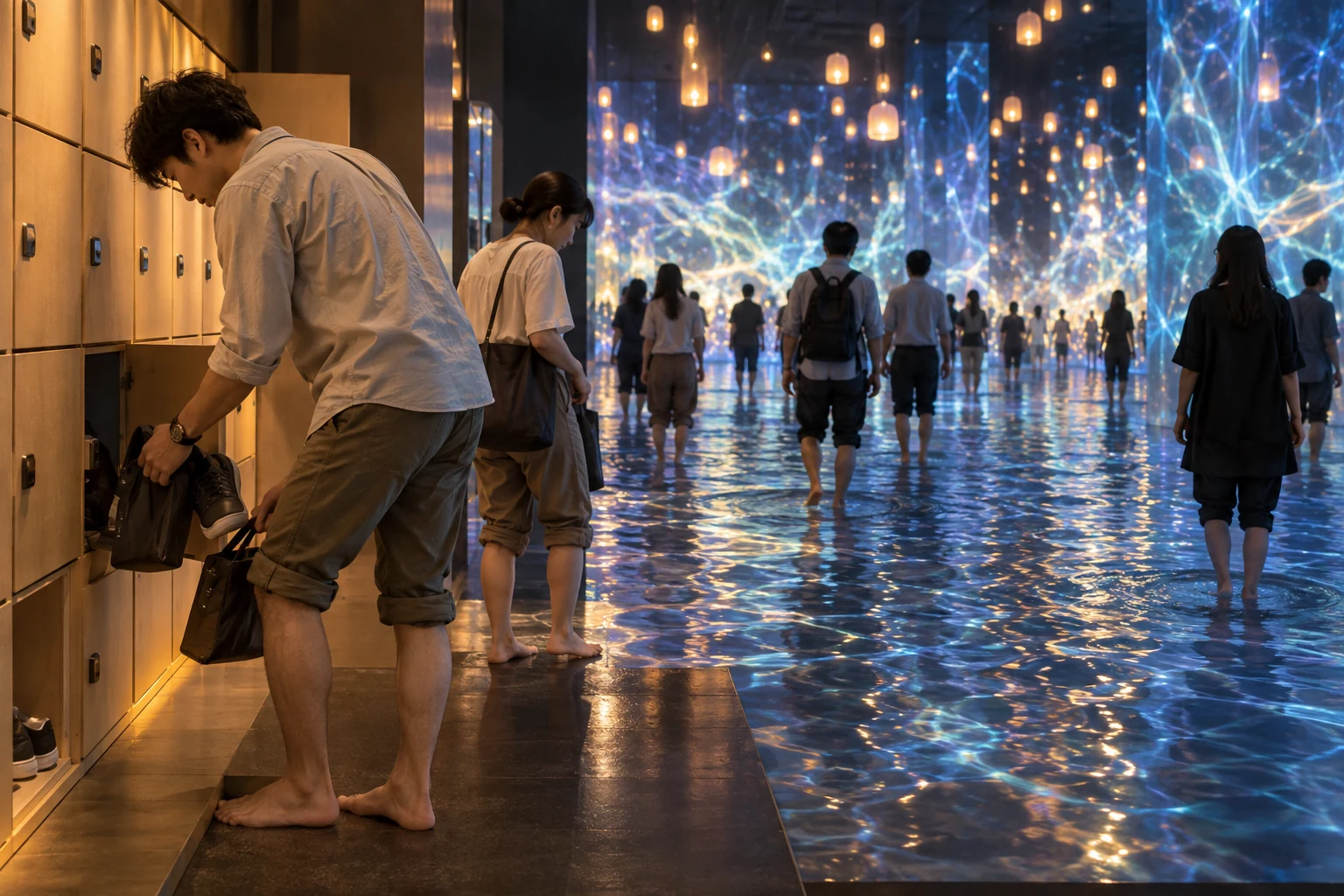
Free lockers measure approximately 23cm wide × 34cm deep × 37cm high. Larger luggage cannot enter the exhibition; it must be secured in the designated stroller-storage area with a wire lock. Leave suitcases at your hotel or a station locker when possible.
What to Wear to Borderless
Borderless is dry, but it is dark and has reflective floors. Comfortable walking shoes are the correct answer. Light-colored or white clothing catches projections well in photographs, although it also announces every coffee decision made earlier that day.
Avoid very short skirts if mirror-floor photographs concern you. Keep bags compact so you are not turning through narrow, dark transitions with a large backpack. There are rest areas, but the visit involves more standing and slow walking than a conventional gallery.
Families, Accessibility and Sensory Load
Neither museum is a quiet, evenly lit gallery. Both include darkness, strong or flashing light, mirrors, sound and confusing spatial cues. Visitors sensitive to light, enclosed spaces or unstable footing should read the official accessibility notes before booking.
With children
Planets has more obvious physical play, but it demands closer supervision around water, slopes and dark rooms. One adult is required for every three children, including children who enter free. Strollers stay outside; baby carriers are allowed.
Borderless requires one adult for every five children of elementary-school age or younger. There is no map, so establish a meeting rule that does not depend on finding “the blue flower room,” which may stop being blue. Keep children within reach in dark areas.
Wheelchairs and limited mobility
Borderless can be accessed by wheelchair or stretcher via elevators, though some works have alternate viewing routes or restrictions. Ask staff at entry for current guidance.
Planets is wheelchair accessible, but the full standard route is not. Some water works require transfer to a venue-provided water wheelchair, and several athletic works cannot be experienced while seated. Detour routes are available. Travelers who need them should budget extra time for staff guidance rather than arriving at the last entry slot.
Photography Without Spending the Whole Visit Behind a Screen
Personal photos and video are allowed at both museums. Flash, tripods and long selfie sticks are not. Commercial photography requires permission.
At Borderless, photograph a room, then wait. The visual composition changes as artworks migrate and other visitors move. A ten-second pause often improves the frame more than another filter.
At Planets, secure your phone before entering water and use a wrist strap if you have one. Clean the lens after the warm locker area; condensation and fingerprints turn every light into a small sun. In mirrored spaces, check the whole frame, including the floor and the patient strangers behind you.
Can You Visit Both?
Yes, but putting both on the same day is better for a second Tokyo trip than a first one. The museums are roughly across central and bayside Tokyo, and together they can consume six or more hours once transport, queues and meals are included.
If you insist, book Borderless first and Planets in the late afternoon or evening. That order keeps the more open-ended museum from being squeezed by a hard midday deadline. Allow at least 90 minutes between the time you expect to leave Borderless and the Planets entry window.
A better plan is to separate them:
Central Tokyo day: Borderless → Azabudai Hills lunch → Tokyo Tower or Roppongi.
Tokyo Bay day: Toyosu Market → Planets → Odaiba at sunset.
Where you stay changes the travel cost of both plans. Our where to stay in Tokyo guide explains which districts suit central sightseeing, nightlife and early transport days.
Common Booking Mistakes
Booking the wrong museum. Check both the name and location before paying: Borderless is Azabudai Hills; Planets is Toyosu.
Using an old Odaiba address for Borderless. The former Odaiba venue closed. The current museum opened at Azabudai Hills in 2024.
Treating a timed ticket as instant entry. The time controls your admission window, not a private appointment. Queue delays still happen.
Wearing tights to Planets. They must come off with your socks. Changing inside a locker area is possible; planning at the hotel is more elegant.
Bringing a suitcase. Planets’ free lockers are small. Borderless is also far more comfortable without travel-day luggage.
Booking another timed attraction too soon. Borderless has no fixed route, and Planets can have an entry wait. Leave breathing room.
Assuming the ticket is refundable. Standard tickets are generally non-refundable. Official tickets may allow limited date or time changes; agency conditions vary.
Final Verdict
For most art-focused travelers, teamLab Borderless is the stronger single choice. It lasts longer, fits more easily into a central Tokyo itinerary and gives you freedom to discover rather than process through a sequence.
For families, first-time visitors and anyone who wants the most physical and immediately dramatic experience, teamLab Planets is the better booking. It also has a deadline: the Toyosu exhibition is currently scheduled only through the end of 2027.
Neither choice is wrong. The wrong choice is arriving at Planets in tights with a large suitcase, or reaching Borderless 90 minutes before dinner and trying to speed-run a museum designed to make you lose track of direction.
Frequently Asked Questions
Is teamLab Borderless or Planets better?
Borderless is better for free exploration, digital art and central-Tokyo convenience. Planets is better for a linear, body-immersive visit with water, gardens and physical interaction.
Is Borderless bigger than Planets?
Borderless generally feels larger because its connected rooms have no fixed route and encourage revisiting. Planets now includes expanded interactive areas, but visitors still move through a more directed sequence.
Do you get wet at teamLab Planets?
Your bare feet and lower legs will get wet. Water can reach adult knee height, and small children may wet more of their clothing. Towels are provided after the water area.
Can I wear a skirt to teamLab Planets?
Yes, but mirrored floors may reflect underneath it. Free rental shorts are available. Trousers or shorts that work around knee-height water are simpler.
How long do you need at each museum?
Plan about 2–3 hours for Borderless and 1.5–3 hours for Planets. These are practical planning estimates, not official time limits. Crowds and your interest in interactive rooms make the difference.
Can I enter if I am late?
Planets states that late visitors can ask staff for same-day entry during operating hours, with last admission one hour before closing. Do not rely on this as a booking strategy. For Borderless, arrive at the admission time shown and contact staff if disrupted.
Are tickets sold at the door?
Both venues prioritize online, date-specific tickets and can sell out. The Planets ticket store says tickets are not sold at on-site counters or vending machines. Borderless notes that remaining same-day inventory may be sold through its official site and that local pricing can differ. Book online in advance.